
Vandaag of morgen in huis

Kwaliteit gegarandeerd

Welkomstaanbiedingen ontgrendelen: GRATIS bezorging | Tot 80% korting | Gratis 30 dagen JoyPlus-proefperiode
Download de app
At first glance, a wok seems simple: a deep pan with a rounded shape. However, models vary considerably in terms of material, base, care requirements and suitability for your hob. Choosing the wrong one can result in a pan that wobbles on an induction hob, rusts after a few washes or has a coating that wears out sooner than expected.
Joybuy Product Recommendation Officer selects products based on verifiable specifications. So don’t just look for terms such as “professional”, “healthy” or “non-stick”. Pay particular attention to the construction and how the wok will be used in your kitchen.
Traditional Chinese woks often have a rounded base. This can work well on a gas hob with a wok ring, but on induction, ceramic or electric hobs, a flat base is usually more practical. Always check whether the wok is suitable for induction and whether the base sits securely on your cooking zone.
Non-stick woks are not all the same. Some models have a synthetic coating, others have a ceramic layer, while a carbon steel wok develops a seasoned patina with proper care. A product description that only mentions “healthy” or “free from harmful substances” does not automatically tell you which coating has been used.
For example, the PURECOOK wok is listed as having a PTFE non-stick coating. This is different from a wok pan without Teflon or a completely uncoated stainless steel wok. Always read the full material description and care instructions.
A 35 or 36 cm wok provides plenty of space for several portions, but it also requires sufficient storage space and a wide cooking zone. For one or two people, a 28 to 30 cm wok is often easier to handle. For families, a 32 cm, 35 cm or 36 cm wok is more suitable, depending on the size of your hob.
An uncoated carbon steel wok requires more care than a non-stick wok, but is well suited to anyone who values high temperatures and traditional stir-frying. A cast iron wok is particularly appealing for heat retention, while stainless steel can be suitable for everyday use and intensive cooking.
For a wok for a gas hob, both flat and rounded models are possible. A rounded base offers the most traditional cooking experience, but when using it on a standard gas burner, it is best to use a suitable wok ring. For induction, you need a magnetic, flat base. A flat-bottomed wok is also suitable for ceramic and electric hobs, provided the product information confirms this.
A wok with lid is useful for stewing, simmering and keeping dishes warm. Glass allows you to monitor the cooking process without lifting the lid. A wok pan with a wooden handle is often comfortable to hold, but wood and bamboo require extra care: these models are generally not suitable for use in the oven or dishwasher.
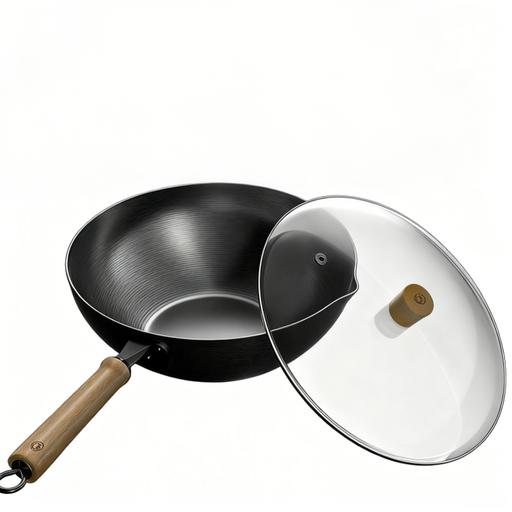
Why it suits this profile: The 32 cm capacity provides plenty of room for everyday stir-fried dishes, and the product information confirms that it is suitable for induction and gas hobs.
The flat construction, listed as suitable for several types of hob, reduces the risk of choosing an incompatible base. According to the product description, this wok has a Teflon-free coating.
32 cm, lid included, and suitable for induction and gas hobs according to the product specifications.
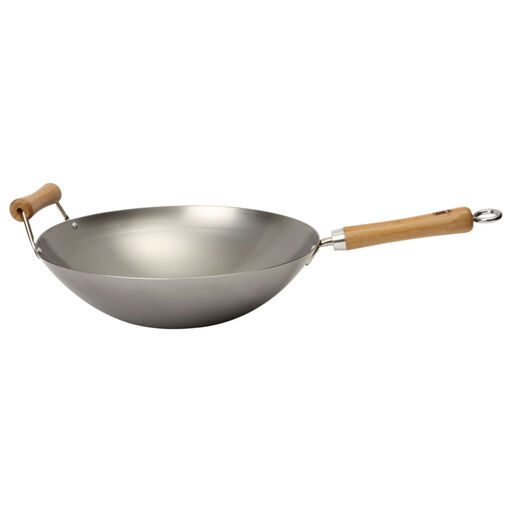
Why it suits this profile: This uncoated carbon steel wok is designed for traditional stir-frying and cooking for approximately 4 to 6 people.
No synthetic non-stick coating is listed. However, you need to season the wok, clean it by hand and dry it immediately to help prevent rust.
36 cm, suitable for all hobs according to the description, with a bamboo main handle and helper handle.
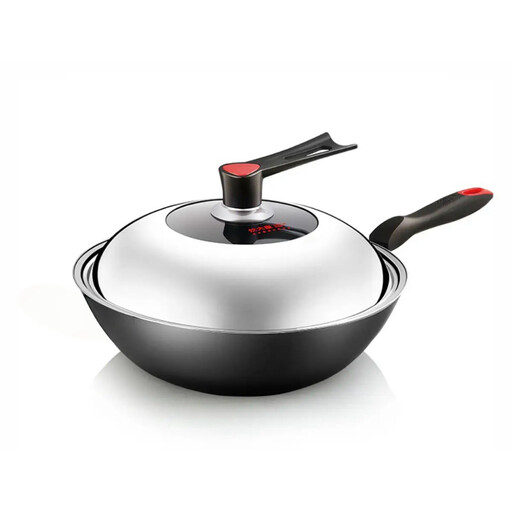
Why it suits this profile: This wok is designed for stir-frying, stewing, steaming and everyday cooking, with a size that is suitable for smaller households.
The product information specifies carbon steel and a seasoning care process. Please note: according to the specifications, this model is recommended for gas hobs and is not automatically suitable for induction.
30 cm, glass lid and rapid heat conduction according to the product description.

Why it suits this profile: According to the product information, the flat magnetic base is suitable for induction, gas, electric and ceramic hobs.
The product specification lists a 304 stainless steel construction and a honeycomb structure. However, check your cooking technique, as a stainless steel wok without a traditional coating may initially be more prone to sticking.
Tri-ply 304 stainless steel, glass lid and broad hob compatibility.
We’ve put together a complete, up-to-date list of products that fully meet these strict selection criteria and the applicable European safety regulations.
The right care routine depends on the material:
For one or two people, 28 to 30 cm is usually practical. A 32 cm wok is well suited to a family or several portions. A 35 or 36 cm wok provides more cooking space, but requires a wide hob and sufficient storage space.
Choose a model with a flat magnetic base and an explicit statement that it is suitable for induction. A rounded Chinese wok often requires a wok ring on a modern hob and is not automatically suitable for induction.
Season the wok before first use, following the instructions. Afterwards, wash it by hand, dry it completely over a low heat and rub a thin layer of oil over the surface. Do not leave water in the pan and avoid using harsh cleaners or wire brushes.
