
Vandaag of morgen in huis

Kwaliteit gegarandeerd

Welkomstaanbiedingen ontgrendelen: GRATIS bezorging | Tot 80% korting | Gratis 30 dagen JoyPlus-proefperiode
Download de app
A wok pan is useful for stir-frying, deep-frying, stewing and everyday meals. Even so, a purchase can sometimes prove disappointing in practice. The pan may turn out to be too large for the hob, the handle may become hot or the non-stick coating may require more maintenance than expected.
As a Joybuy Product Recommendation Officer, I therefore focus primarily on verifiable features: material, base, size, hob compatibility and maintenance. Below, you’ll find what to look for before buying a wok pan and which models suit different cooking styles.
A wok pan suitable for all hobs must have a magnetic, flat base for induction. A round Chinese wok will usually not sit securely on a standard induction hob without a wok ring or special cooking zone. Therefore, check that the product information explicitly mentions induction, gas, electric and ceramic hobs.
Also pay attention to the diameter of the magnetic section. A 30 cm wok may have a smaller flat base than you expect. As a result, the entire pan may not heat evenly on a large cooking zone.
A non-stick wok pan can be convenient for vegetables, fish and meals requiring little oil. However, a coating remains vulnerable to prolonged heating while empty, sharp kitchen tools and harsh cleaning. With a honeycomb wok, the texture is designed to reduce contact between cookware and the coating or cooking surface, but that does not mean every metal utensil is suitable.
According to product information from various brands, hand-washing is recommended to help preserve the structure and coating for longer. Always check the care instructions, even if a product is advertised as dishwasher-safe.
A 24 to 26 cm wok pan is well suited to one to three people. For a family, a 28 cm wok or 30 cm wok is often more practical. Too many ingredients in a small pan cool the cooking surface down. The result is then more like stewing than stir-frying.
A larger pan does take up more space and can become heavy when full. So measure your cooking zone, kitchen cupboard and sink in advance.
A stainless steel wok pan, also referred to as an RVS wok pan, can withstand everyday use and some models do not have a chemical inner coating. Food can stick more easily to uncoated stainless steel. The “hot pan, cold oil” technique and cooking over a medium heat can help, but do require some practice.
Carbon steel heats up quickly and is suitable for high temperatures and traditional stir-frying. According to WANGYUANJI’s product information, this type of wok must be seasoned before first use. With use and oil, a natural patina then develops. Hand-washing, thorough drying and light oiling are essential to help prevent rust.
A ceramic coating generally provides a smoother cooking surface. For claims such as “without PFAS” or “PFAS-free”, you should check the product specifications for the specific model. A brand claim is not a general characteristic of all ceramic pans. For example, the manufacturer states that the coating on the Redchef set is free from PTFE, PFOA and PFAS; this applies to the product described and not automatically to other models.
For an induction wok pan, a flat magnetic base is important. Look out for the following:
A three-layer construction, such as stainless steel-aluminium-stainless steel, is intended according to the product description to distribute heat more quickly and evenly. Treat this as a construction feature, not a guarantee that hotspots will never occur.
A wok pan with lid is more versatile for stewing, simmering and keeping food warm. A glass lid lets you monitor the cooking process without repeatedly losing heat. Check whether the handle is heat-resistant and whether the lid is suitable for oven use; these features vary from product to product.
For a pan with a ceramic or other non-stick coating, wooden, silicone or nylon utensils are generally a safe choice according to the product information. Sharp metal edges can damage the structure or coating. Also allow a hot pan to cool down before rinsing it with cold water.
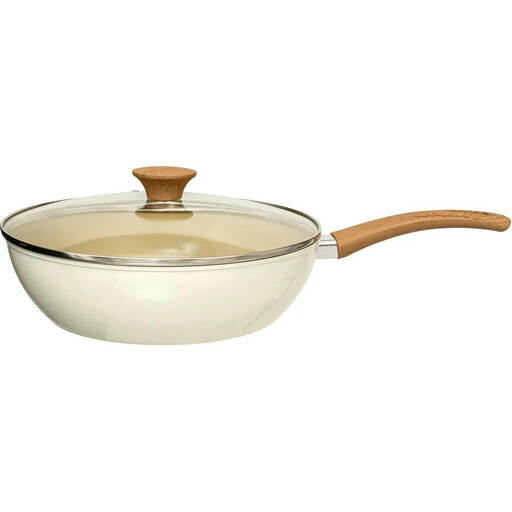
Why it suits this profile: The 28 cm diameter provides plenty of room for everyday family meals. The pan has two non-stick layers, a glass lid and, according to the product information, is suitable for all heat sources.
The product information clearly states the size, the two layers and compatibility. Hand-washing is recommended for a longer service life.
28 cm, glass lid, stated usable capacity of 8.5 litres, and suitable for induction, gas, electric and ceramic hobs.

Why it suits this profile: This model combines a three-layer 304 stainless steel construction with a ceramic inner coating, honeycomb structure and glass lid. According to the product description, the flat magnetic base is suitable for several types of hob.
The size and hob compatibility are clearly specified. Hand-washing is recommended, making it clear from the outset that convenience and maximum coating life may involve a trade-off.
30 cm, 304 stainless steel, ceramic coating, honeycomb interior, glass lid, and suitable for induction, gas, electric and ceramic hobs.
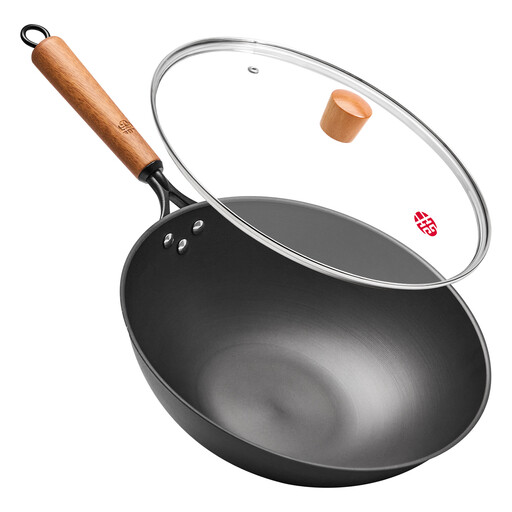
Why it suits this profile: This uncoated Chinese wok is designed for high temperatures and traditional stir-frying. According to the product information, the flat base is suitable for gas, induction, electric and ceramic hobs.
There is no chemical non-stick coating to damage. However, seasoning, hand-washing, drying and oiling are all part of using this wok.
12.6 inch, flat base, glass lid, uncoated carbon steel construction and suitable for 3 to 5 portions according to the product information.
We’ve compiled a complete, up-to-date list of products that fully meet these strict selection criteria and the applicable European safety regulations.
A 30 cm wok generally offers more working space for several portions than a 24 or 26 cm wok. However, check that the flat base fits your induction zone and that you can lift the pan comfortably when it is full.
No. A product claim such as “without PFAS” does not automatically tell you anything about heat distribution, size, handle or maintenance. Check the full product specifications and instructions for use. With uncoated carbon steel models, seasoning and regular oiling also play an important role.
Heat the pan gradually first, then add oil and avoid moving the ingredients too soon. Preferably use a medium heat until you are familiar with the pan. Some practice is normal with an uncoated stainless steel wok pan; a honeycomb wok or ceramic non-stick coating, on the other hand, requires careful maintenance to preserve the surface.
