
Vandaag of morgen in huis

Kwaliteit gegarandeerd

Welkomstaanbiedingen ontgrendelen: GRATIS bezorging | Tot 80% korting | Gratis 30 dagen JoyPlus-proefperiode
Download de app
An induction wok needs to do more than simply fit on an induction zone. The base must make stable contact with the hob, the size must suit your household and the material must withstand high temperatures. With an uncoated wok in particular, care and cooking technique play an important role.
Many disappointing purchases result from three recurring pitfalls:
A carbon steel wok generally heats up quickly and responds rapidly when you change the heat. This makes it well suited to high-temperature stir-frying. An uncoated wok usually needs to be seasoned before first use. With regular use and care, a patina develops that can help reduce sticking.
Pay attention to these points:
For a non-Teflon wok, “coating-free” is the relevant specification. Claims such as “healthy” or “chemical-free” are no substitute for checking the material, usage instructions and the EU responsible party.
Check whether the manufacturer explicitly lists induction, gas, electric and ceramic compatibility. A wok for gas and induction should preferably have a flat, magnetic base. With induction, the pan is heated directly by the magnetic field; a base that is too small or uneven may result in less even heating.
Also look at:
A round base may be appealing for traditional wok cooking on gas, but on a modern hob it will often require a separate wok ring. This makes the pan less versatile for everyday use.
A 30 cm wok is often suitable for around two to three portions, depending on its shape and depth. Models measuring 32 or 33 cm provide more room for stir-frying without ingredients quickly spilling over the sides. A 36 cm wok is better suited to four to six portions, but requires more storage space and lifting strength.
A wok with a lid is useful for stewing, cooking through and keeping food warm. You will usually leave the lid off when dry-frying or stir-frying. Check whether the lid is made of glass and whether the handle is heat-resistant.
Carbon steel generally requires:
According to information provided by the brands concerned, a well-maintained surface may gradually become less prone to sticking. This characteristic depends on the temperature, oil, cooking technique and care routine.
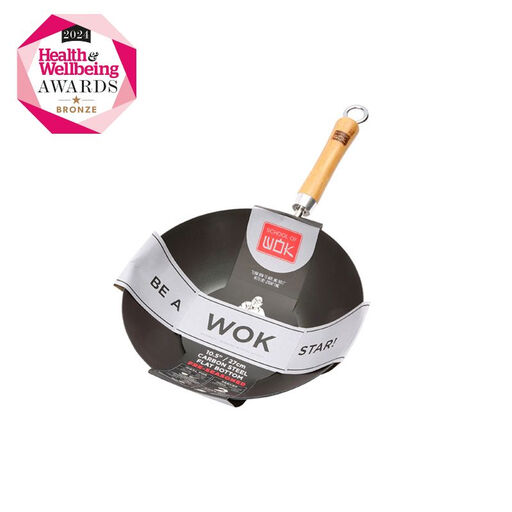
Why it suits this profile: The compact size is designed for approximately one to two portions. According to the product information, the wok is already pre-seasoned, so you do not need to season it yourself before use.
According to the product description, the flat base is suitable for all hobs, including induction. The size prevents a small meal from getting lost in an oversized pan.
27 cm, carbon steel, flat base, bamboo handle and suitable for induction, gas, electric and ceramic hobs.
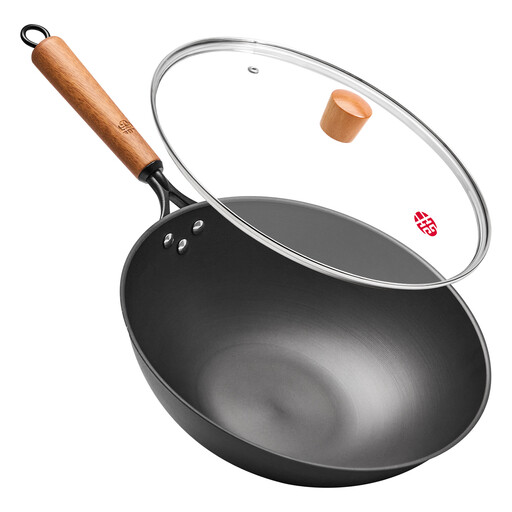
Why it suits this profile: This model combines a flat base with a glass lid, an additional handle and a removable wooden handle. It is ideal if you want to use one pan for stir-frying, stewing and storing food.
The product information explicitly states that it has a coating-free carbon steel surface and is compatible with gas, induction, electric and ceramic hobs.
32 cm, 1.17 kg according to the specifications, glass lid, flat base and nitriding treatment according to the product description.
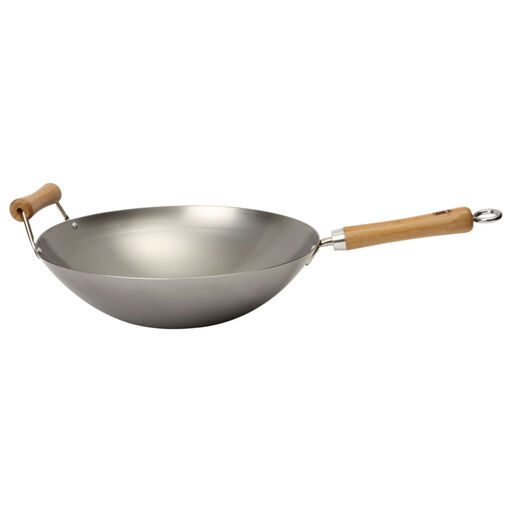
Why it suits this profile: According to the product information, the 36 cm diameter is intended for approximately four to six people. The two bamboo handles make it easier to move the pan when full.
The model is uncoated and has a flat base for induction. This means you do not need to choose a synthetic non-stick coating for high-temperature cooking.
36 cm, coating-free carbon steel, main handle plus helper handle, and suitable for all hobs according to the product information.
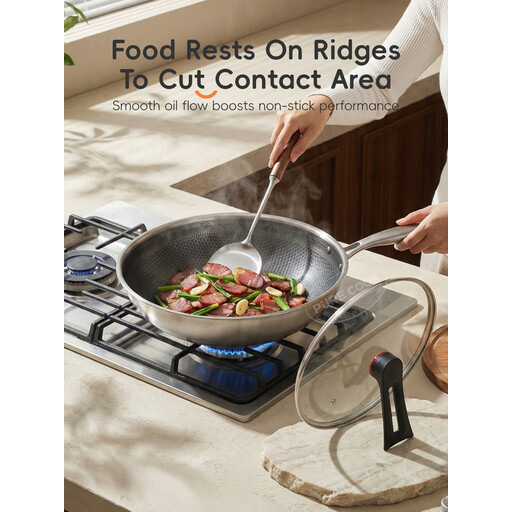
Why it suits this profile: This 32 cm wok has a three-layer 304 stainless steel construction and a glass lid. According to the product information, it is suitable for gas, induction and ceramic electric hobs.
The product description refers to a stainless steel honeycomb structure and no chemical non-stick coating. However, always check the current product specifications, as the title also mentions “non-stick”.
32 cm, 304 stainless steel, three-layer construction, glass lid and compatibility with multiple hobs.
We have put together a complete, up-to-date list of products that fully meet these strict selection criteria and the applicable European safety regulations.
No. Choose a model whose manufacturer explicitly states that it is suitable for induction and which has a flat, magnetic base. A round base may be unstable and often requires a wok ring.
Yes, carbon steel is often used for a non-Teflon wok. The pan will usually need seasoning and should be dried and lightly oiled immediately after washing. Without this care, rust may develop and food may stick more firmly.
Its lifespan depends on the material, base, handle and care routine. A carbon steel wok can last for a long time if you keep it out of the dishwasher, dry it thoroughly and maintain its patina. A stainless steel model does not need seasoning, but food may stick more readily if it is not preheated correctly. So do not just consider the purchase price; also check whether the maintenance routine suits your cooking habits.
