
Vandaag of morgen in huis

Kwaliteit gegarandeerd

Welkomstaanbiedingen ontgrendelen: GRATIS bezorging | Tot 80% korting | Gratis 30 dagen JoyPlus-proefperiode
Download de app
An induction wok may seem straightforward to choose at first glance. However, models vary considerably in terms of their base, material, weight and maintenance. A pan that works well on gas may heat less evenly on induction. And a wok with a non-stick coating requires a different cooking style from a carbon-steel wok.
Pay particular attention to these three common pitfalls:
Induction requires a magnetic, flat base. A traditional round wok without flat contact does not always work well on a Dutch induction hob. Check the product description to see whether the pan is explicitly suitable for induction and, if stated, check the diameter of the base.
A wok for all hobs usually has a flat base suitable for induction, gas, electric and ceramic hobs. Also consider the cooking zone: a base that is much larger or smaller than the zone may heat less efficiently.
Stainless-steel wok: stainless steel is sturdy and suitable for high temperatures. Without a coating, food may stick more quickly. Preheating the pan, using enough oil and cooking at a moderate temperature can help.
Non-stick wok: convenient for everyday cooking with little oil and easy cleaning. Follow the manufacturer's temperature and care instructions. According to the product description of some models, the coating is PFAS-free or PFOA-free; always check exactly which product and claim are being referred to.
Cast-iron wok: retains heat for a long time and is suitable for stir-frying, simmering and stewing. The trade-off is a higher weight. A 30 cm cast-iron wok can weigh over 3 kg, making it less practical for regular tossing.
Carbon-steel wok: responds quickly to temperature changes and is suitable for high-temperature stir-frying. It usually has no coating. You need to season the pan before first use, wash it by hand, dry it thoroughly and lightly oil it to help prevent rust.
A 30 cm wok offers a useful compromise between cooking space and manoeuvrability for many households. For one to three portions, 28 cm may be sufficient; for families or three to five portions, 30 to 32 cm can provide more room.
In addition to the diameter, consider:
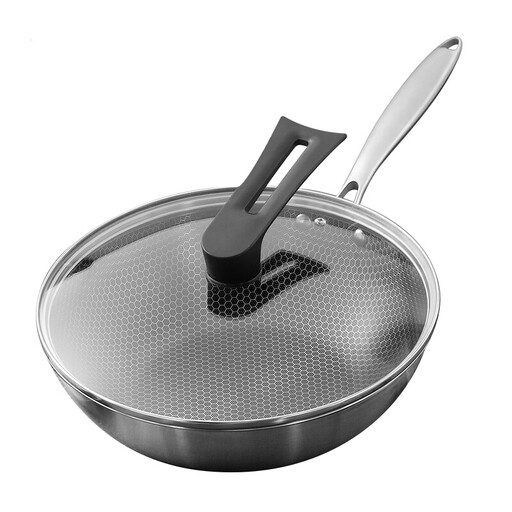
Why it suits this profile: According to the product description, this stainless-steel wok has a honeycomb structure, is suitable for gas, induction and electric hobs, and comes with a lid. This makes it practical for a wide range of everyday dishes.
The stated compatibility means you are less likely to discover only after buying it that the wok does not work on induction. However, check that the base size suits your cooking zone.
30 cm diameter, stainless-steel construction, lid included and suitable for several types of hob. The manufacturer states that it produces less smoke during cooking; this is a product claim, not a guaranteed result.
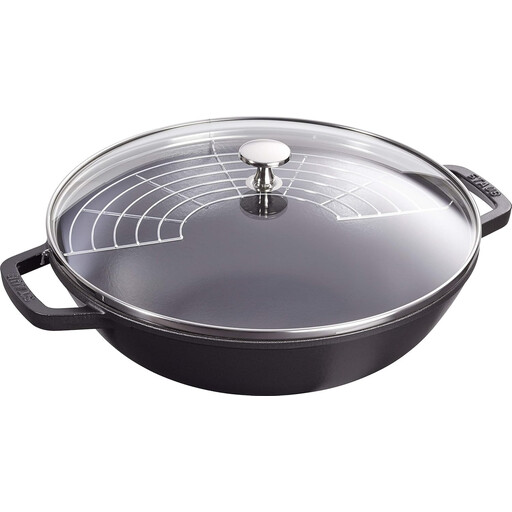
Why it suits this profile: According to the product information, this enamelled cast-iron wok is suitable for induction, gas, electric and ceramic cooking. The model has a capacity of 4.4 litres and comes with a glass lid, steaming rack, wooden spatula and chopsticks.
The flat base and stated suitability for all hobs make the choice straightforward. However, weighing 5.1 kg, it requires a stable surface and should be moved carefully.
Enamelled cast iron, 4.4-litre capacity, glass lid and accessories. The product information states a minimum statutory warranty of two years.
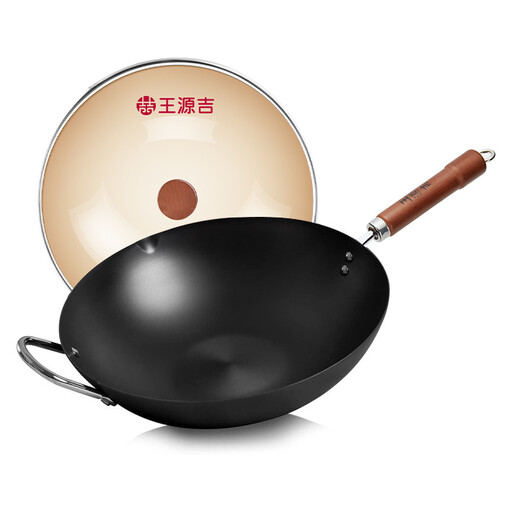
Why it suits this profile: This carbon-steel wok has a flat base, a glass lid and an additional handle. According to the product description, it is suitable for gas, induction and electric hobs and is intended for approximately two to four portions.
The product information does not mention a chemical coating. This helps avoid confusion between a coating and a patina built up through maintenance. Seasoning and oiling are still necessary.
Uncoated carbon-steel construction, flat base, glass lid and second handle. Hand-washing and careful drying are required; according to the description, the pan is not suitable for the oven or dishwasher.
We have put together a complete, up-to-date list of products that fully meet these strict selection criteria and the applicable European safety regulations.
Choose a wok with a flat magnetic base and an explicit statement that it is induction-compatible. A wok for all hobs is often practical if you move house later or use multiple types of hob. Also check that the base matches the diameter of your induction zone.
That depends on the manufacturer's care and usage instructions. A non-stick wok is particularly useful for everyday frying with little oil. For very high temperatures and traditional stir-frying, many users choose a stainless-steel or carbon-steel wok. With a coated pan, do not use sharp metal utensils if the product information advises against them.
Its lifespan depends on how it is used, stored and maintained. Carbon steel should be dried immediately after washing and lightly oiled. Cast iron is heavy and robust, but it can be damaged if dropped or exposed to severe thermal shock. Always follow the manufacturer's instructions and regularly check the pan for rust, cracks or a loose handle.
A lid is useful for stewing, simmering, steaming and retaining moisture. If you only use the wok for quick stir-frying, you can manage perfectly well without one. A supplied lid saves you from having to find a correctly fitting size later.
