
Vandaag of morgen in huis

Kwaliteit gegarandeerd

Welkomstaanbiedingen ontgrendelen: GRATIS bezorging | Tot 80% korting | Gratis 30 dagen JoyPlus-proefperiode
Download de app
A set of stainless steel food storage containers with lids might seem straightforward to choose. However, there are clear differences in capacity, closure, lid materials and how you can use them. A container that works well for leftovers in the fridge won’t necessarily be handy for soup in a work bag or a meal in the freezer.
The Joybuy Product Recommendation Officer helps you cut through marketing claims and focus on verifiable points. Pay particular attention to these three common pitfalls:
With steel storage containers, you’ll often come across 304 or 316 stainless steel. Both are used for food contact. According to the product descriptions of the brands mentioned, 304 stainless steel is intended for everyday storage and meal prep, while 316 stainless steel is presented with extra corrosion resistance.
That doesn’t automatically mean 316 stainless steel is necessary for every household. For leftovers, fruit, bread and dry snacks, 304 stainless steel can be perfectly suitable. If you often take acidic sauces, salty dishes or food to work, sport or camping, you might consider 316 stainless steel as an extra material specification.
Also look out for:
A stainless steel container is not intended for the microwave. If you want to reheat food, check whether the product is explicitly suitable for that and remove the lid when the product information advises you to. When in doubt, use a separate microwave-safe dish.
For leak-proof storage containers, the construction and maintenance of the lid are especially important. A silicone ring can help create an airtight seal, but the ring must fit properly and be free of food residue. Clips provide extra pressure around the rim; a screw lid is particularly practical for thermal food jars.
“Airtight” also doesn’t mean food stays fresh indefinitely. Cool dishes quickly, store them at the right temperature and follow the usual food safety guidelines.
Check before you buy whether:
Many dishwasher-safe food containers have different care instructions for the body and the lid. With some sets, the stainless steel body can go in the dishwasher, while the lid and sealing ring are better washed by hand or on the top rack.
For freezer use, you need enough headroom because food can expand. Always check the instructions for the specific model. A stackable design helps in a Dutch fridge with limited drawers, but watch the total height once the lids are on.

Why this fits the profile: The set combines 600 ml, 1,100 ml and 2,200 ml. This lets you divide small snacks, a lunch and larger leftovers in one purchase.
The different sizes mean you don’t have to buy a separate container for each portion. According to the product description, the containers are suitable for the freezer and dishwasher; check the lid instructions separately.
316 stainless steel, three capacity sizes, stackable design and lids for sealed storage.
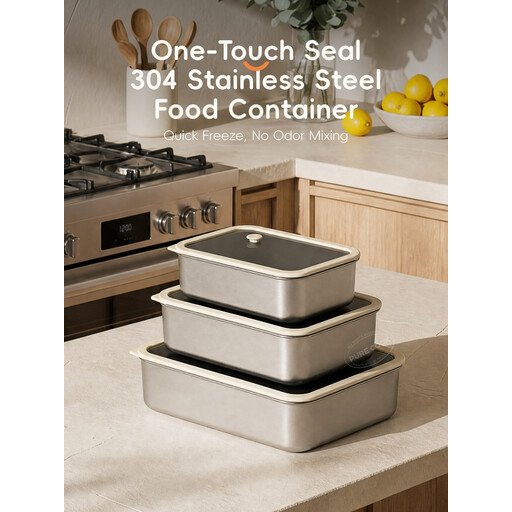
Why this fits the profile: The set contains containers of 1,000, 1,800 and 3,000 ml. The shallow shape is useful for meals, salads and larger portions in the fridge or freezer.
The product description mentions a borosilicate glass lid with a silicone ring. This makes the contents visible, but requires care with drops and sudden temperature changes.
304 stainless steel without coating, three generous sizes and a lid that lets you see the contents.

Why this fits the profile: For soup, curry or a hot meal on the go, a regular storage container isn’t always practical. This thermal food jar has a wide opening and a capacity of 1.5 litres.
The wide opening is easier to fill and clean than a narrow bottle opening. According to the product description, upright transport is important; so don’t turn the jar over in a full bag.
316 stainless steel, vacuum insulation, wide opening and a stated temperature retention of 4 to 6 hours.
Wash new stainless steel food storage containers before first use. On models with clips, remove the silicone ring regularly so that moisture and food residue don’t build up. Use a soft sponge and avoid steel wool or harsh abrasives; these can cause scratches.
Allow the container and lid to dry completely before storing them closed. This helps limit odours and moisture marks. Use a thermal food jar according to the included instructions and check the seal if the product becomes damaged.
We’ve put together a full, up-to-date list of products that fully meet these strict selection criteria and comply with current European safety regulations.
That varies by model. Products sold as freezer-safe storage containers often have a suitable stainless steel body, but the lid and sealing ring may have different temperature limits. Leave room for expansion and follow the product instructions.
No, stainless steel is not suitable for use in a microwave. Remove food from the container and reheat it in a suitable dish. With glass lids or plastic parts, you should also check the specific instructions.
The lifespan depends on the quality of the material, the closure and the maintenance. Stainless steel generally doesn’t absorb odours like some plastics do, but lids and silicone rings are wear parts. Replace a ring when it becomes deformed, cracked or no longer fits properly.
