
Vandaag of morgen in huis

Kwaliteit gegarandeerd

Welkomstaanbiedingen ontgrendelen: GRATIS bezorging | Tot 80% korting | Gratis 30 dagen JoyPlus-proefperiode
Download de app
A stainless steel lunch box may seem straightforward: choose a size, put the lid on and take your meal with you. In practice, it is mainly the closures, seals and awkward layouts that cause disappointment. A container may feel sturdy, yet still leak inside a full bag or be difficult to clean.
So do not rely solely on terms such as “durable”, “leakproof” or “premium”. Check the product specifications and consider how you will use the lunch box every day.
A silicone seal helps prevent spills, but the lid construction is just as important. A loose lid without clips or a screw thread can shift during transport. This is particularly impractical with soup, sauce or yoghurt.
Look for:
A product description may describe a lunch box as leakproof. Treat this as a manufacturer’s claim and check the usage instructions as well. Even a well-sealed leakproof lunch box cannot guarantee spill-free transport if the lid has not been secured properly or the container is turned upside down.
A compartmented lunch box is useful for bread, fruit and snacks. However, fixed compartments can be less flexible for moist dishes. Dressing or sauce may also come into contact with other foods.
A stainless steel bento lunch box with two to five compartments is particularly suitable for meals where you want to keep the components separate. For leftovers, pasta or a large salad, a single compartment is often more practical.
Not every stainless steel food container can be placed in the dishwasher with all its components. The metal container may be dishwasher-safe, while the lid or silicone ring may need to be washed by hand. Insulated products often come with even stricter instructions.
So check each component to see:
Stainless steel should generally not be placed in a microwave. Always follow the product information, especially for food storage containers with lids.
304 stainless steel and 18/8 stainless steel are widely used for food containers. Product descriptions often associate 316 or 316L stainless steel with greater corrosion resistance. This may be useful for intensive use, but the material alone does not determine how well a lunch box seals, how easy it is to clean or whether it fits in your bag.
As well as the steel, consider:
A stainless steel lunch box is not automatically suitable for hot soup, oven use or long-term freezer storage. The manufacturer must specifically state that it is suitable for these uses.
For a lunch box for work and school, capacity is more important than an attractive appearance. A small container of around 470 ml is suitable for a light single serving. A capacity of 1.4 to 1.5 litres is more suitable for a large meal, multiple portions or family use.
Bear in mind:
A set with several sizes can be useful if you store both snacks and leftovers. However, check whether the lids are interchangeable; this is not always stated in the product information.
A thermal food container has a double wall with vacuum insulation. According to Maxcook’s product descriptions, these models help keep hot or cold contents at the right temperature for longer. The stated duration is 4 to 6 hours, depending on the model and conditions.
For better results, the manufacturer states that you can preheat or pre-cool the container. Do not overfill the pot and open hot contents carefully. An insulated food container is suitable for soup, stews or porridge, but is less flexible for meals made up of several separate components.
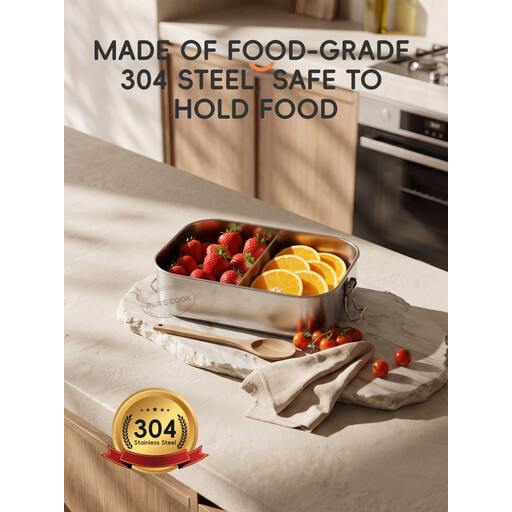
Why it suits this profile: The two-part layout offers a simple way to take bread and fruit to school or the office while keeping them separate.
The product description mentions locking clips, a removable silicone seal and a dishwasher-safe construction. However, check the current instructions for each component before use.
304 stainless steel, two compartments and a capacity of 61.2 fl oz according to the product information.

Why it suits this profile: Four spacious 1,600 ml containers are designed for meal prep, leftovers and organised storage in the fridge or freezer.
The stated specifications mention 316L stainless steel, matching lids, freezer use and dishwasher use. The description also warns against using the containers in a microwave or over an open flame.
Four identical 1,600 ml containers; suitable for freezer storage and, according to the product information, dishwasher-safe.

Why it suits this profile: The wide opening and generous capacity are practical for soup, stews or meals while travelling, camping or working long hours.
The product description mentions vacuum insulation, a wide opening and a tightly sealing lid. The manufacturer recommends hand washing and warns against turning the pot upside down.
316 stainless steel, a capacity of 1.5 litres and a stated temperature retention of 4 to 6 hours according to the product information.
We have put together a complete, up-to-date list of products that fully meet these strict selection criteria and the applicable European safety regulations.
Wash a new stainless steel lunch box with mild washing-up liquid before using it for the first time. Allow the container and seal to dry completely afterwards. Food residue in the silicone ring can cause odours or discolouration, so remove the ring from the lid if possible.
Do not use wire wool or abrasive scouring pads. With a thermal food container, it is advisable to check the seal regularly for cracks and clean the lid components according to the instructions. Do not leave a sealed container with residual moisture inside for extended periods.
Usually not. Metal should not be placed in a microwave. Some models are suitable for the freezer, dishwasher or oven, but this must be clearly stated in the product information. If in doubt, use the container only for storing and transporting food.
First, check that the silicone ring is sitting correctly in the groove and that all clips or the screw cap are fully closed. Do not fill the container above the marked line and transport liquid dishes upright. With hot meals, pay extra attention to pressure build-up and follow the manufacturer’s safety instructions.
That depends on how you use it. According to product specifications, 316 or 316L may offer greater corrosion resistance, but 304 or 18/8 stainless steel may already be suitable for everyday bread, fruit and dry snacks. Also consider capacity, closure, cleaning and warranty. These features often have a greater influence on whether the lunch box suits your routine.
