
Vandaag of morgen in huis

Kwaliteit gegarandeerd

Welkomstaanbiedingen ontgrendelen: GRATIS bezorging | Tot 80% korting | Gratis 30 dagen JoyPlus-proefperiode
Download de app
A good food storage container should suit your everyday needs. Whether you are packing food for school, the office, meal prep or a day out, you do not want to end up with a leaking bag, a lid that is difficult to close or a container that does not fit in your kitchen cupboard. When choosing stainless steel food storage containers, the material, closure and size are particularly important.
Marketing copy can sometimes make the choice unnecessarily difficult. Look out for these three common pitfalls:
“Leak-proof” without a clearly defined closure
Check whether the product has a silicone seal, clip fasteners or a screw-top lid. A loose-fitting lid is less suitable for soup, sauce or yoghurt. Even a leak-proof food container must be closed and transported according to the product instructions.
A useful-looking number of compartments, but little practical capacity
A bento lunchbox with five compartments can be handy for snacks and different dishes. However, the compartments may be too small for a complete meal. So look at both the total capacity and the dimensions of each compartment.
Confusing stainless steel with thermal insulation
An ordinary stainless steel lunchbox stores food, but it does not automatically keep it hot or cold for hours. For that, you need a vacuum-insulated food container or food jar thermos. According to Maxcook’s product description, the thermal models are designed to retain temperature for 4 to 6 hours. The actual duration depends on factors including preheating, the amount of food and the ambient temperature.
304 stainless steel is widely used for lunchboxes and food containers. It is suitable for everyday use and is often associated with durability and resistance to odours in product information.
316 stainless steel and 316L stainless steel are also offered for food storage. According to the product descriptions for the Maxcook models mentioned, these variants are designed to provide a high level of corrosion resistance. That does not mean that every product marked “316” will automatically be better suited to your needs. The closure, wall thickness, finish and maintenance remain important.
Also check the complete product information. A material name alone says nothing about microwave use. For example, the Maxcook 316L set states that it must not be used in the microwave or near an open flame.
A well-fitting lid and a seal you can check are important when carrying food in a rucksack or work bag. Look for:
An airtight food container is particularly useful for leftovers, dry ingredients and meal prep. For liquid food, the product description should explicitly mention a leak-proof design. Maxcook food jars also come with instructions not to turn the jar upside down or tilt it.
A capacity of 1.4 or 1.5 litres is generous enough for a large meal or several portions, but it also takes up more space. A compact stainless steel lunchbox is more convenient for school or the office. For families and meal preppers, a kitchen storage set with multiple containers may be more efficient.
Also check:
According to the product information, the Maxcook 4-piece 316L set is suitable for use in the dishwasher and freezer. The same information states that it must not be used in the microwave. The description recommends washing the thermal food jars by hand.
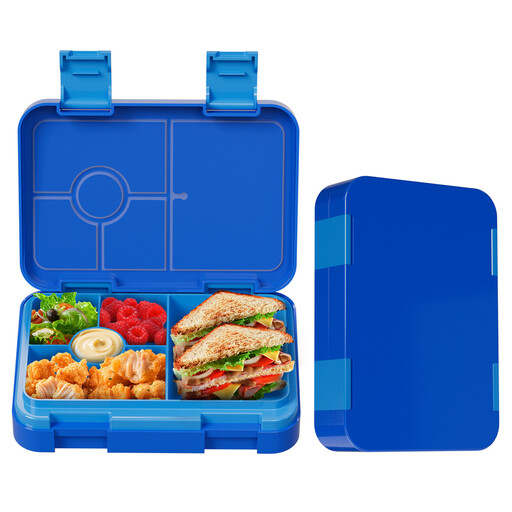
Why it suits this profile: The five compartments are practical for keeping bread, fruit, snacks and side dishes together in one lunchbox. The double latches are convenient for everyday use at school or in the office.
The compartments help prevent different foods from mixing. Before buying, check the exact capacity, dimensions and material in the product listing.
Five compartments and double latches according to the product name; suitable for a varied packed lunch.

Why it suits this profile: This thermal food container is designed for hot or cold meals on the go, such as during a long working day, a walk or a short trip.
The wide opening makes filling, eating and cleaning easier than with a narrow bottle opening. The product description mentions vacuum insulation and a leak-proof lid design; do not tilt the jar during transport.
316 stainless steel, 1.5-litre capacity, wide opening and, according to the product description, 4–6 hours of thermal retention.

Why it suits this profile: Four rectangular containers of 1,600 ml each are ideal for meal prep, storing large quantities of leftovers and keeping your fridge neatly organised.
The fixed set means you do not have to combine various individual sizes. The product information states that the containers have well-fitting lids and are suitable for use in the dishwasher and freezer; microwave use is not permitted.
Four 1,600 ml containers, 316L stainless steel and, according to the product description, suitable for use in the dishwasher and freezer.
We have put together a complete, up-to-date list of products that fully meet these strict selection criteria and the applicable European safety regulations.
Usually not. Metal should not be placed in a microwave unless the manufacturer explicitly states otherwise. Use a microwave-safe glass or plastic container for reheating, then transfer the food to a stainless steel lunchbox.
Their lifespan depends on the quality of the stainless steel, the closure and how well the container is maintained. A container without cracks or distortion can last for a long time, but silicone rings and clip fasteners are wear parts. Replace the seal if it becomes loose, hard or no longer fits properly.
For soup, an insulated food container with a wide opening and screw-top lid is usually more practical. An ordinary bento lunchbox is mainly suitable for solid foods. For every food thermos, check the capacity, closure, cleaning instructions and stated thermal performance.
