
Vandaag of morgen in huis

Kwaliteit gegarandeerd

Welkomstaanbiedingen ontgrendelen: GRATIS bezorging | Tot 80% korting | Gratis 30 dagen JoyPlus-proefperiode
Download de app
A good food container needs to do more than look neat. In practice, it’s about choosing the right capacity, a lid that stays put and care that’s easy to keep up with. That applies to leftovers in the fridge, lunch at work, snacks for school and meals on the go.
When it comes to stainless steel food containers, there are a few common pitfalls to watch out for:
304 stainless steel is a commonly used material for food storage containers. It’s suitable for everyday use and, according to the product specifications for various models, has a smooth, uncoated interior.
316 stainless steel is often highlighted in product descriptions for its greater corrosion resistance. This makes it an interesting option if you use your containers intensively or regularly fill them with moist or salty foods. However, a higher grade of steel doesn’t automatically mean that every part of the set has the same properties, so check the material of the lid and sealing ring too.
Also consider the construction. A smooth, uncoated interior is easy to wipe clean and is generally less likely to absorb odours or stains than a damaged plastic lining.
A food storage container with a lid is only practical if the lid fits securely. Check the following:
According to the product information, a container with four locking clips can form an airtight seal. This is useful for meal prep and taking food with you, but always follow the instructions for use. For example, the Maxcook sets specify that the container should be kept upright when carrying liquids. So “airtight” doesn’t mean that every container is completely spill-proof if shaken or tipped over.
For a household with different portion sizes, stackable food containers in a range of sizes are usually more practical than four identical containers. Consider:
Measure your fridge shelf and lunch bag too. A rectangular container often makes better use of space than a round one. When stacking containers, check the shape of the base and lid: the product description should clearly state that they’re designed to stack.
If you’re looking for freezer-safe containers, check the product specifications. Stainless steel food containers may be suitable for the freezer, but the lid may have different temperature limits. Leave some room around food that expands as it freezes.
For dishwasher-safe food containers, it’s important to check which parts are covered. For example, the Maxcook 316 stainless steel set with 600, 1,100 and 2,200 ml capacities states that the metal containers are dishwasher-safe, while the PP lids should be washed by hand. Remove the silicone ring and dry all parts before closing the container again.
Stainless steel should not be put in the microwave unless the manufacturer specifically says it’s safe to do so. The product information provided includes different instructions for different products. Always check the manual for your specific model, and only use a metal container in the microwave if the manufacturer explicitly permits it. Never use a container over an open flame.

Why it suits this profile: The set includes 600, 1,100 and 2,200 ml containers, so you don’t need to buy several different sizes straight away.
The different capacities help you avoid containers that are too small or unnecessarily large. Do note that, according to the product information, only the stainless steel containers are dishwasher-safe.
316 stainless steel, three sizes and, according to the product description, suitable for freezer use.

Why it suits this profile: This set is designed for larger portions and meal prep, with capacities of 1,000, 1,800 and 3,000 ml.
The capacity is clearly specified, and the rectangular shape is designed for efficient stacking. Check the warnings about glass and temperature changes.
304 stainless steel, borosilicate glass lids, a silicone seal and three generous sizes.

Why it suits this profile: This insulated food container is designed for hot or cold meals on your commute, when travelling or enjoying outdoor activities.
The wide opening makes filling and cleaning easier than with a narrow flask. According to the product information, hand washing is recommended; the lid should not be submerged for long periods.
1.5-litre capacity, 316 stainless steel, vacuum insulation and a wide opening.
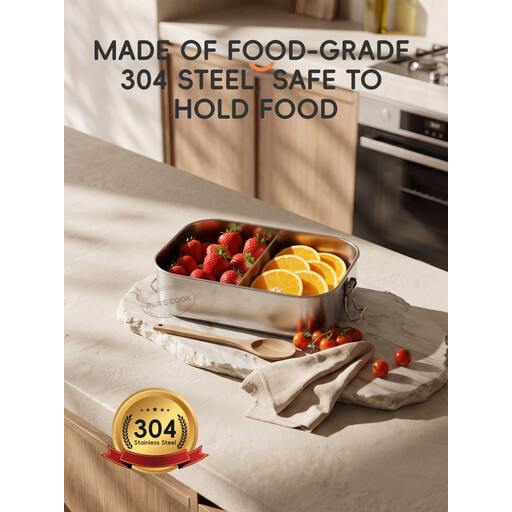
Why it suits this profile: The built-in divider keeps foods such as rice and side dishes separate, making it useful for work, school or a picnic.
The two compartments stop flavours from mixing directly. The locking clips and silicone ring help prevent spills, but liquid foods should be carried upright.
304 stainless steel, two compartments, metal clips and, according to the product information, dishwasher-safe.
We’ve put together a complete, up-to-date list of products that meet these strict selection criteria and current European safety regulations.
It depends on the model. Some product descriptions explicitly state that the container is freezer-safe. Check the lid too, leave room for food to expand, and wait until the food has cooled sufficiently before closing the container completely.
Don’t assume that you can. Metal is generally not suitable for microwave use. Always follow the instructions from the manufacturer of your specific model. If in doubt, transfer the food to a microwave-safe dish.
Their lifespan depends on the stainless steel, the closure and how well they’re cared for. A metal container can remain useful for a long time, while a silicone sealing ring may wear out over time. Wash the ring regularly, remove food debris from the groove and replace parts if the lid no longer fits securely.
