
Vandaag of morgen in huis

Kwaliteit gegarandeerd

Welkomstaanbiedingen ontgrendelen: GRATIS bezorging | Tot 80% korting | Gratis 30 dagen JoyPlus-proefperiode
Download de app
Stainless steel food storage containers with lids are useful for leftovers, meal prep, lunches and storing food in the fridge. However, an attractive product photo tells you little about everyday use. For example, a lid may look secure but still leak if the locking clips are not fastened evenly. Large containers may also not fit well in a Dutch fridge or lunch bag.
So pay particular attention to the construction, materials and usage restrictions. This helps you avoid paying for features you will hardly use in practice.
Terms such as airtight, leakproof and freshness-preserving are often used together. So check how the seal is constructed. A silicone sealing ring and several locking clips may provide a more reliable seal than a loose lid that is simply pressed onto the rim.
Positioning is important when storing liquids. Do not fill the container right up to the rim, check that the ring is lying flat and fasten all the locks. A container described as leak-resistant may still leak if it is tilted inside a bag or has not been closed correctly.
Stainless steel and microwaves are generally not a suitable combination. Some product listings state that the container itself is suitable for microwave or oven use, while the safety information simultaneously warns against microwave use. This is contradictory information.
Always remove the lid and follow the instructions supplied with the product. If the instructions explicitly state that microwave use is not permitted, do not use the container for reheating. An oven-safe glass lid also does not mean that a plastic lid can go into the oven.
A set containing 3,000 ml containers may be useful for a large meal or several portions, but less suitable for a small fridge or everyday lunch. As well as capacity, look at the length, width and height. For commuters and students, a lower-profile model is often easier to carry. For families, a deep food container may be particularly useful for leftovers, pasta or salad.
304 stainless steel is a commonly used material for food containers. The product information for various PURECOOK models states that the inner container is made from food-safe 304 stainless steel, without a coating. According to the product description, this makes the surface suitable for everyday use and relatively easy to clean.
316 stainless steel is often chosen for its greater resistance to corrosion. According to the product listing, the Maxcook containers in this selection are made from food-safe 316 stainless steel. This is a verifiable material specification, but on its own it does not indicate how long a container will last. Its lifespan also depends on the locking clips, sealing rings, cleaning and how it is used.
Also pay attention to the lid. It may be made from PP plastic, silicone and, in some cases, borosilicate glass. With plastic lids, it is important to check whether they are BPA-free and suitable for the dishwasher, freezer or heating.
The following components are particularly relevant for airtight food storage containers:
A sealing ring absorbs odours if it is not dried properly. Remove the ring from the lid regularly, wash both parts and allow them to dry completely before closing the container.
Not every product labelled “food storage” is automatically suitable for all appliances. Check the product specifications separately for:
Take extra care with glass lids when there are sudden temperature changes. Placing a cold glass lid directly onto very hot food can put stress on the material. Allow hot contents to cool first when instructed to do so in the product information.
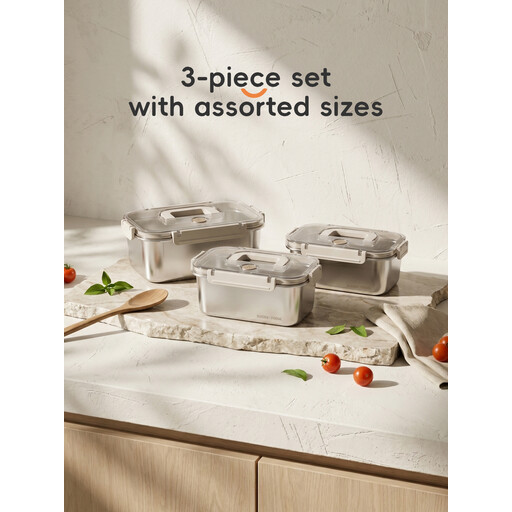
Why it suits this profile: This set contains three rectangular containers measuring 1,700, 2,100 and 3,200 ml. That provides a practical foundation for leftovers, larger portions and fridge storage.
The product description specifies 304 stainless steel, four locking clips and a silicone sealing ring. Always check the seal before carrying liquids.
Three generous sizes, a stackable design and, according to the listing, suitability for the dishwasher and freezer.

Why it suits this profile: Buyers looking for a higher stainless steel specification get three sizes measuring 600, 1,100 and 2,200 ml for snacks, lunch and full meals.
The capacities are clearly specified. According to the product information, the containers are suitable for the freezer and dishwasher; microwave use is not permitted.
316 stainless steel, three useful sizes and a design that, according to the listing, is stackable and dishwasher-safe.

Why it suits this profile: The deep sizes of 1,000, 1,800 and 3,000 ml are suitable for meal prep, salads, picnics, commuting and larger portions.
According to the product description, the combination of a silicone sealing ring and secure lid is designed for leakproof storage. However, the glass lid requires care when temperatures change.
Deep, stackable design; 304 stainless steel; high-borosilicate glass lid; according to the listing, suitable for the dishwasher, freezer and indirect heating.
We have put together a complete, up-to-date list of products that fully meet these strict selection criteria and the applicable European safety regulations.
For a longer lifespan, follow this simple routine:
A stainless steel lunchbox with one compartment is practical for a simple meal. For salad, fruit and snacks, a model with several compartments may be more convenient. If you mainly store leftovers, choose a set with different sizes.
That depends on the product specifications. According to their product listings, the PURECOOK and Maxcook sets mentioned are suitable for freezer use. Leave space above the contents and avoid sudden temperature changes, particularly with glass lids.
Some stainless steel food storage containers and lids are dishwasher-safe, but check each component individually. If possible, remove a separate silicone sealing ring from the lid so that food residue can be removed thoroughly. Then dry everything completely to help prevent odours and stains.
There is no fixed lifespan. The stainless steel container itself may remain usable for a long time, while locking clips and silicone rings are likely to wear out sooner. Replace components when the ring becomes hard, cracked or deformed, or when the lid no longer closes evenly. Choosing the right size, cleaning the containers carefully and avoiding overheating will help keep them practical for longer.
