
Vandaag of morgen in huis

Kwaliteit gegarandeerd

Welkomstaanbiedingen ontgrendelen: GRATIS bezorging | Tot 80% korting | Gratis 30 dagen JoyPlus-proefperiode
Download de app
Stainless steel food storage containers with lids are useful for leftovers, meal prep, lunches and storing food in the fridge. However, a shiny exterior says little about practical quality. A container may look sturdy but still leak because of a poorly fitting seal. Terms such as “airtight”, “dishwasher-safe” and “microwave-safe” may also not apply to every component.
Use these checks to choose stainless steel food storage containers based on verifiable specifications rather than marketing language.
For dry snacks, a simple clip-on lid is often sufficient. For soup, sauce or yoghurt, however, you need a silicone sealing ring and a closure that provides enough pressure. Also check whether the lid has several locking clips. A loose lid edge without a clearly defined seal offers less protection when a container is lying horizontally in a bag.
According to the product descriptions of various models, silicone rings and clip closures provide an airtight or leak-proof seal. This is a claim made in the brand’s product information; always check the closure mechanism and care instructions before buying.
With some stainless steel food storage container sets, only the metal inner container may be placed in the dishwasher. The PP plastic lid and silicone ring must then be washed by hand. High temperatures and harsh cleaning can affect the fit or flexibility of the seal over time.
So do not just look for the words dishwasher-safe. Check the specification for each component. This helps prevent disappointment during everyday use.
Stainless steel must not simply be placed in a microwave. Metal can cause sparks and damage the appliance. Some product pages describe a metal container as suitable for certain heating methods while also providing safety warnings. Therefore, only use the heating method explicitly stated on the packaging and product page.
A glass lid will usually need to be removed before heating a dish. A PP lid generally cannot go in the microwave either. For more information about microwave use, you can also see microwave-safe storage containers.
304 stainless steel is a widely used material for food containers. It is uncoated, suitable for normal household use and relatively easy to clean. 316 stainless steel also contains molybdenum and is often associated in product information with greater corrosion resistance. This may be useful for intensive use or contact with salty and acidic foods.
The material grade does not tell you everything about the overall user experience. A 316 stainless steel container with a fragile lid may be less practical in everyday use than a 304 stainless steel container with a well-designed closure. So also examine the lid, ring, locking clips and cleaning instructions.
A good set should ideally include several sizes:
Deep rectangular containers often make efficient use of fridge shelves. Round models can be convenient for soups and loose ingredients. As well as checking the capacity, look at the external dimensions: a 3,000 ml container will not automatically fit in every fridge drawer.
For leak-proof food containers, a silicone sealing ring, sturdy clips and a flat lid are important features. A stackable design saves space, but check that the containers remain stable when stacked while full. Removable rings are more hygienic to clean, provided you allow them to dry completely after washing.
Also check whether the chosen model is suitable for freezer use. When freezing food, leave enough room for expansion and avoid sudden temperature changes with glass lids.

Why it suits this profile: This set includes 1,000 ml, 1,800 ml and 3,000 ml containers, making it suitable for both small portions and large quantities of leftovers.
The product description specifies a 304 stainless steel container, glass lid and silicone sealing ring. This makes it clear which components provide the seal.
Three capacities, a stackable design and components described in the product information as dishwasher-safe. The glass lid lets you see the contents.
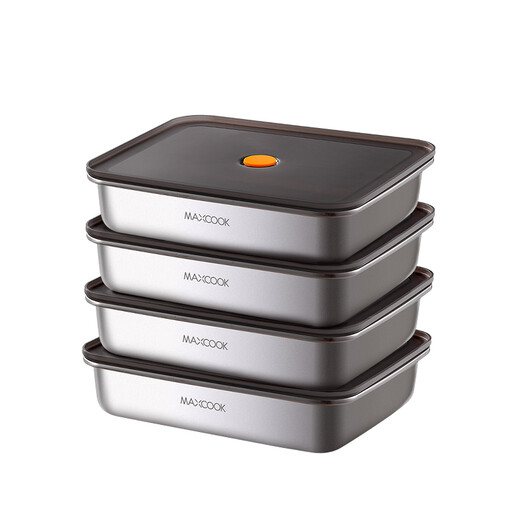
Why it suits this profile: The set contains four identical rectangular 1,600 ml containers, which are practical for consistent meal-prep portions and larger households.
The material specification states 316L stainless steel, and the product information says it is suitable for the dishwasher and freezer. However, check the instructions for the lids before use.
Four identical sizes, a rectangular shape and a tightly closing lid according to the product description, suitable for the fridge, freezer and lunch.

Why it suits this profile: The combination of 600 ml, 1,100 ml and 2,200 ml suits athletes, students and commuters who take different portion sizes with them.
The product information mentions four-sided locking clips and a silicone ring. According to the same information, the lids are not dishwasher-safe.
316 stainless steel, three capacities, freezer suitability according to the product description and a stackable design. Hand-washing the lids requires extra care.
Wash new containers with mild washing-up liquid before first use. Remove the silicone ring from the lid if the instructions allow this. This makes it less likely for food residue to build up in the groove. Do not use wire wool or abrasive scourers, as they can cause scratches.
Allow the container, lid and ring to dry completely before closing and storing them. Do not fill a container to the brim when freezing liquids. With glass lids, large temperature differences are also a concern; allow hot food to cool before sealing or freezing it, unless the product instructions state otherwise.
We have put together a complete, up-to-date list of products that fully meet these strict selection criteria and the applicable European safety regulations.
That depends on the specific model. Check whether the product information explicitly states that it is freezer-safe. Also leave room for expansion and avoid sudden temperature changes, particularly with glass lids.
The metal container is dishwasher-safe with many models, but this does not always apply to the lid and silicone ring. For the MAXCOOK 316 models, for example, the product information states that only the stainless steel body may be placed in the dishwasher. Always check the instructions for each component.
Do not use stainless steel in the microwave unless the manufacturer provides very specific, unambiguous instructions for your model. The product information supplied contains conflicting statements for some models. The safe option is to remove the lid and not place the container in the microwave when the instructions prohibit it.
