
Vandaag of morgen in huis

Kwaliteit gegarandeerd

Welkomstaanbiedingen ontgrendelen: GRATIS bezorging | Tot 80% korting | Gratis 30 dagen JoyPlus-proefperiode
Download de app
Stainless steel food storage containers are useful for meal prep, fridge storage, school, work and travel. However, a product title containing “leak-proof”, “durable” or “suitable for the freezer” does not tell you everything. The container’s construction, seal and usage restrictions determine whether it will actually suit your needs.
Not every lid creates an airtight seal. With soup, sauce or yoghurt, a simple clip closure can start to leak if the lunchbox is carried upright or knocked over. Check whether the product description mentions a silicone ring, sturdy closing clips or an explicitly leak-resistant design.
Pay attention to the finer details, too. According to Maxcook’s product information, the food thermos is designed for leak-free transport, but it is recommended that you do not turn or tilt the pot. “Leak-resistant” does not mean that you can put every container loose in a bag when it is completely full.
Stainless steel must not be used in a microwave. Some containers can be used in an oven or hot-water bath, but often only without the lid. A glass lid can also break if it is knocked hard or exposed to a sudden change in temperature.
Before buying, check the instructions for microwave, oven, hot-water bath and dishwasher use. The PURECOOK containers with glass lids are listed as suitable for heating in a water bath. According to the product description, the Maxcook 316L containers are suitable for the freezer and dishwasher, but not for the microwave.
A large food container may seem practical, but it might not fit in your fridge compartment, cycling bag or lunch bag. Stainless steel is sturdier, but often heavier than plastic. For a full meal, 600 to 1,100 ml is often practical; larger sizes are better suited to leftovers, family portions or meals shared with others.
Measure the available space and check both the capacity and external dimensions. A set with different capacities is practical when you alternate between storing snacks, salads, leftovers and complete meals.
304 stainless steel is a commonly used material for food storage containers. Certain models are coating-free and, according to the product description, do not absorb grease or food odours. 316 or 316L stainless steel is often chosen for its stated resistance to corrosion. This makes it an interesting material for intensive use, but it does not automatically say anything about the quality of the lid or closure.
Always check that the material of the container itself is clearly stated. A stainless steel lid, for example, does not mean that the inner container is also made of stainless steel; some storage jars have a glass body.
For stainless steel food storage containers with lids, the following details are relevant:
A wide opening is especially useful for a soup thermos or insulated food thermos. It makes it easier to add your meal, eat directly from the pot and clean the inside thoroughly.
Stackable food containers save space in kitchen cupboards and the fridge. Nestable models can be placed inside one another when empty. However, bear in mind that deep containers are not always suitable for a narrow lunch bag.
Several sizes are useful for meal prep. According to Maxcook’s product information, a set with 600 ml, 1,100 ml and 2,200 ml offers different portion sizes. For families, a set with 1,000 ml, 1,800 ml and 3,000 ml containers may be more practical for leftovers and larger quantities.
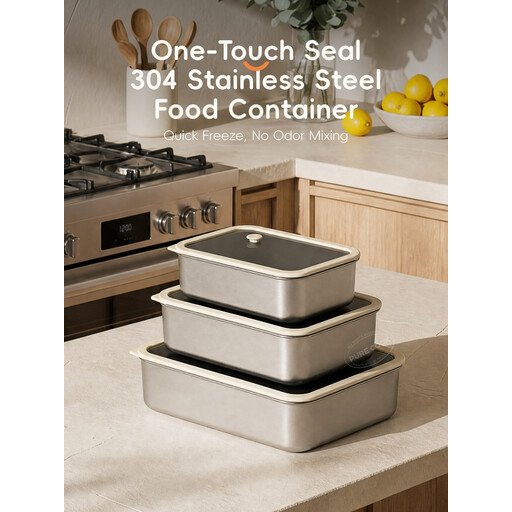
Why it suits this profile: The three sizes—1,000, 1,800 and 3,000 ml—are useful for everyday portions, leftovers and meal prep.
According to the product information, the glass lid has a silicone ring and airtight seal. Check the lid before transporting it and handle the glass with care.
304 stainless steel, three capacities and a design that is described as nestable and stackable.
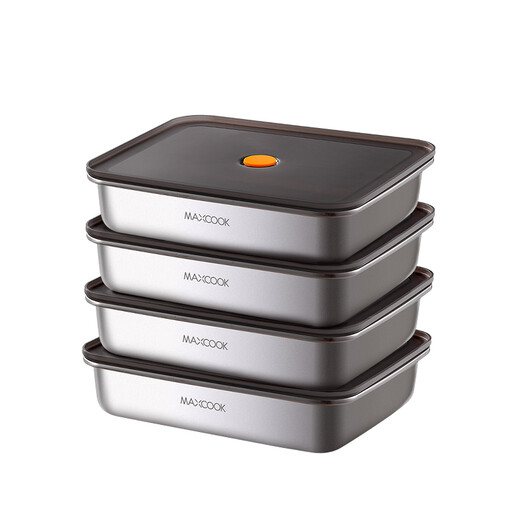
Why it suits this profile: Four rectangular containers, each with a capacity of 1,600 ml, are ideal for larger meal prep routines and households that store several portions at once.
The product information states that the containers are dishwasher- and freezer-safe. Do not use the container in a microwave and avoid contact with naked flames.
316L stainless steel, four identical 1,600 ml containers and lids for sealed storage.

Why it suits this profile: The large capacity and wide opening are practical for hot meals at work, while travelling, during outdoor activities or on a long school day.
According to the product information, the pot has a vacuum-insulated layer and leak-resistant closure. Preheating or pre-cooling is recommended before filling; hand washing is required.
316 stainless steel, 1.5-litre capacity, wide opening and stated thermal retention of 4–6 hours according to the brand description.
We have put together a complete, up-to-date list of products that fully meet these strict selection criteria and the applicable European safety regulations.
Wash new stainless steel food storage containers before using them for the first time. Clean seams, silicone rings and lids thoroughly, as food residue can collect in these areas. Allow all parts to dry completely before closing or storing them.
Always follow the manufacturer’s instructions:
A leak-proof lunchbox remains reliable only when the rim is clean and the closure is secured correctly. Replace a damaged ring or a lid that no longer closes evenly.
This varies by model. According to the product information, some Maxcook 316L and 316 stainless steel sets are suitable for the freezer and dishwasher. Other models, such as certain food thermos flasks, are intended to be hand-washed to protect the insulation layer and seal. Always check the product specifications.
You can if the closure and seal are designed for this purpose. A wide, insulated soup thermos is often more practical than a shallow container. Do not overfill it, tighten the lid securely and transport the thermos according to the manufacturer’s instructions.
Its lifespan depends on the material, closure, usage and maintenance. Stainless steel itself generally withstands daily use, but silicone rings and plastic components may wear out sooner. A container will last longer if you avoid using sharp objects, dry all parts thoroughly and replace damaged seals promptly.
