
Vandaag of morgen in huis

Kwaliteit gegarandeerd

Welkomstaanbiedingen ontgrendelen: GRATIS bezorging | Tot 80% korting | Gratis 30 dagen JoyPlus-proefperiode
Download de app
Buying a full spool only to find that the filament doesn’t feed properly through your printer is a waste of time and money. When choosing eSUN PLA+ filament, 1.75 mm, 1 kg, colour isn’t the only thing to consider. The diameter, print settings, spool design and compatibility with your FDM printer can all affect how neatly your models come out.
This buying guide helps beginners and experienced makers assess marketing claims more confidently. You’ll find practical tips on PLA+ 3D printer filament, followed by product recommendations for different uses.
1.75 mm is a common size for many FDM printers, including models from Bambu Lab, Creality, Prusa and Ender 3. However, that doesn’t mean every spool will work without adjustments. Always check:
So, filament made for an Ender 3 may physically fit another printer, but the optimal settings may differ.
PLA+ is generally marketed as tougher and less brittle than standard PLA. According to eSUN’s product description, its PLA+ formula is designed to offer greater strength and toughness. This makes it an interesting option for decorative parts, prototypes, model-making and lightweight functional objects.
That doesn’t guarantee that a printed part will be suitable for high temperatures, prolonged stress or safety-critical applications. For these situations, consider the material, wall thickness, infill, print orientation and operating temperature.
Matte PLA can make small layer transitions less noticeable, but it looks different from glossy PLA+. Dark colours can make details look different from light beige or white. If you plan to paint your parts later, a neutral colour may be more practical.
A good-looking colour also doesn’t indicate greater dimensional accuracy. So, assess colour and surface finish separately from the technical specifications.
The products featured in this selection have a diameter of 1.75 mm. eSUN lists a diameter tolerance of ±0.03 mm for several PLA+ variants. A consistent diameter helps the extruder feed the material more evenly.
However, a tolerance stated on the product page doesn’t guarantee optimal printing without calibration on every printer. After loading a new spool, check the first layers and adjust the flow if needed.
A 1 kg PLA filament spool is handy for larger models and regular use. Several eSUN PLA+ variants are listed as approximately 340 to 350 metres long. The exact length may vary by colour and composition.
Store your spool somewhere dry and, ideally, in a sealed container. Moisture can make PLA noisier during extrusion, lead to an uneven surface finish and weaken layer adhesion. Dry storage is especially important if you’ll be using the spool over several weeks.
The product descriptions state that the filament supports high-speed 3D printing on compatible printers. However, the speed you can achieve depends on the nozzle, layer height, cooling, volumetric flow and printer profile. Treat the speed listed on the product page as a starting point, not a fixed expectation.
Start with eSUN’s recommended temperature range and, if in doubt, run a temperature or retraction test. When changing filament, heat the nozzle first, following the product instructions. This can help reduce the risk of a blockage during the changeover.
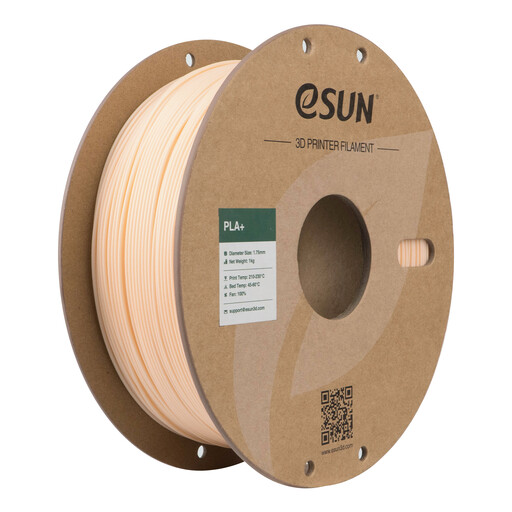
Why it suits this profile: The light, neutral colour is a good choice for first projects, prototypes and models you plan to finish or paint later. The spool has a common size of 1.75 mm and weighs 1 kg.
The product description lists a tolerance of ±0.03 mm and a carefully wound spool. Be sure to check your printer settings before starting long prints.
1.75 mm, 1 kg, PLA+ and, according to eSUN, suitable for many FDM printers, including Ender 3 and Prusa models.
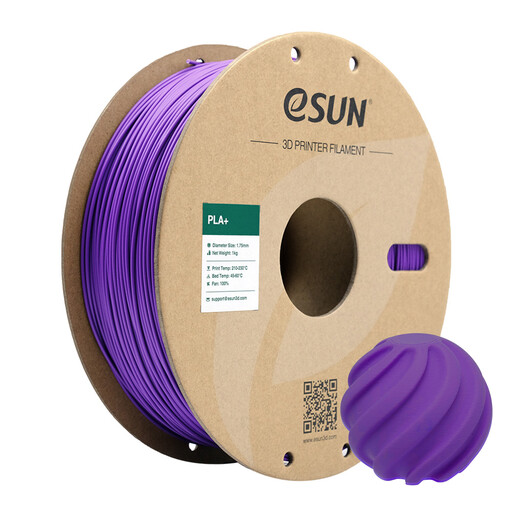
Why it suits this profile: This PLA+ variant comes in a striking purple colour, making it a good choice for finished pieces on display, model-making and creative projects.
According to the product description, eSUN highlights its high toughness, smooth feeding and reduced warping. The final result still depends on calibration and print design.
PLA+ formula, purple colour, 1.75 mm and 1 kg; designed for use in many FDM printers.
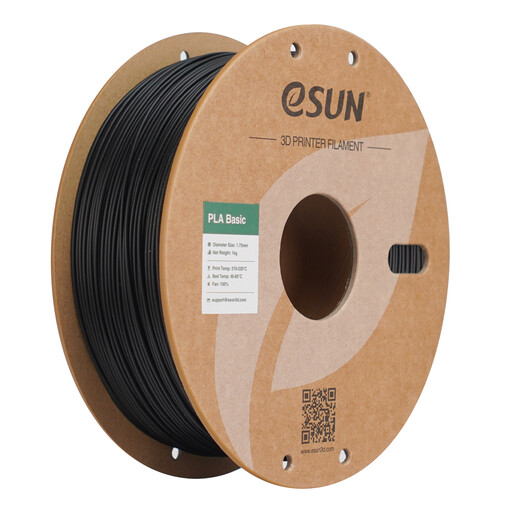
Why it suits this profile: For rapid prototyping, props and larger print runs, high-speed 3D printing filament may be worth considering, provided your printer and nozzle can handle the set flow rate.
The product information lists speeds of up to 300 mm/s and a flow rate of 35 mm³/s under specific conditions. Don’t use these figures without checking your own printer profile.
Black, 1.75 mm, 1 kg and, according to eSUN, compatible with printers including the Bambu Lab X1/P1P and Creality K1.
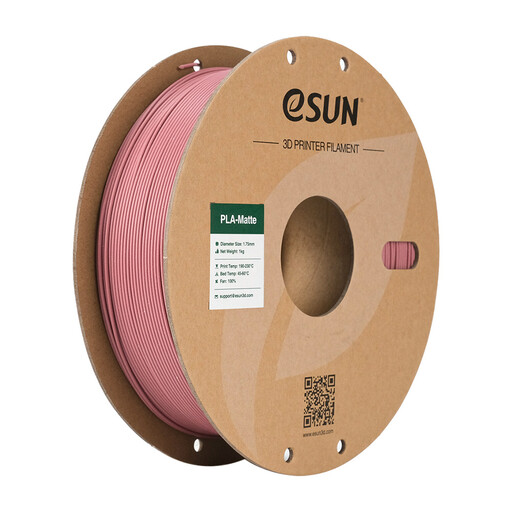
Why it suits this profile: The matte purple finish is well suited to decorative models, figures and designs where you want a less glossy surface.
Here, you’re choosing the surface finish deliberately, rather than focusing on colour alone. Check beforehand that your printer profile is suitable for matte PLA.
Matte texture, 1.75 mm and 1 kg; developed as a PLA material for FDM printers.
We’ve put together a complete, up-to-date list of products that meet these strict selection criteria and the applicable European safety requirements.
For consistent results, follow these steps:
PLA and PLA+ are generally intended for indoor printing. According to eSUN’s product descriptions, its PLA+ variants are made using plant-starch-based raw materials. This supports describing the filament as being made from a plant-based raw material, but it doesn’t automatically make it compostable or suitable for every environmental application.
According to the product information, eSUN PLA+ is compatible with many FDM printers, including the Ender 3. Be sure to check the nozzle size, temperature settings and spool holder on your specific model. It’s a good idea to run a small test print before making a large part.
According to eSUN’s own product information, PLA+ offers greater strength and toughness than standard PLA. The actual strength of a print also depends on layer height, infill, wall thickness, print orientation and how well the layers bond.
That depends on the weight of your models and the print settings you choose. A small decorative print may use just a few dozen grams, while a large model can take hundreds of grams. You can use a slicer to check the estimated material usage and print time before printing.
