
Vandaag of morgen in huis

Kwaliteit gegarandeerd

Welkomstaanbiedingen ontgrendelen: GRATIS bezorging | Tot 80% korting | Gratis 30 dagen JoyPlus-proefperiode
Download de app
An electric heater may seem simple: plug it in and turn on the heat. However, models vary considerably in terms of power, controls, noise levels and safety features. A low purchase price may therefore prove less attractive if the heater is too loud for the bedroom, fails to distribute enough heat or lacks a useful timer.
Pay particular attention to these common pitfalls:
A 1500W electric heater is often suitable for a small to medium-sized personal space, such as a home office, student room or bedroom. A 2000W electric heater may be worth considering for a larger or less well-insulated room, but the stated coverage is only a guideline.
Pay attention to:
A model with settings such as 900W, 1300W and 1500W may be more practical than a heater that is simply on or off. According to DREO's own information, the Atom 318, Atom 416 and Solaris 628 models can adjust their power in stages. The stated energy saving of up to 40% is a claim made by the brand itself and is not a guaranteed result for every home.
A ceramic heater or ceramic fan heater uses a PTC heating element. PTC stands for Positive Temperature Coefficient: the electrical behaviour of the material changes as the temperature rises. In practice, what matters most is how the element, fan and thermostat work together.
Therefore, do not just check for the word “ceramic”. Also look at:
A heater with oscillation moves the air outlet from side to side. This can help distribute heat more widely around a room. For a desk or a fixed seating position, oscillation is less essential than it is for a living room or shared workspace.
A heater with remote control is convenient when the heater is positioned beside a bed, sofa or desk. An LED display makes the set temperature and timer easier to see. An electric heater with a timer can switch off automatically after a selected period, but check whether the timer can be set in hours and whether the function works in all modes.
These features are practical for everyday use:
According to the product information provided by the brands mentioned, the selected models offer various combinations of these features. Always check the manual and product specifications for the model you choose.
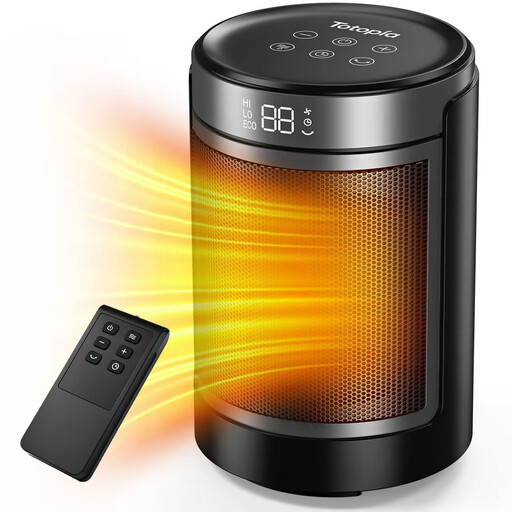
Why it suits this profile: This compact model offers four settings, including fan, 750W, 1500W and ECO. This gives students and people working from home the flexibility to adjust the heat to suit the situation.
The adjustable settings prevent you from using maximum power for every situation. The 12-hour timer and tip-over and overheating protection are also listed in the product description.
PTC ceramic element, LED display, remote control, wide oscillation and a timer from 1 to 12 hours.
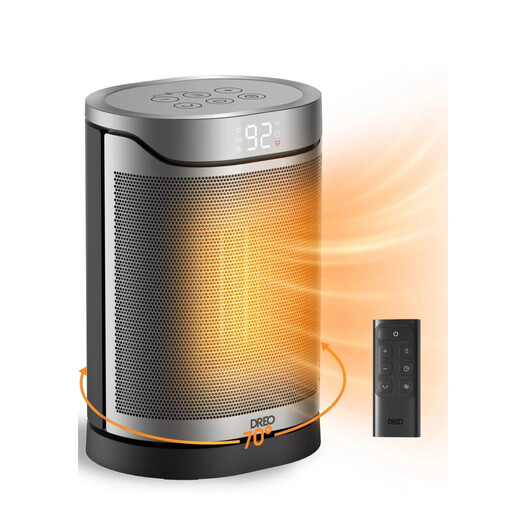
Why it suits this profile: According to DREO's own information, this model has an adjustable thermostat from 5 to 35°C, 70° oscillation and a stated noise level of 25–42 dB. This makes it suitable for use in a bedroom or quiet home office.
The brand states a specific decibel range rather than simply describing it as “quiet”. The stated safety features include tip-over, overheating and flame-retardant housing protection.
1500W power, 12-hour timer, remote control, temperature control and, according to the brand's own information, CE and CB certification.

Why it suits this profile: For a medium-sized room or extended use, this model offers 2000W of power, 70° oscillation and a stated coverage of 15–25 m², according to its own product information.
The heater combines multiple power levels with a thermostat and timer. This means you do not need to use 2000W continuously once the room has reached the desired temperature.
2000W PTC element, 12-hour timer, remote control, temperature setting from 5–35°C and, according to the brand's own information, a noise level of 25–42 dB.
We have put together a complete, up-to-date list of products that fully meet these strict selection criteria and the applicable European safety regulations.
Place an electric heater on a flat, hard and stable surface. Keep the air inlet and outlet clear, and do not place the appliance under a desk where clothing or paper could come into contact with the casing. According to the product warnings, keep it at least the recommended distance from curtains, bedding and furniture.
Do not use an electric fan heater in a bathroom or other damp area unless the manual explicitly states that it is suitable for such use. Ideally, plug a powerful model directly into a suitable socket and do not use it alongside several other high-powered appliances on the same extension lead.
Use this calculation: power in kW × usage time × your electricity tariff. A 1500W heater uses 1.5 kWh per hour when operating at maximum power. A 2000W model uses 2 kWh per hour in the same conditions. A thermostat or ECO mode may reduce average consumption, but the exact result depends on the room and how the heater is used.
It can be, provided the model is suitable for indoor use and has a low stated noise level. Ideally, choose a quiet electric heater with a thermostat, timer, tip-over protection and overheating protection. Keep it clear of bedding and curtains, and always follow the instructions.
Its service life depends on how often it is used, dust, ventilation and maintenance. Allow the appliance to cool down before cleaning it, keep the air vents clear and carry it by the handle when one is provided. A warranty period is not a fixed service life, but it does provide information about the support available in the event of manufacturing defects.
