
Vandaag of morgen in huis

Kwaliteit gegarandeerd

Welkomstaanbiedingen ontgrendelen: GRATIS bezorging | Tot 80% korting | Gratis 30 dagen JoyPlus-proefperiode
Download de app
An electric heater and fire pit have the same purpose: to provide heat where you need it. However, what you need from them can vary considerably depending on the situation. A ceramic heater with a thermostat can be useful in a garage, while a fire pit with a spark screen is best suited to controlled outdoor use.
Many disappointing purchases are not due to a lack of power, but to unrealistic expectations. Before you buy, watch out for these common pitfalls.
A higher wattage does not automatically mean a room will be heated evenly. A 2000W radiant heater directs heat mainly towards people and surfaces nearby. An electric fan heater circulates warm air more quickly, but it can be noisier and create draughts.
For a construction heater or workshop heater, the size of the space, its insulation and ventilation also matter. A 3 kW construction heater may be suitable for a smaller, temporary workspace. Models rated at 5 kW or 9 kW may be more suitable for larger or less well-insulated spaces, provided the electrical connection can support them.
Not every fire pit is designed for cooking. Check whether the product information mentions a grill rack, food-safe components or use as a barbecue. Don’t automatically assume that a model described only as a fire pit can also be used as a barbecue.
A fire pit with a spark screen helps contain sparks and larger glowing embers, but it doesn’t make having a fire risk-free. Place the fire pit on a stable, non-combustible surface and keep it well away from fences, garden furniture and dry materials.
For electric models, overheat protection, a sturdy housing and a clear thermostat are practical features to check. A brand’s own research may claim that a feature supports certain performance, but such claims are no substitute for the product specifications and instructions for use.
Also check that the product has an appropriate CE mark and clear safety information. For high-powered models, check the plug type, connection rating and requirements of your fuse box. Any changes to fixed electrical installations should be carried out by a qualified electrician.
A 2 kW appliance theoretically draws around 8.7 amps at 230 volts. At 3 kW, this rises to around 13 amps. Actual consumption depends on how long the heater runs and the thermostat setting. Models rated at 5 kW and 9 kW need extra care: check that they are designed for a suitable connection, and don’t use unsuitable extension leads or multiway adaptors.
A ceramic heater with a thermostat can be a practical choice for a small room, garage or workspace. For temporary heating on a building site, a construction heater with multiple heat settings is often more flexible. A thermostat can stop the appliance from heating unnecessarily, but it only saves energy when the settings and how you use it are adjusted accordingly.
A fan heater actively blows warm air into the room. This makes it a good fit for a workshop, warehouse or garage where you want to heat a larger area quickly. A radiant heater directs heat more precisely and may be suitable when you need extra warmth at one workstation or seat.
Look for:
For warehouse heating and intensive use, it’s wise to look beyond the rated power. Also check the operating time, protection rating and maintenance instructions in the product information.
The fire pit’s stated dimensions indicate how much wood you can safely put in it and how much space it will take up. The model below measures 67 x 67 x 47 cm and is made of steel. Before buying, check whether the spark screen and poker are included in the set.
A fire pit with a poker makes it easier to move logs without bringing your hands close to the flames. After use, let the fire pit cool completely before removing the ash or putting it away. Also check local rules on open fires, as these can vary by council and weather conditions.
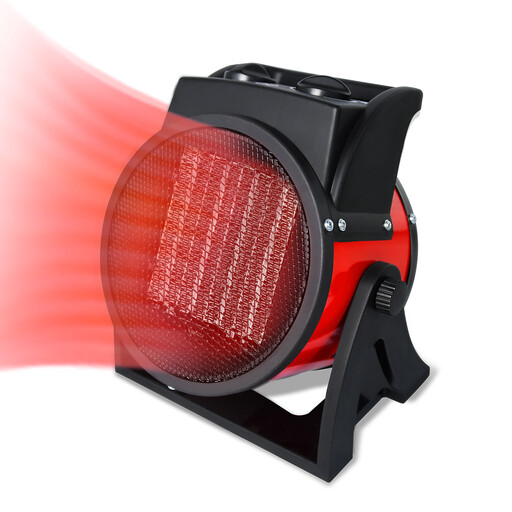
Why it suits this profile: This ceramic heater has a power output of 2 kW, a thermostat and three heat settings. This makes it suitable for a smaller garage, room or temporary workspace where you want to adjust the heat.
With three settings and a thermostat, you don’t have to rely solely on maximum power. Do check that 2 kW is suitable for the size and insulation of your space.
PTC heating, three heat settings and a thermostat, according to the product listing.
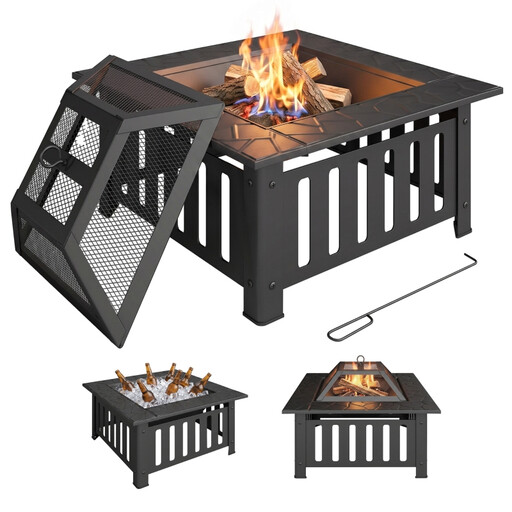
Why it suits this profile: This steel fire pit is designed for outdoor use in the garden, at a campsite or during a carefully managed outdoor gathering. Its size provides a clearly defined space for the fire, and the set includes a spark screen and poker.
The spark screen and poker are clearly listed as included components. However, they don’t remove the need for supervision, safe distances and a stable surface.
Steel construction, dimensions of 67 x 67 x 47 cm, spark screen and poker.
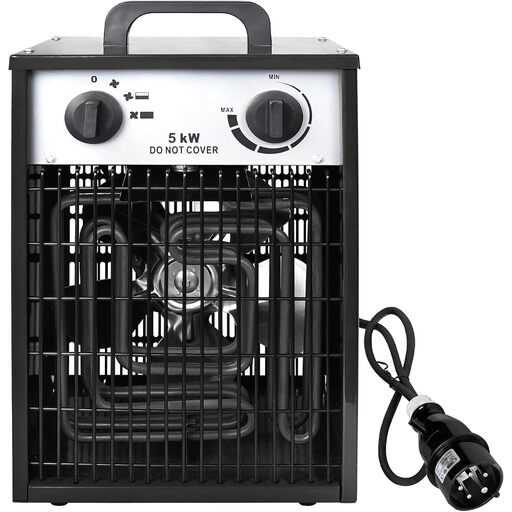
Why it suits this profile: Its higher power output and four heat settings make it a good fit for temporary use in a workshop, garage, warehouse or building site. Check the required electrical connection before use.
The four settings give you more options than simply switching it on or off. However, its power output means you should check the plug, circuit and intended environment.
5 kW power output, four heat settings and overheat protection, according to the product listing.
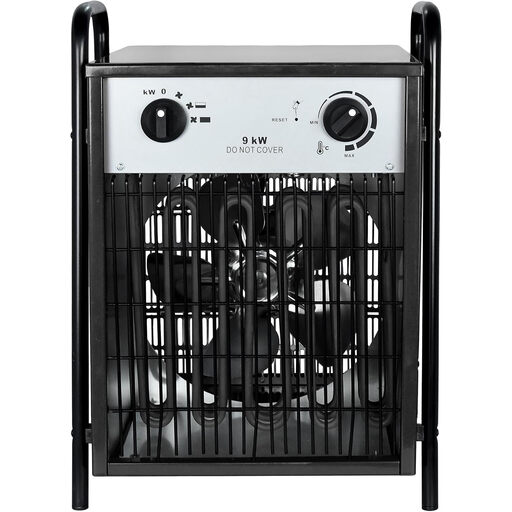
Why it suits this profile: This model is intended for situations where a high power output is being considered, such as larger workshops or building sites. First, have the available connection and ventilation checked to make sure they’re suitable.
Four heat settings mean you don’t always have to use the highest one. With a 9 kW model, checking the connection and positioning, and seeking professional advice, are still essential.
9 kW power output, four heat settings and overheat protection, according to the product listing.
We’ve put together a complete, up-to-date list of products that meet these strict selection criteria and the applicable European safety requirements.
It depends on the power output, how long you use it for and the current energy price. An electric model converts electricity directly into heat where it’s positioned, but a 2 kW appliance running for several hours will still use several kilowatt-hours. So compare more than just the purchase price: consider the power output and how much you expect to use it.
Not without checking the product specifications and electrical connection. A high power output may exceed the capacity of the available circuit. Check the plug, phase connection, fuse and installation requirements. Don’t use an adaptor that isn’t explicitly suitable for the load.
Place the fire pit on a stable, non-combustible surface, keep it away from flammable materials and use the spark screen if one is included. Keep water or a suitable fire extinguisher nearby, never leave the fire unattended, and check local rules and any temporary fire bans. A fire pit with a poker helps you move logs, but it doesn’t replace supervision.
