
Vandaag of morgen in huis

Kwaliteit gegarandeerd

Welkomstaanbiedingen ontgrendelen: GRATIS bezorging | Tot 80% korting | Gratis 30 dagen JoyPlus-proefperiode
Download de app
An electric heater can be useful in a cold bedroom, home office, student room or living room. However, it is not wise to look only at the wattage or the promise of “instant heat”. A 2000-watt model may provide powerful heating, but it can also use relatively large amounts of electricity. A quiet heater can be pleasant while you are working, whereas a fan heater will remain audible because of the airflow.
The right choice depends on the room, when you use it and the features you genuinely need.
A 2000-watt heater offers a high maximum output, but that does not automatically mean it is suitable for every room. Insulation, ceiling height, draughts and the desired temperature also play a role. For a small study, 600 to 1500 watts may be sufficient. For a larger living room, 2000 watts may be more practical as temporary supplementary electric heating.
Also consider energy consumption: a 2000-watt heater uses 2 kWh per hour at maximum output. The actual cost depends on your energy tariff and how long the heater runs at full power.
A ceramic fan heater uses a fan to distribute warm air. This usually heats the room quickly, but it also creates noise. Manufacturers sometimes state a noise level in decibels. According to the product information, the stated noise level of the PELONIS is approximately 50 dB, while the DREO is listed at 25–42 dB. Treat this as a product specification under certain conditions, not as a guarantee that the appliance will be inaudible in every room.
For a bedroom, a low fan setting, quiet mode or timer is often more important than maximum output alone.
Tip-over protection and overheat protection are valuable features, but they do not make improper use safe. Always place an electric heater on a stable, level surface. In accordance with the product instructions, keep it approximately one metre away from curtains, bedding, furniture and other flammable materials. Never cover the appliance or use it in the immediate vicinity of a bath, shower or swimming pool.
Before buying, also check whether the product comes with clear instructions, manufacturer details and appropriate European product information. A CE mark is an important statement of conformity, but it is no reason to ignore the safety instructions.
Compare the output with the room in which you intend to use the heater:
A ceramic heater with a PTC element generally regulates heat output through different settings. Check whether the manufacturer specifies a floor area and whether this matches your situation. Product listings may state different coverage areas, so if in doubt, consult the manual or the latest product specifications.
A heater with a thermostat switches the heating on or off around a set temperature. This helps prevent the appliance from running continuously at full power unnecessarily. Check the adjustment range and how the temperature is measured.
A heater with a timer is useful when you want the heating to stop automatically after a set period. Models vary considerably: some offer 12 hours, while others provide 24 hours. A heater with a remote control is practical in the living room or bedroom, but check whether all functions are also available on the appliance itself.
A portable heater with a handle is easy to move between the office, bedroom and living room. A tower model takes up little floor space, while a compact model is easier to fit under a desk. Pay attention to the air outlet: it must not be blocked by a wall, curtain, duvet or clothing.
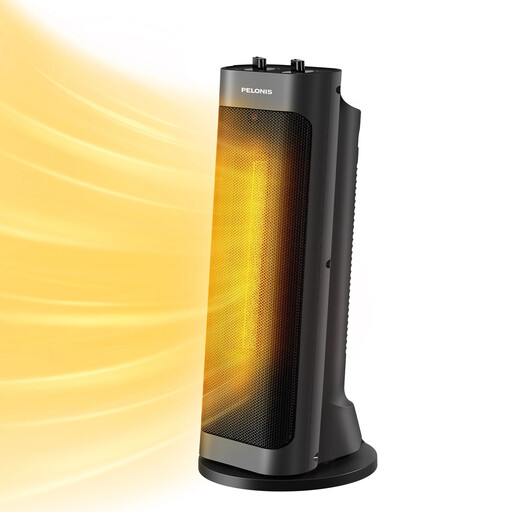
Why it suits this profile: This compact model has four heat settings, a thermostat, 70° oscillation and a carry handle. It is therefore suitable for anyone looking for straightforward supplementary electric heating for an office, bedroom or study.
The specifications mention tip-over and overheat protection. However, note the different coverage areas stated in the product information; therefore, check the latest manual for your room.
PTC ceramic heating, 2000-watt maximum output, thermostat and 70° oscillation.

Why it suits this profile: Suitable for anyone who values precise controls, wide heat distribution and a low stated noise level in a medium-sized room.
The product information lists 25–42 dB, a thermostat from 5–35 °C, a 12-hour timer and several layers of protection. This makes the key purchase criteria easy to verify.
2000 watts, 70° oscillation, remote control, child lock and tip-over protection.
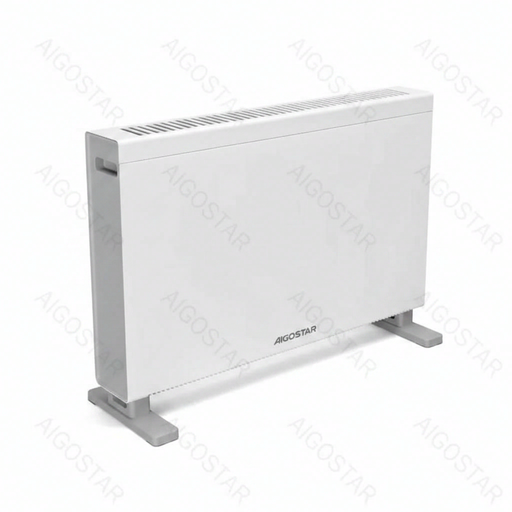
Why it suits this profile: This convection heater is designed for longer periods of use in rooms of approximately 20–25 m², such as a living room or home office.
The product description lists two power settings of 1250 and 2000 watts, a thermostat and a 24-hour timer. This allows you to tailor usage more effectively than with a simple on/off switch.
Remote control, LED controls, 24-hour timer, tip-over and overheat protection.
We have put together a complete, up-to-date list of products that fully meet these strict selection criteria and the applicable European safety regulations.
An electric heater converts electricity directly into heat, but consumption still depends on the output and how long it is used. A 2000-watt model uses a maximum of 2 kWh per hour. A thermostat, lower setting and timer can help limit unnecessary heating. “Energy-efficient” is therefore mainly a combination of appliance settings, insulation and usage time.
For a bedroom, look for a quiet heater with a timer, thermostat and tip-over protection. Check the stated noise level, but bear in mind that levels can vary between settings. Do not place the appliance next to the bed, under a blanket or close to curtains. Always follow the manufacturer’s positioning and usage instructions.
Its lifespan depends on build quality, dust, frequency of use and maintenance. Switch the appliance off and unplug it before cleaning or moving it. Stop using a heater if it shows visible damage, has a damaged cable, gives off an unusual smell or operates irregularly. If it develops a fault, contact the retailer or manufacturer rather than opening the appliance yourself.
