
Vandaag of morgen in huis

Kwaliteit gegarandeerd

Welkomstaanbiedingen ontgrendelen: GRATIS bezorging | Tot 80% korting | Gratis 30 dagen JoyPlus-proefperiode
Download de app
An electric heater seems simple: plug it in and switch on the heat. Yet many people buy a model that isn’t right for the room or the way they plan to use it. A compact heater, for example, can be ideal under a desk but may not have enough power for a living room. On the other hand, a powerful site heater could use more electricity than necessary in a small bedroom.
Look out for these three common pitfalls:
Power is measured in watts. A 600-watt model is mainly suited to personal warmth, for example at a desk or in a small study. An electric heater rated at 1500 to 2000 watts is better suited to a bedroom, office or compact living room. Models rated at 3000 to 9000 watts are available for garages, workshops and building sites, but you’ll need a suitable electrical connection.
Use the maximum power as a practical guide, not a guarantee of a particular temperature. A heater with a thermostat switches the heating element off or reduces its output once it reaches the set temperature. This can be more comfortable than an appliance that runs continuously at full power.
A ceramic heater or PTC heater uses a ceramic heating element. PTC stands for Positive Temperature Coefficient: the electrical resistance changes as the element heats up. Many models also have a fan to spread warm air more quickly.
An electric fan heater usually warms a room quickly, but fan noise varies between models. For a bedroom or office, the stated noise level, a quiet mode and an adjustable thermostat matter more than a high maximum output alone.
Check whether the heater has:
Always place a portable heater on a flat, hard surface. Keep curtains, bedding, paper and furniture well away from it. Never cover the appliance or use it in a damp room unless the product information explicitly says it’s suitable. If possible, plug a high-powered model directly into a suitable wall socket, and check the manual before using an extension lead.

Why it suits this profile: This compact model is designed for a desk, bedroom or other small space. At 0.93 kg, it’s easy to move around.
Its limited power makes clear that this is a personal heat source, not a solution for a large living room. The product information lists tip-over and overheat protection.
600W according to the product name, 45° oscillation, thermostat and a compact size of 142 × 132 × 188 mm.

Why it suits this profile: This model combines a compact design with several settings and a low stated noise level. It’s a good fit for a bedroom, study or office where a quiet environment matters.
The product specifications list 600W and 1500W separately, so you don’t have to rely on the highest setting alone. It also has tip-over and overheat protection.
Maximum output of 1500W, stated noise level of 24 dB(A), three temperature settings and a handle. It weighs 1.51 kg.
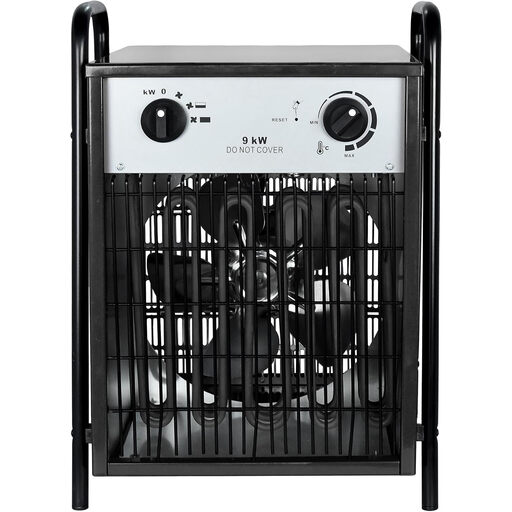
Why it suits this profile: This is a site heater for a garage, warehouse, workshop or building site. Its power is designed for larger or less well-insulated spaces.
Its clearly defined purpose helps you avoid choosing a heavy-duty site heater for a bedroom. Check the connection and safety instructions before buying; the available product description is limited.
9KW according to the product name and four heat settings according to the available product title.
We’ve put together a complete, up-to-date list of products that meet these strict selection criteria and the applicable European safety requirements.
You can work out the energy use with this simple formula:
power in kilowatts × running time in hours = energy use in kWh
A 2000-watt heater theoretically uses 2 kWh per hour when it runs continuously at full power. A thermostat or ECO mode can reduce the time it spends running at full power, but the result varies depending on the room and settings. So don’t just look at the purchase price: consider the maximum wattage, timer and control options too.
Yes, as long as the model is designed for indoor use and is placed securely. Ideally, choose a quiet, compact heater with a thermostat, timer and tip-over protection. Keep bedding and curtains well away, and never run the appliance while it’s covered.
Its lifespan depends on how often it’s used, dust in the ventilation system, storage and the quality of the electrical connection. Keep the air vents clear, clean the appliance only when it’s switched off and has cooled down, and follow the manufacturer’s maintenance instructions. The statutory guarantee in the EU is separate from normal wear and tear or damage caused by incorrect use.
Not necessarily. Both types can use a similar amount of electrical power. A PTC heater can provide warmth quickly and is often paired with a thermostat or ECO mode. The overall cost mainly depends on the wattage, temperature setting, room insulation and how long you use it.
