
Livraison le jour même et le lendemain

Qualité garantie

Débloquez vos offres de bienvenue: Livraison GRATUITE | Jusqu'à -80 % | 30 jours d'essai gratuits à JoyPlus
Téléchargez l'application
A ratchet looks simple: fit the socket, set the direction and turn. Yet many people buy a ratchet handle or set that isn’t right for the job. A drive size that’s too large makes it difficult to work in tight spaces, a limited socket set may be missing important sizes, and a ratchet with lots of teeth isn’t necessarily suited to heavy-duty use.
For mechanics, trade professionals, maintenance teams and DIYers, these are the three main pitfalls to watch out for:
The drive size determines which sockets and accessories will fit:
An adaptor can connect different sizes, but it doesn’t automatically make a small ratchet suitable for high torque. Check the stated product specifications, and use a torque wrench whenever the vehicle or component manufacturer specifies a particular tightening torque.
A 72-tooth ratchet and a 90-tooth ratchet can both work well in practice. The main difference is the angle of movement required. According to the stated product specifications, a 72-tooth mechanism often has a working angle of around 5 degrees, while a 90-tooth ratchet may have an angle of around 4 degrees.
A smaller angle is useful when you have little room to move the ratchet handle back and forth. This makes a fine-tooth ratchet with a quick-release mechanism handy for engine bays, machine building and assembly work between pipes. Also check that the direction switches smoothly and that the socket stays firmly attached to the head.
Many models in this category are made from chrome vanadium steel. This is a verifiable material specification, but it isn’t the only factor that determines how long the tool will last. Heat treatment, finish, joints and correct use also play a part.
Look for:
Don’t use a ratchet as a striking tool or extend the handle with a loose pipe. After use, clean off oil and dirt, dry the mechanism and, where appropriate, apply a small amount of tool oil. This helps keep the ratchet mechanism moving smoothly without treating a brand’s performance claims as proven fact.
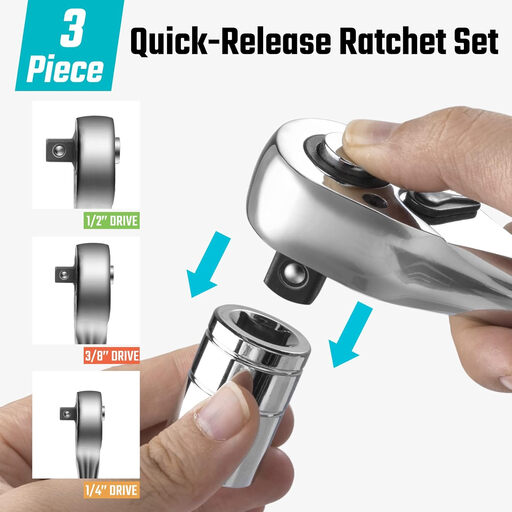
Why it suits this type of user: The three drive sizes cover small, medium and larger jobs. It’s a practical choice if you’re looking for one basic set for car, bicycle and household maintenance.
You’re not limited to one drive size. The product description lists 72 teeth, a 5-degree return angle and quick release for changing sockets.
Three ratchet handles in 1/4, 3/8 and 1/2 inch; supplied with a storage case.
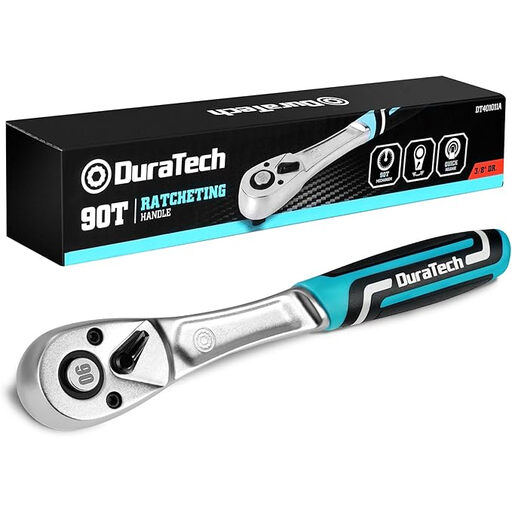
Why it suits this type of user: This standalone 3/8-inch ratchet handle is a good choice if you already own sockets and want to invest in a fine-tooth mechanism for assembly work in confined spaces.
The product specifications list 90 teeth, a 4-degree working angle, a quick-release button and a reversible ratchet direction.
3/8-inch drive; chrome vanadium steel handle; 8-inch length according to the product information.
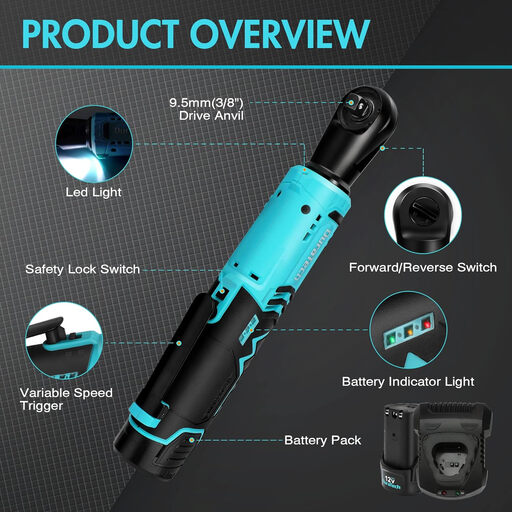
Why it suits this type of user: An electric ratchet wrench can save time when tightening and loosening fasteners during regular car maintenance or assembly work. Before buying, check that the available socket sizes suit your needs.
The set includes two batteries, a 3/8-inch fitting, LED lighting and a forward/reverse switch. Speed and torque are product specifications; finish tightening by hand wherever required.
12 V system; two 2.0 Ah batteries; eight sockets, adaptor, extension bar, charger and storage case according to the product description.
A manual ratchet is generally easy to maintain and ready to use straight away. For occasional jobs, a ratchet set is often enough. A ratchet screwdriver with 1/4-inch bits is better suited to screws in furniture, bicycles and light assembly work. For bolts and nuts, choose a ratchet handle with the right sockets.
An electric ratchet wrench is particularly useful if you need to work through a lot of fasteners in succession. When buying, check the battery voltage, charging time, included batteries, speed, maximum stated torque and availability of replacement batteries. Don’t use the electric drive as a substitute for a torque wrench.
For tight spaces, a flexible ratchet spanner or ratcheting combination spanner may also be useful. A fixed ratcheting combination spanner is compact; according to the product description, a flexible head can move up to 180 degrees. That extra reach is useful, but check that the head stays stable enough for the job.
We’ve put together a full, up-to-date list of products that meet these strict selection criteria and the applicable European safety regulations.
For many car maintenance jobs, a 3/8-inch ratchet is a practical middle-ground size. A 1/4-inch ratchet may be more convenient for smaller fasteners. Larger wheel or chassis fasteners sometimes require a 1/2-inch ratchet. Always check the socket size and the specified tightening torque.
Neither is automatically right for every job. According to the stated product specifications, a 90-tooth ratchet has a smaller working angle, which can make it easier to use in tight spaces. A 72-tooth model can also be a good choice for general maintenance. Material, head design and using the tool correctly matter too.
Keep the ratchet clean and dry, remove sand and grease from the head, and don’t store it loose among damp tools. A small amount of suitable oil can help keep the mechanism moving smoothly. Use the ratchet only for its stated applications, and use a torque wrench for controlled tightening.
