
Vandaag of morgen in huis

Kwaliteit gegarandeerd

Welkomstaanbiedingen ontgrendelen: GRATIS bezorging | Tot 80% korting | Gratis 30 dagen JoyPlus-proefperiode
Download de app
A 3/8-inch ratchet is a versatile choice for car maintenance, machine work, assembly and household repairs. Its 3/8-inch drive size, or around 9.5 mm, fits many common socket sets. However, not every ratchet is suited to the same job.
Many buyers focus mainly on the number of teeth or a low price, sometimes overlooking other features. For example, a ratchet may need too much clearance to move in a cramped engine bay, while an electric ratchet may not offer enough control for delicate assembly work. Use this buying guide to compare the key specifications and avoid choosing the wrong tool.
A 72-tooth ratchet usually needs less movement on the return stroke than a coarser mechanism. According to its product specifications, a 90-tooth ratchet may work with an even smaller operating angle. This is useful when you have limited room to move the handle.
However, the number of teeth doesn’t tell you everything. Check the head shape, overall length, direction switch and socket retention mechanism too.
A 3/8-inch drive fits sockets with the same drive size directly. A ratchet set with 1/4-, 3/8- and 1/2-inch drives offers more flexibility, but is often larger and more expensive. For small screws and electronics, 1/4 inch is usually more practical. For heavier work, 1/2 inch may be more suitable.
Also check the difference between SAE sockets, which use imperial sizes, and metric sockets. Metric sizes are important for many jobs in the Netherlands.
A 12 V electric ratchet wrench can speed up loosening and tightening. In this case, speed, battery capacity and the sockets supplied are all important. For the final check of a specified tightening torque, however, use the tool designed for the job, such as a torque wrench. Always check the manual and product specifications.
The 3/8-inch size is a practical middle ground. A 3/8-inch ratchet is usually compact enough for smaller spaces, while offering more reach than a compact 1/4-inch ratchet. Before you buy, check:
A ratchet with a quick-release keeps the socket on the square drive while you work and makes it easier to change sockets. The exact mechanism varies by model, so check the product description.
The operating angle tells you how far you need to move the ratchet back before the mechanism engages again. A stated angle of 4° with 90 teeth or 5° with 72 teeth is particularly relevant in tight spaces, such as around engine blocks, pipes, furniture or machine housings.
A small angle doesn’t automatically make a ratchet suitable for heavy loads. Check the permitted torque, head construction and manufacturer’s instructions too.
Many models in this category use chrome vanadium steel or a chrome alloy. These are verifiable material specifications, but they don’t, by themselves, tell you how long a product will last. Using the tool correctly, cleaning it and staying within its stated limits are important too.
A fully polished finish can make dirt and grease easier to remove. A knurled or rubberised handle may provide a better grip. If you’re working in a dusty environment, a sealed ratchet head may be worth considering. This feature is listed for some DURATECH models in the product description.
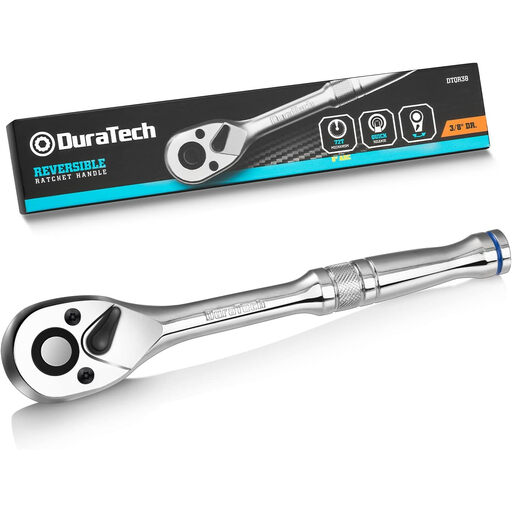
Why it suits this type of user: A standalone 3/8-inch ratchet is a straightforward option if you already own sockets and don’t need an extensive set.
The product description lists a quick-release, a reversible mechanism and a 5° operating angle with 72 teeth. Check whether your sockets are metric or imperial.
3/8-inch drive, 72 teeth, polished chrome finish and a knurled handle.
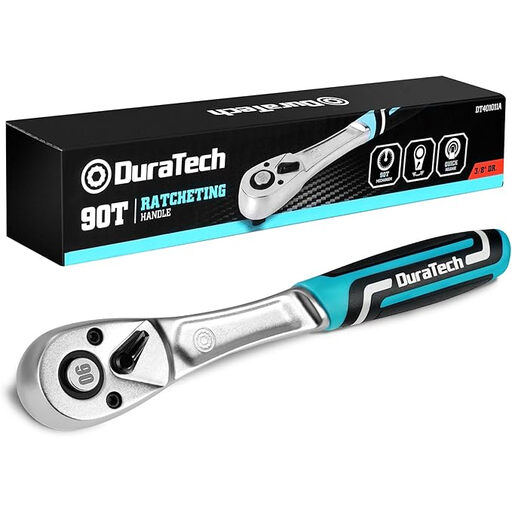
Why it suits this type of user: This model is a good fit if you value a sealed head, a small operating angle and a metal construction, as stated in the product information.
The description lists a fully enclosed ratchet head and a 4° operating angle with 90 teeth. These features address dust and limited room to move, but don’t replace regular maintenance.
90 teeth, 4° operating angle, reversible switch and fully polished chrome finish.
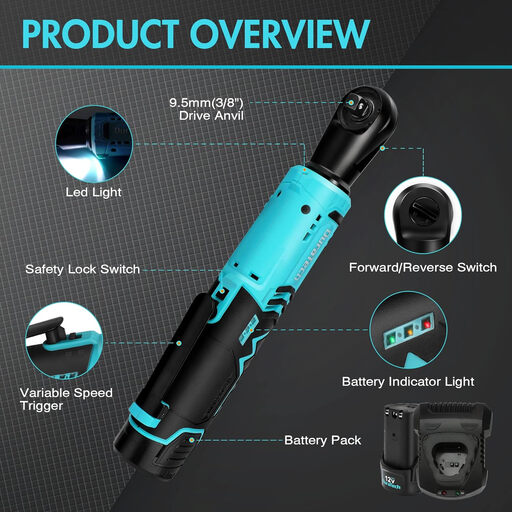
Why it suits this type of user: For car maintenance and assembly work involving lots of bolts to loosen or tighten in succession, a battery-powered model can save time.
According to the product description, the set includes two 2.0 Ah batteries, a charger, a light, a storage case and sockets. Check the charging time and stated torque before you buy.
12 V drive, LED light, forward/reverse switch and a 3/8-inch to 1/4-inch adapter included.
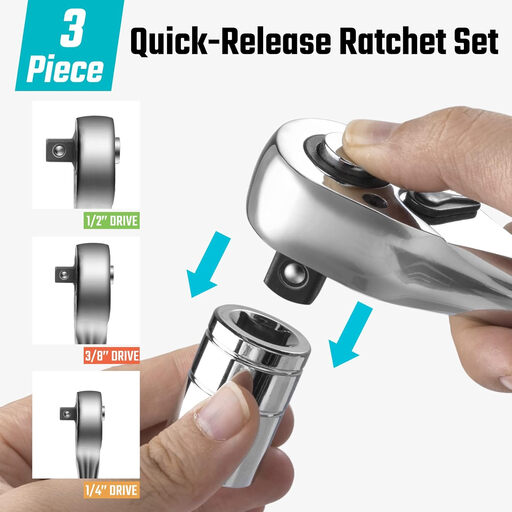
Why it suits this type of user: This set is a good choice for DIYers and mechanics who work with different bolt sizes and want to keep their tools organised.
The three drive sizes reduce the need to buy a separate ratchet for every job. According to the description, the set has 72 teeth and a quick-release.
1/4, 3/8 and 1/2 inch, 72 teeth, reversible mechanism and a storage case.
We’ve put together a complete, up-to-date list of products that meet these strict selection criteria and the applicable European safety regulations.
Yes, a 3/8-inch ratchet is often used for car maintenance, light machinery and assembly work. For each job, check the socket size you need, the space available and the required tightening torque. A different drive size may be needed for very large or seized fasteners.
According to product information, a 72-tooth ratchet often has an operating angle of around 5°. A 90-tooth ratchet may work at around 4°. This means that, in a tight space, a 90-tooth ratchet needs less movement on the return stroke. The right choice also depends on the head shape, handle and construction.
Wipe the ratchet clean after use and remove any grease or dirt before storing it. Keep it dry in a case or tool drawer. Don’t use a ratchet as a hammer or extension tool, and don’t exceed its stated torque. For an electric ratchet, also check the battery, charger and moving parts according to the manual.
