A ratchet set that fails after just a few uses, or a ratchet that just won't fit into that tight space. It's a familiar problem for professionals and serious DIYers alike. Purchasing a new ratchet set is an investment in efficiency. The right choice saves you time and frustration. But what should you look for? The difference is in the details: the tooth count, the drive size, and the build quality. This guide will help you make an informed choice based on factual specifications.
Key Considerations When Buying a Ratchet Wrench Set
Before you make a decision, it's helpful to understand the most important parameters. These specifications determine how the ratchet performs in various situations.
1. Drive Sizes: 1/4", 3/8", and 1/2"
The drive size, expressed in inches, determines which size sockets you can use on the ratchet. A 1/4", 3/8" & 1/2" ratchet set provides the most common sizes for a wide range of tasks.
- 1/4" (6.35 mm): Ideal for precision work and small nuts and bolts, such as in electronics or car interior components. Requires less force but offers more precision.
- 3/8" (9.53 mm): The most versatile and common size. Suitable for general maintenance, like working on engine blocks, brakes, and chassis parts. A good balance between size and power.
- 1/2" (12.7 mm): Designed for heavy-duty work. Required for large nuts and bolts that need high torque, such as with lug nuts or suspension components.
A 3-piece ratchet set with these three sizes covers most applications for automotive tools and general maintenance.
2. The Ratchet Mechanism: 72-Tooth vs. 90-Tooth
The number of teeth in the ratchet mechanism determines the arc swing required to engage the next 'click'. This is crucial when working in tight spaces.
- 72-Tooth Ratchet: Has a 5-degree arc swing (360° / 72 teeth = 5°). This is a solid standard for most professional and DIY applications, offering a good balance between durability and precision.
- 90-Tooth Ratchet: Requires only a 4-degree arc swing (360° / 90 teeth = 4°). This small difference can be decisive when room for movement is minimal, for example, deep in an engine bay. A 90-tooth mechanism is often a feature of a more professional-grade ratchet set.
3. Material and Functionality
- Material: Most quality ratchets are made from a chrome alloy (such as Chrome Vanadium or Chrome Molybdenum). A fully polished chrome finish isn't just for looks; it makes the tool easier to wipe clean and more resistant to rust and corrosion.
- Reversible Ratchet: A switch on the head of the ratchet allows you to quickly switch between tightening and loosening without removing the socket from the bolt. This is a standard feature on almost every modern ratchet.
- Quick-Release: A button on the ratchet head that unlocks the socket. This makes changing sockets faster and safer, as the socket cannot accidentally fall off the ratchet.
- Ratchet Set in a Case: A sturdy storage case protects your tools from moisture and impact, and keeps everything organised. This is practical for both workshop storage and transport to a job.
Our Top Picks for 2026
Based on the criteria above, we have compared two popular options. Both sets include the three essential drive sizes and come in a storage case. The main difference lies in the ratchet mechanism.
DURATECH 3-Piece Ratchet Set, 72-Tooth
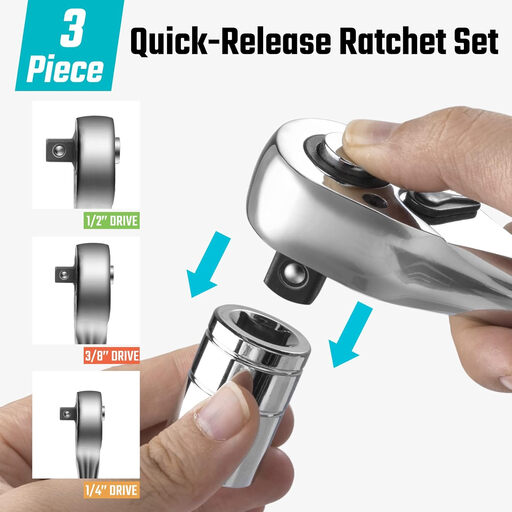
Why this product? This set is a solid all-rounder. With a 72-tooth mechanism and a 5-degree arc swing, it is suitable for the vast majority of repair and maintenance tasks. The quick-release function increases efficiency on the job.
Pros
- Complete Foundation: Includes the 1/4", 3/8", and 1/2" drive sizes.
- Efficient Mechanism: The 72-tooth mechanism with a 5-degree arc swing is a proven standard.
- Ease of Use: Features a reversible ratchet and a quick-release button for fast socket changes.
- Durability: Made from a chrome alloy with a polished finish that resists rust and corrosion.
- Organisation: Comes in a sturdy ratchet set case.
Who is this for? This set is an excellent choice for the serious DIYer and the all-round professional looking for a reliable and versatile ratchet wrench set for general tasks.
View product details and price
DURATECH 3-Piece Ratchet Set, 90-Tooth
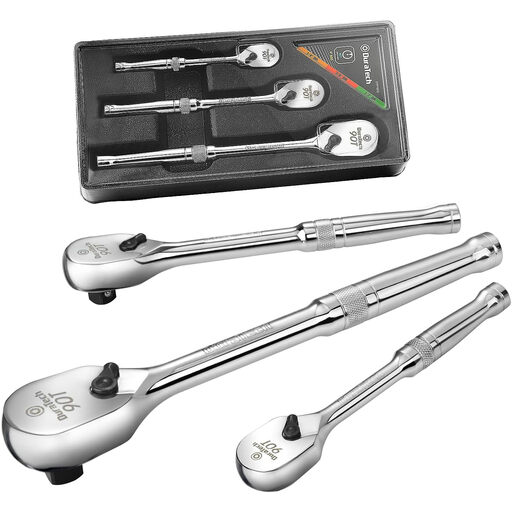
Why this product? This set stands out with its 90-tooth mechanism, resulting in a smaller 4-degree arc swing. This provides an advantage in very tight spaces. The fully sealed ratchet head also offers better resistance to dust and dirt.
Pros
- High Precision: The 90-tooth mechanism requires only a 4-degree arc swing, ideal for confined spaces.
- Dust-Resistant: The fully sealed ratchet head is designed to perform better in dusty or dirty environments, such as a workshop or garage.
- Complete Foundation: Also includes the 1/4", 3/8", and 1/2" drive sizes.
- Robust Material: Made from a heat-treated chrome alloy with a polished finish for easy maintenance.
- Practical Storage: Supplied in a matching storage case.
Who is this for? This professional-grade ratchet set is particularly suitable for auto mechanics, technicians, and demanding users who often work in tight, dirty conditions and require maximum precision.
View product details and price
Need Other Options or Add-ons?
The 3-piece sets mentioned above provide an excellent foundation. However, your project may require a different configuration, such as a more extensive socket set, a torque wrench, or just a single, individual ratchet. For a broader overview of individual parts and other tool sets, you can browse our assortment.
View the category: Tool Parts
Frequently Asked Questions (FAQ)
What is the practical difference between a 72-tooth and a 90-tooth ratchet?
A 90-tooth ratchet has a smaller arc swing (4 degrees) than a 72-tooth ratchet (5 degrees). This means that with a 90-tooth ratchet, you can tighten a nut or bolt in a tighter space because the handle needs to move less to engage the next 'click'. For most jobs, a 72-tooth model is sufficient, but for specialised work (like in a crowded engine bay), a 90-tooth model can make all the difference.
What do I use the different drive sizes (1/4", 3/8", 1/2") for?
- 1/4": For light-duty work with small fasteners, where precision is more important than power.
- 3/8": The most universal size for general automotive maintenance and DIY jobs.
- 1/2": For heavy-duty work that requires high torque (force), such as loosening lug nuts.
Is a storage case really necessary for a ratchet set?
A case is highly recommended. It protects your tools from damage and rust, and ensures you keep your ratchets and any sockets organised and complete. A ratchet set in a case is therefore easier to transport, and you're less likely to be missing the right tool.
Written by: Joybuy Product Recommendation Officer