
Vandaag of morgen in huis

Kwaliteit gegarandeerd

Welkomstaanbiedingen ontgrendelen: GRATIS bezorging | Tot 80% korting | Gratis 30 dagen JoyPlus-proefperiode
Download de app
An induction hob requires pans with a magnetic base. However, the label "suitable for induction" doesn't automatically mean a pan will suit your cooking habits. A small frying pan, for example, may not make enough contact with the cooking zone, while a heavy cast-iron pan can be impractical for everyday use.
As Joybuy Product Recommendation Officer, I therefore focus on verifiable features: material, base, size, maintenance and the stated compatibility. This way, you avoid paying for functions you'll hardly ever use.
A pan may be suitable for induction, yet still be less practical if the base is warped, too small or not flat. Always check that the product information explicitly mentions induction, and also look at the diameter of the base. A 28 cm pan doesn't always have a base that's exactly 28 cm.
If you also cook on gas, electric or ceramic hobs, it's better to choose pans for all hob types. That makes the pan set usable if you move house or use a different hob.
A non-stick pan can make cooking eggs, pancakes and fish easier. However, the coating does require appropriate use. Sharp metal spatulas, abrasive scouring pads and prolonged cooking at high temperatures can shorten its lifespan. Also check whether the pan is dishwasher-safe; "suitable for the dishwasher" doesn't always mean hand washing isn't the better option.
A stainless steel pan without coating requires a different cooking technique. According to the product information for the Maxcook Tri-Ply wok, a preheated pan with cold oil and medium-low heat works better to prevent sticking. That's not non-stick performance, but a usage instruction for the material.
An induction pan set may look appealing, but check which sizes are actually in the box. A set with several small pans may be less suitable for a family than a combination of one frying pan of 24 or 28 cm and a saucepan of 20 to 24 cm.
Also consider your storage space. Removable handles can be handy in a small kitchen, while fixed handles are often ready to use straight away.
Claims about even heat distribution or scratch resistance come from the product information of the respective brand. Also assess the actual construction, such as a 3-layer base, the material and the stated hob types.
For one person or a couple, an induction frying pan of 20 to 24 cm is often practical. For families, 26 to 30 cm offers more space. An induction wok of 28 or 30 cm is suitable for stir-fry dishes, but check that the flat base makes sufficient contact with the induction zone.
An induction saucepan of 16 cm is handy for sauces or small portions. For pasta, potatoes and vegetables, 20 to 24 cm is usually more versatile.
A pan with a glass lid allows you to monitor the cooking process without lifting the lid each time. Check the maximum oven temperature of the pan, the lid and the handle separately.
A dishwasher-safe pan saves time, but hand washing can support a longer lifespan for some coatings, plastic handles and cast iron. Always refer to the specific care instructions.
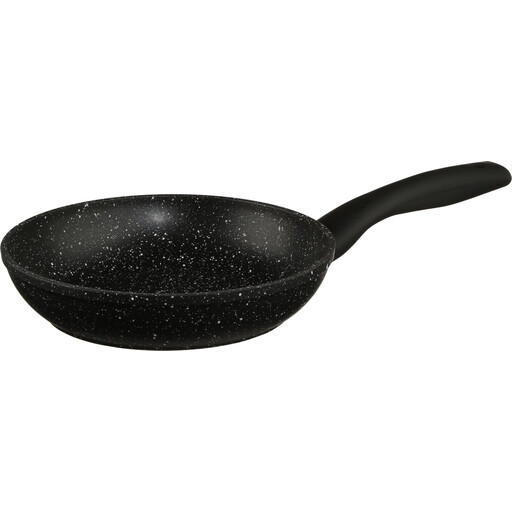
Why this fits the profile: A compact 20 cm pan for single-person households, students and everyday small portions. According to the product information, the pan is suitable for gas, induction, ceramic and electric cooking.
The induction disc and stated compatibility make it clear what the pan is intended for. The size prevents you from using an unnecessarily large pan on a small cooking zone.
Aluminium body, two non-stick layers, 1.9 litre capacity and, according to the product information, dishwasher-safe.
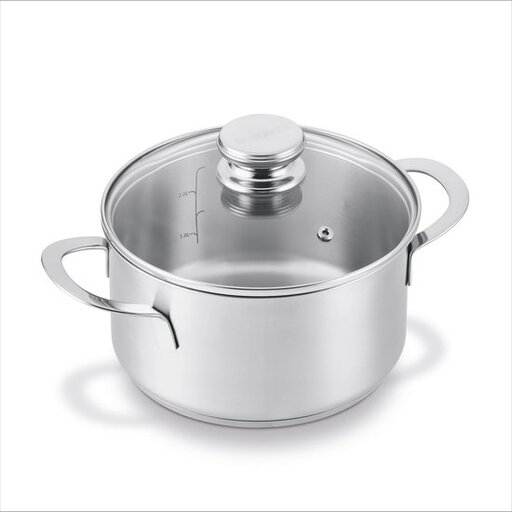
Why this fits the profile: For home cooks looking for a roomy saucepan for vegetables, rice, potatoes and larger portions.
The product information states suitability for induction, gas, electric, ceramic and halogen hobs. This means the pan is not limited to one hob type.
24 cm, 5.5 litre capacity, glass lid with steam vents, internal measurement markings and dishwasher-safe design according to the product information.
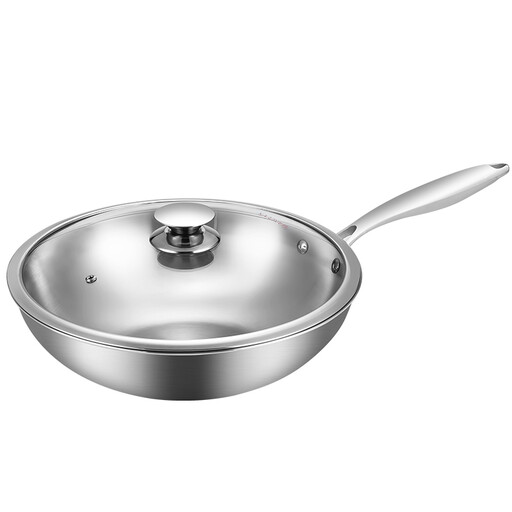
Why this fits the profile: A wok for stir-frying, searing and everyday cooking when you want to use an uncoated stainless steel pan.
The product description does not mention a non-stick coating. Therefore, you won't need to maintain a coating, but you must use the correct preheating technique.
304 stainless steel, 3-layer composite base, 28 cm, glass lid and, according to the product information, suitable for induction, gas, electric and ceramic cooking.
We've put together a full, up-to-date list of products that fully meet these strict selection criteria and current European safety regulations.
Pans with a magnetic base generally work on induction. Always check the official product information. Stainless steel only works when the base or construction is magnetically suitable; aluminium usually needs an induction disc.
This varies by model. Many products list multiple heat sources. A pan that is suitable for all hob types can be used on induction, gas, electric and ceramic, but check this per product.
The lifespan depends on temperature, utensils, cleaning and storage. Do not use sharp metal tools, avoid overheating and follow the care instructions. An uncoated stainless steel pan has no coating that can wear out, but it does require an adapted cooking technique.
