
Vandaag of morgen in huis

Kwaliteit gegarandeerd

Welkomstaanbiedingen ontgrendelen: GRATIS bezorging | Tot 80% korting | Gratis 30 dagen JoyPlus-proefperiode
Download de app
Stainless steel pans are a popular choice in British households because they can withstand daily use and are often suitable for induction, gas and ceramic hobs. However, a shiny interior doesn't tell you much about practical quality. A thin pan can develop hot spots, a wok may not work on induction, and a coating-free base requires a different cooking technique to a non-stick pan.
With these checks, you can compare stainless steel pans based on concrete features, without being swayed by generic marketing claims.
"Stainless steel" doesn't automatically describe the full construction. A tri-ply pan usually consists of three layers: stainless steel, an aluminium core, and stainless steel again. That core helps distribute heat more quickly and evenly than a simple single-walled pan.
So check whether the product description mentions a three-layer structure or sandwich base. Also pay attention to the material type. 304 stainless steel is widely used in cookware, but the presence of 304 steel alone says nothing about the pan's thickness, weight or heat distribution.
A coating-free stainless steel frying pan doesn't have a classic non-stick layer. That can be a plus if you're looking for a pan without coating, but food can stick more easily when the pan is cold or used at too high a temperature. Preheat the pan gently, then add oil and generally use a medium heat.
A non-stick pan works differently. For example, the product information for certain models mentions a ceramic or other coating. With the SENSARTE set, the product information states that a Swiss ILAG coating is used, which is free from PFOA and PFOS. That's a product specification, not a general feature of all non-stick pans. Always check the care instructions and the maximum oven temperature.
A 28 or 30 cm pan is handy for several people, but it doesn't always fit well on a small induction zone. A base that's too large will then heat up less evenly. Check the base diameter, not just the diameter of the top rim.
Also look out for these points:
A pan with an aluminium core between two stainless steel layers can distribute heat more evenly. This matters for sauces, fish, meat and dishes that need to simmer for longer. A tri-ply construction usually also makes a pan heavier than single-walled steel. So check whether the weight remains comfortable when you lift the pan when it's full.
With a 304 stainless steel pan, it's wise to also look at the rest of the construction. A 304 inner layer, a magnetic outer layer and a sturdy base can together determine whether the pan is suitable for induction.
Choose the size based on your household and cooking style:
A deep sauté pan with a lid is more versatile for braising and simmering than a shallow frying pan. A stainless steel wok is particularly useful if you stir-fry often and want plenty of space around the food.
"A dishwasher-safe pan" doesn't mean hand washing is unnecessary. Intensive dishwasher cycles can cause discolouration and put strain on plastic handles. So follow the instructions for each model.
With coating-free pans, it helps to:
White spots or a rainbow-like discolouration are often caused by minerals, salt or heating. According to the product information for some stainless steel pans, these marks can be removed with vinegar or lemon. Don't use an abrasive scouring pad if the manufacturer advises against it.
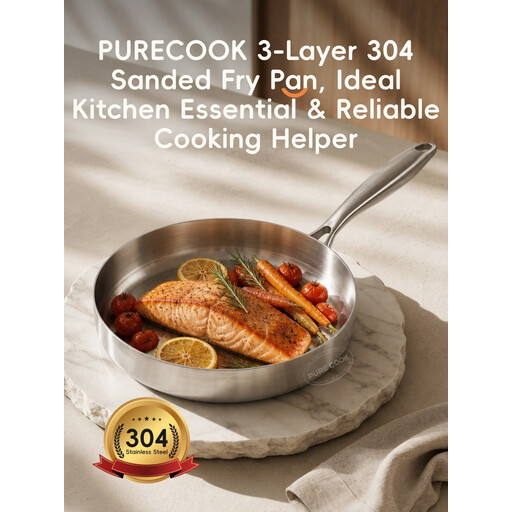
Why this fits the profile: The compact size is easy to manage for beginners and suitable for smaller portions. According to the product information, the pan works on gas, induction and other common hobs.
The three-layer construction is clearly stated, so you don't have to rely on the term stainless steel alone. The finished rim can make cleaning easier.
20 cm diameter, 304 tri-ply stainless steel and suitable for induction and gas according to the product information.

Why this fits the profile: This spacious stainless steel frying pan is aimed at families and home cooks who want to combine frying, stir-frying and simmering in one pan.
The product information mentions an aluminium core between stainless steel layers, a lid and compatibility with all hobs. Check the stated oven temperature before using the pan.
28 cm, 304 tri-ply construction, glass lid and dishwasher safety according to the product description.
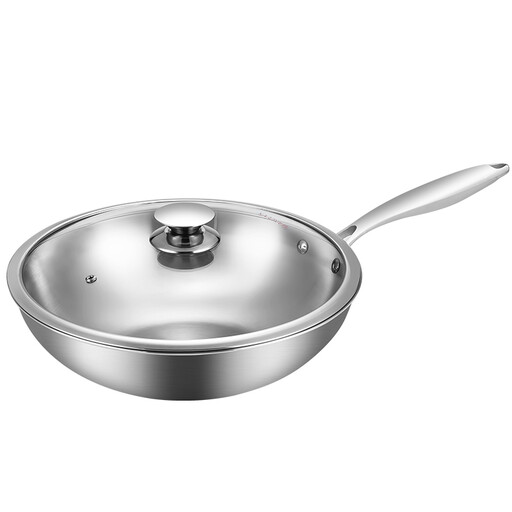
Why this fits the profile: The wok is designed for stir-frying, searing and everyday meals where you need to toss ingredients quickly.
According to the product information, this wok is coating-free and suitable for induction, gas, electric and ceramic hobs. Hand washing is recommended, so be aware of the extra care needed.
28 cm, tri-ply 304 stainless steel, glass lid and dishwasher safety according to the product information.
A pan set makes sense if you need multiple cooking sizes and have enough cupboard space. According to the product information, the PURECOOK 5-piece set includes a frying pan, shallow pan, deep pan and steamer insert. The pieces are stackable and suitable for gas, induction and ceramic hobs.
An alternative is the Tefal Duetto set with various saucepans, a soup pot, milk pan and frying pan. The set has glass lids, size markings and a sandwich base. Note: the product information states that this set is not dishwasher safe. If you're mainly looking for one good stainless steel frying pan or wok, buying a set might mean paying for items you rarely use.
We've put together a full, up-to-date list of products that fully meet these strict selection criteria and comply with current European safety regulations.
Many models are suitable for induction, but always check this in the product specifications. A magnetic outer layer or flat sandwich base is usually required. Also check whether the base diameter fits your induction zone.
First preheat the pan gradually, then add oil and only place the food in the pan when the oil is hot enough. Use a medium heat and let meat or fish sear before turning it. A coating-free pan requires more precise timing than a non-stick pan.
The lifespan depends on material thickness, construction, use and care. A tri-ply pan can last a long time with normal use, but handles, lids and any coatings may wear out sooner. Follow the cleaning instructions, avoid thermal shock and don't heat an empty pan unnecessarily high.
