
Vandaag of morgen in huis

Kwaliteit gegarandeerd

Welkomstaanbiedingen ontgrendelen: GRATIS bezorging | Tot 80% korting | Gratis 30 dagen JoyPlus-proefperiode
Download de app
Loose packaging, half-empty bags and containers without matching lids can quickly make your fridge look untidy. Good food storage containers are useful for keeping leftovers, meal prep and food supplies fresh, but not every model suits every kitchen. For example, an appealing term such as “airtight” means little if the lid is difficult to close or the container does not fit in your fridge.
This buying guide helps you compare food containers by size, material, closure, stackability and ease of use. That way, you avoid paying for features you will not use.
Fridge organisers and fridge storage boxes are often bought based on a photograph. In practice, a difference of just a few centimetres can mean that a box will not fit between the shelves. So pay attention to:
For example, a set with three containers measuring 30,5 x 21 x 9 cm is suitable for wide fridge shelves, but not automatically for narrow door compartments.
A click-lock lid may close securely without being suitable for liquids or transport. Check whether the product description explicitly mentions an airtight or leak-proof seal. Also look at the closing mechanism: a silicone sealing ring, clips or a snap-on lid that seals all the way around.
For products with an airtight seal, this refers to a product specification or brand description. According to Curver’s product information, the Fresh & Go containers have snap-on lids that create an airtight seal. This does not guarantee that food will stay fresh indefinitely; storage time also depends on the food, temperature and hygienic use.
Not all plastic storage boxes can be used in the microwave, and not every fridge storage box is dishwasher-safe. Always check the instructions. With microwave-safe storage containers, the lid usually needs to be removed to prevent pressure from building up. A container suitable for the freezer is not automatically suitable for heating.
Look out for conflicting information. For example, the product description for the PURECOOK glass storage jars states that the glass jars are not dishwasher-safe, while dishwasher cleaning is mentioned elsewhere. In such cases, the specific instructions for use take precedence.
The right capacity depends on how you plan to use the container:
A set with several sizes is practical when you want to store both small ingredients and complete meals. As well as the capacity, check the external dimensions, as thick rims and lids affect the space available.
Plastic storage boxes are lightweight and often affordable. Ideally, choose models that explicitly state that they are made from BPA-free material and are suitable for food use. According to the product description, the Curver Fresh & Go range is made from BPA-free plastic and is suitable for temperatures from -40 °C to +100 °C. The stated temperature range does not mean that every use is possible without restrictions: follow the warnings regarding microwaves, ovens and hot, high-fat foods.
Glass food storage containers do not absorb odours and make it easy to see the contents. Borosilicate glass is a commonly used material for heat-resistant storage containers, but glass is still breakable. Avoid sudden changes from cold to very hot temperatures to reduce the risk of thermal shock.
Stainless steel food containers are sturdy and suitable for the fridge, freezer and transport. They are not intended for direct use in a microwave. With the PURECOOK set, the container is made from 304 stainless steel, with a PP lid and silicone sealing ring. According to the product information, the clips must be properly closed, and the container must not be used in a microwave or over an open flame.
Stackable storage containers save space when they are filled. Nestable models take up less room when empty. A fridge organiser with a handle is useful when you want to remove a whole group of products from the fridge at once.
Also check the care instructions. Some containers can go in the dishwasher, while others must only be washed by hand. Removable silicone rings are practical, but they must be placed back in the groove correctly to maintain the seal.
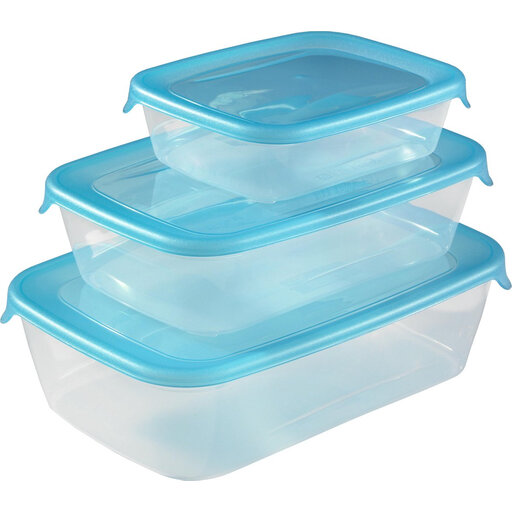
Why this suits the profile: Three different sizes give beginners a simple foundation for leftovers, lunch and small quantities of food.
The capacity and number of pieces are clearly specified. According to the product description, the containers can be nested and stacked, so you need fewer separate sizes.
Set of three sizes; according to the product specification, suitable for the freezer, microwave and dishwasher. Remove the lid before microwave use.
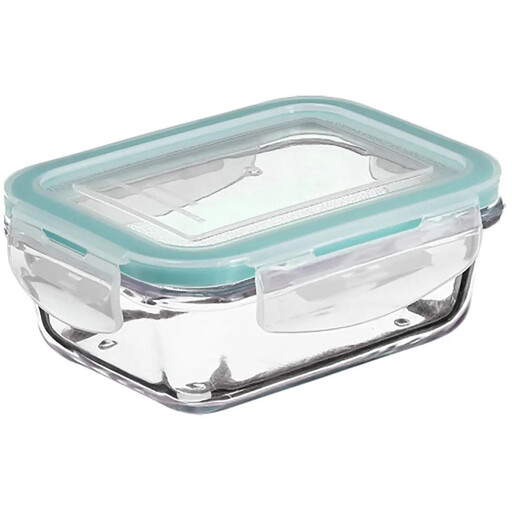
Why this suits the profile: This glass container is designed for larger portions, leftovers and meals prepared in advance.
The dimensions of 23 x 17 x 9 cm and the capacity of 1,73 litres make it easy to check the fit in advance. It is not a small container that unexpectedly offers too little space.
Borosilicate glass; according to the product information, suitable for the fridge, freezer, microwave without the lid and dishwasher.
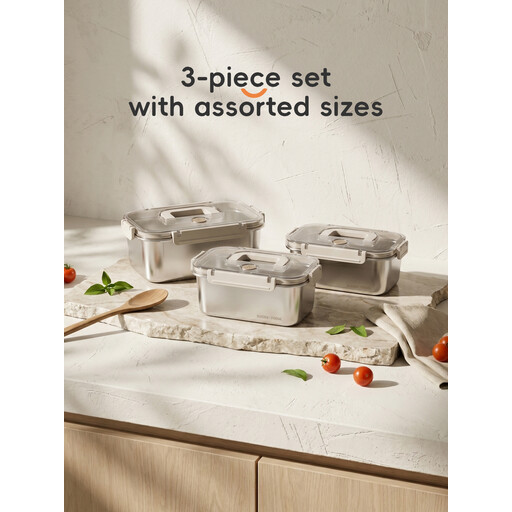
Why this suits the profile: The three large sizes of 1,7, 2,1 and 3,2 litres are suitable for families, bulk meals, picnics and intensive meal prep.
The material and three separate capacities are clearly specified. The container is not intended for microwave use, so you can take this limitation into account in advance.
304 stainless steel container; stackable design; PP lids with silicone sealing ring and dishwasher information in the product description.
For fridge organisation alone, open boxes are often more suitable than storage containers with lids. The 5five Smart Fridge Storage Bins Set contains three transparent PET boxes measuring 30,5 x 21 x 9 cm, each with a handle. According to the product information, they are not stackable, but can be placed next to one another and are dishwasher-safe. This makes them particularly suitable for vegetables, fruit, jars or loose packaging.
We have put together a complete, up-to-date list of products that fully meet these strict selection criteria and the applicable European safety regulations.
For meal prep, containers of 0,5 to 1,2 litres are often practical for individual portions. Choose models that, according to the product information, are suitable for the freezer, microwave and dishwasher. Always check whether the lid needs to be removed before heating.
Their lifespan depends on the material, cleaning and use. Replace a container if it is cracked, misshapen or heavily discoloured, or if a sealing ring no longer fits properly. With plastic storage boxes, frequent intensive microwave use may leave marks sooner than storing food in the fridge.
Plastic is generally lighter and convenient for transport. Glass is heavier, but according to product specifications it is less likely to absorb odours and can be used in the microwave when the model is suitable. So do not compare only the purchase price; also consider the number of sizes, cleaning requirements and the features you actually need.
