
Vandaag of morgen in huis

Kwaliteit gegarandeerd

Welkomstaanbiedingen ontgrendelen: GRATIS bezorging | Tot 80% korting | Gratis 30 dagen JoyPlus-proefperiode
Download de app
Glass storage containers are handy for leftovers, meal prep, herbs and dry ingredients. However, a purchase can sometimes disappoint in practice. A container may be too big for the fridge, a lid can be difficult to clean, or a set might turn out to consist mainly of one size. If you pay attention to a few key features beforehand, you can avoid a bad buy.
The term airtight sounds appealing, but check how the seal actually works. A loose lid without a silicone ring seals differently from a lid with snap closures or a storage jar with clamps. For flour, rice, nuts and herbs, a well-fitting ring and a sturdy closure are practically important.
Also note the difference between airtight and leak-proof. A product description may state that a container is suitable for liquids, but always check the specifications and user instructions for that. A storage jar for dry ingredients is not automatically suitable for taking in a bag.
Borosilicate glass is known for its practical properties with temperature changes. That does not mean every container can go straight from the freezer to a hot oven without preparation. Sudden temperature differences can cause glass to crack.
Therefore, check per product whether it is suitable for:
When using the microwave, the lid usually needs to be removed or opened. Always follow the product instructions. Even with high borosilicate glass, the permitted use can vary by manufacturer.
A set of glass containers may seem good value when it contains many pieces, but a household often mainly uses a few sizes. Small containers are suitable for sauces, herbs and snacks. Medium-sized models work well for lunch, fruit and leftovers. Large boxes are more practical for pasta, oven dishes or a meal for several people.
Look beyond the number of pieces at the capacity in millilitres, the shape and the dimensions. Rectangular glass food containers are often efficient to stack. Round storage jars, on the other hand, are practical for spoons, scoops and ingredients that need to be taken out of a wide opening.
A glass container generally absorbs fewer odours and colour stains than some plastic varieties. However, check separately what the lid, locking clips and sealing ring are made of. Many combinations consist of:
A silicone ring is practical when it is removable. This way, food residue can be cleaned from under the ring. With clips, it is wise to check that they close firmly and do not get in the way when stacking.
If cupboard space is limited, first measure the shelf depth and fridge drawer. Pay attention to the external dimensions, not just the capacity. A 1-litre container can still take up a lot of space depending on its shape.
For kitchen organisation, a fixed layout works well:
Transparent glass makes the contents visible. That helps when restocking, but labels with product name and best-before date remain useful.
Wash new containers with warm water and washing-up liquid before first use. Check whether the manufacturer allows dishwasher use. Sometimes this only applies to the glass part, and the lid, clips or silicone ring need to be cleaned by hand.
Do not reuse damaged containers. Small cracks can become larger due to temperature changes. Do not pour boiling water into a cold glass container and do not place glass directly on an open flame. These precautions apply to all glass storage containers, even those made from borosilicate glass.
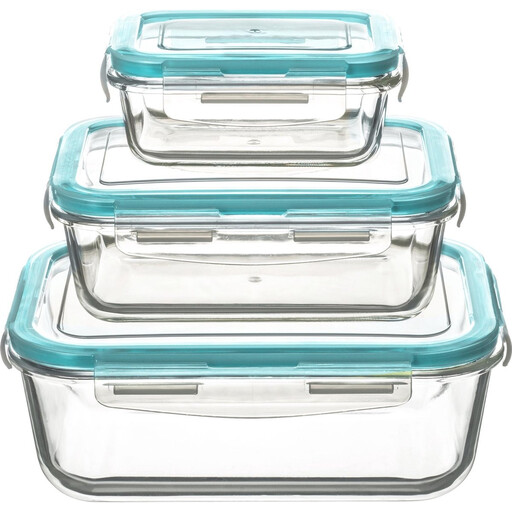
Why this fits the profile: A compact set of three rectangular containers is manageable for beginners who want to store leftovers, lunch and snacks without buying a large collection straight away.
The description explicitly states that the containers are dishwasher, microwave and freezer safe. When using the microwave, the lids or clips must be removed or loosened.
Borosilicate glass, transparent design and a capacity of 1.73 litres according to the product information.

Why this fits the profile: This set suits households that need different sizes for the fridge, lunch and meal prep, and value locking lids.
The rectangular shape and locking lids make the contents and storage method clearer than with a set that only has loose lids.
Set of eight borosilicate glass containers with locking lids; suitable for structured storage and meal prep organisation.

Why this fits the profile: The combination of five containers of 1,040 ml and five containers of 370 ml suits families, office lunches and meal prep with fixed portions.
The two fixed capacities reduce the chance of a set that mainly consists of unused sizes. The snap-lock closure is designed for regular opening and closing.
Ten pieces, high borosilicate glass construction and clearly separated sizes for meals and snacks.
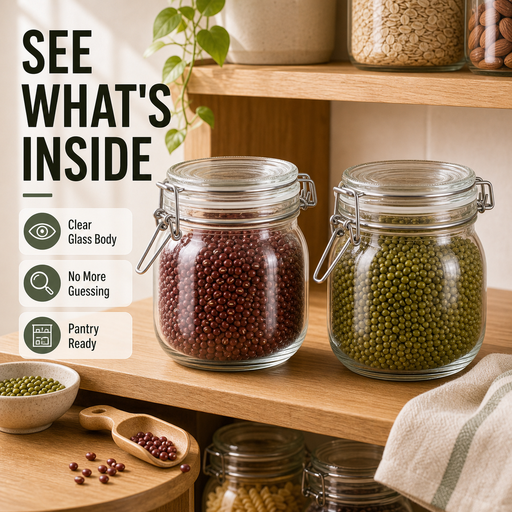
Why this fits the profile: This set of two 700 ml jars is aimed at herbs, grains, nuts, snacks and other dry ingredients in the pantry.
The product description mentions a removable silicone ring and clip closure. The description advises handling the glass jar with care and only using it in the microwave or oven when this is expressly stated.
High borosilicate glass, silicone sealing ring, stainless steel clips and a transparent capacity of 700 ml per jar.
We have compiled a full, up-to-date list of products that fully meet these strict selection criteria and comply with current European safety regulations.
That varies by model. Check whether microwave use is explicitly stated in the product information. Remove or open the lid when the instructions require it and avoid large temperature differences. Placing a container straight from the freezer into a hot environment can damage the glass.
The lifespan mainly depends on breakage, scratches, lids and sealing rings. Glass does not absorb odours like some materials, but it can break from dropping or thermal shock. Replace a container if it has cracks and check over time whether the silicone ring still seals properly.
The purchase price of a set of glass containers can be higher than that of simple plastic containers. However, this is offset by reusability and dishwasher-safe options, when the manufacturer states this. The actual cost depends on the purchase price, replacement of lids or rings and how often the containers are used. Therefore, look at capacity, care and suitability for your kitchen rather than just the number of pieces.
