
Vandaag of morgen in huis

Kwaliteit gegarandeerd

Welkomstaanbiedingen ontgrendelen: GRATIS bezorging | Tot 80% korting | Gratis 30 dagen JoyPlus-proefperiode
Download de app
Storing leftovers, dry ingredients and meal-prepped meals seems straightforward. Yet many consumers only encounter problems after purchase: a lid that does not close properly, containers that do not stack neatly or glass that turns out to be unsuitable for the microwave. With this guide to glass food storage containers, you can see which specifications matter and which type suits your household, student room, office or meal-prep routine.
The term airtight means little on its own. Check whether the product information specifies a snap-on lid, silicone sealing ring or locking clips. A loose-fitting lid may be sufficient for dry pasta in a kitchen cupboard, but it is less practical for soup in a full cooler bag.
Also pay attention to the difference between a storage jar and a food container. Airtight storage jars with a round opening are useful for rice, oatmeal and spices. Rectangular glass food storage containers generally make better use of space in the refrigerator and freezer.
Borosilicate glass is known for offering better resistance to temperature changes, but shatter-resistant does not mean unbreakable. Do not place a cold container directly on a hot oven tray or pour boiling water into cold glass.
Always check separately whether the container is suitable for the microwave, oven, freezer and dishwasher. A lid may have different limitations from the glass dish. With many glass meal-prep containers, for example, the lid must be removed before heating the food.
A set with a high total capacity is not automatically practical. Large containers take up more space and are less suitable for small portions. Consider:
A leakproof lunch box must also close securely and be comfortable to carry. For dry ingredients, a tall storage jar may be the more convenient choice.
Borosilicate glass containers are often associated in product descriptions with greater resistance to heat and cold than standard glass. This can be useful when freezing meals and reheating them later. Exact temperature limits vary by product.
The Alpina Glass Food Container Set - 9 Units, for example, specifies borosilicate glass, a temperature range of -40 to 300 degrees and use in the freezer, microwave and dishwasher. The description also states that the set is not suitable for oven use. Always check the product specifications rather than relying solely on the material name.
For leftovers, sauces and meal prep, glass storage containers with lids and a reliable closing mechanism are practical. Silicone rings can absorb odors and grease if they are not cleaned properly. A removable ring is therefore a useful feature.
Pay attention to the care instructions. On some models, the glass is dishwasher-safe, while the lid or metal closure is best washed by hand. After cleaning, check that the ring is lying flat in the groove before closing the lid.
For everyday use, a combination of small and medium food storage containers can be more efficient than using only one-litre containers. For example:
Transparent models make the contents easy to see. This helps when organising your pantry, but labels showing the date and contents remain useful for opened products.
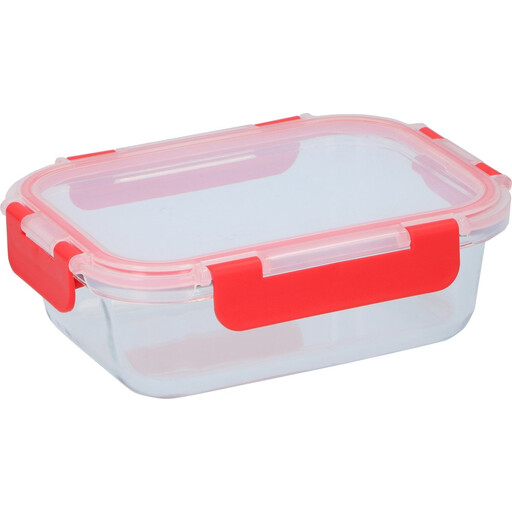
Why it fits: A compact size for students, small households and office lunches. According to the product description, the container is BPA-free, stackable and equipped with a snap-on lid.
The 620 ml capacity prevents you from using an unnecessarily large container for a small portion. The dimensions are 18.2 x 13.5 x 6 cm.
Borosilicate glass; according to the product information, suitable for the freezer, microwave and oven. The lid must be removed.
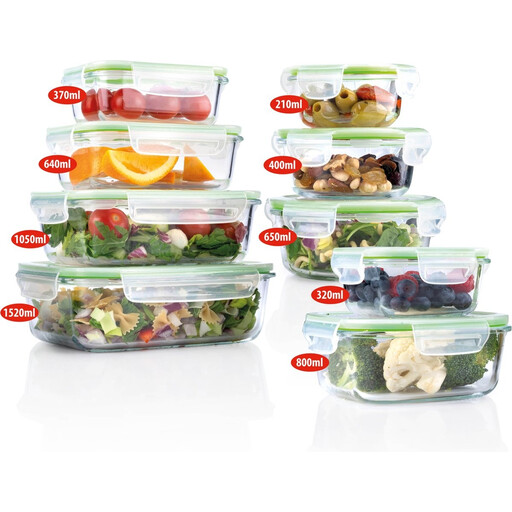
Why it fits: The set is designed for a variety of meals and snacks. The product description lists 18 pieces and nine sizes, including options for salads, pasta, soup and nuts.
The range of sizes reduces the likelihood of storing small portions in containers that are too large. According to the specifications, the set is stackable.
According to the product information, the containers are airtight, leakproof and suitable for the dishwasher, microwave and freezer. The stated total capacity of the set is 6 litres.
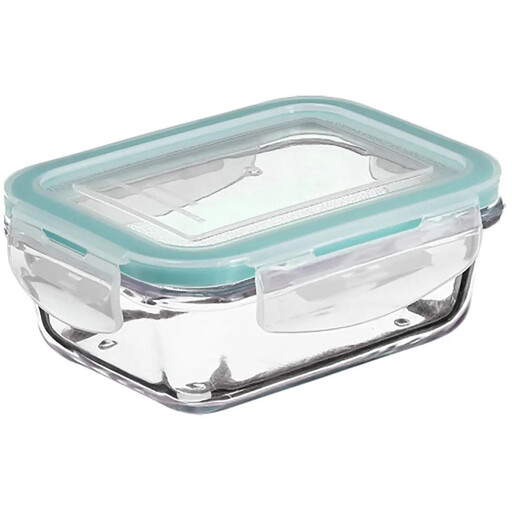
Why it fits: The rectangular 23 x 17 x 9 cm format provides space for larger leftovers, a meal for several people or a packed lunch for the journey.
The dimensions are clearly stated in advance, so you can check whether the container will fit in your refrigerator or bag. It is a single container, not a set with undisclosed sizes.
According to the product description, the container has an airtight lid with leakproof clips and is suitable for the refrigerator, freezer, microwave without the lid and dishwasher.
Wash glass food storage containers with warm water and dish soap before first use. Check silicone rings for food residue and allow all components to dry completely before sealing them. For hot dishes, it is best to leave the lid off initially until the food has cooled sufficiently.
Only use a container in the oven or microwave when this is explicitly stated in the product information. Never place metal clips or a metal lid in the microwave. A crack, sharp edge or deformed sealing ring is a reason to stop using the component.
Browse our current selection of glass storage containers and compare capacity, closure, material and care requirements for each product.
This varies by model. Check whether the manufacturer specifies freezer use and leave room for liquids to expand. Avoid sudden temperature changes to reduce the risk of thermal shock.
With normal use, the glass can last for many years, but lids, clips and silicone rings generally wear out sooner. Clean these components according to the instructions and replace a damaged ring or closure whenever possible.
The purchase price may be higher, while glass does not absorb odors or colors in the way some plastics can. Overall value depends on service life, maintenance and whether replacement lids or rings are available. Therefore, do not look only at the set price; also consider the material, warranty and replaceability of individual components.
