
Vandaag of morgen in huis

Kwaliteit gegarandeerd

Welkomstaanbiedingen ontgrendelen: GRATIS bezorging | Tot 80% korting | Gratis 30 dagen JoyPlus-proefperiode
Download de app
Leftovers, lunches, chopped vegetables and meal prep are easier to keep organised with good food storage containers with lids. However, not every set is right for every use. A container that works perfectly well for dry snacks may be awkward for soup or a full freezer.
Product descriptions also regularly use terms such as “airtight”, “leakproof” or “suitable for every situation”. Always check the specific details. For example, a lid may seal well for use in the fridge but be less suitable for carrying in a full bag.
A container may be suitable for the microwave, but the lid might need to be removed or loosened first. Pressure can build up inside sealed containers. Take extra care with metal containers: for example, the Maxcook set made from 316L stainless steel explicitly states that it must not be used in the microwave.
So don’t just look for “microwave-safe”. Also check:
A set with lots of containers may seem appealing, but large food storage containers take up space if you mainly store small portions. Sizes of around 350 to 800 ml are often more practical for lunches, snacks and leftovers. Containers of 1 to 2 litres are more useful for meal portions or family leftovers.
As well as capacity, check the external dimensions. A 1-litre container with a wide shape may fit less efficiently in a fridge drawer than a taller, narrower model.
A silicone ring, snap-lock lid or locking clips can help seal the contents. That doesn’t mean you can safely carry every container on its side in a bag full of soup. For liquid food, some product descriptions recommend keeping the container upright.
So check:
Glass food storage containers made from borosilicate glass are transparent and are often used in the fridge, freezer and microwave. However, they are heavier than plastic. Avoid sudden temperature changes with glass and always check the manufacturer’s warnings.
Plastic food storage containers are lightweight and practical for lunchboxes, meal prep and carrying food. Check the stated temperature limits and whether the material is suitable for food contact. A BPA-free label is useful, but it doesn’t automatically mean every part is microwave- or dishwasher-safe.
Stainless steel food storage containers are sturdy and suitable for the fridge and freezer when this is stated in the product information. They are not automatically suitable for the microwave. With some sets, only the metal container is dishwasher-safe, while the lid must be washed by hand.
Choose the capacity to suit how you’ll use the containers:
Rectangular models often make efficient use of space in the fridge and freezer. Round containers can be handy for sauces or loose ingredients. Check whether the containers are stackable and whether empty ones fit inside each other.
A well-fitting lid matters more than a striking design. Look for snap-lock closures, locking clips and a sealing ring. Also check whether all the parts are dishwasher-safe. With some sets, this applies only to the container, not the lids.
For hygienic use:
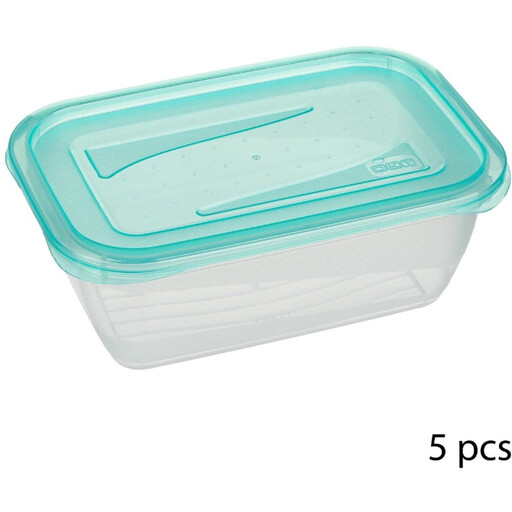
Why it suits this type of shopper: This set of five 0.5-litre containers is ideal for small portions, snacks, leftovers and simple meal prep. The transparent design makes it easy to see what’s inside.
The capacity is clearly stated, so you won’t end up buying a large set for small portions. According to the product information, the containers are suitable for the freezer, microwave and dishwasher; remove the lid before heating.
Five matching 0.5-litre containers, transparent PE material and a compact size of approximately 15 x 10 x 5,2 cm.
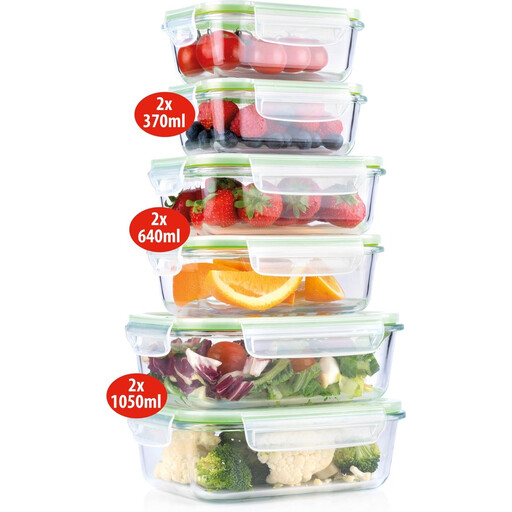
Why it suits this type of shopper: If you want containers for a range of portions and uses, this glass set offers several sizes for leftovers, lunches and meal prep.
The set includes three sizes: 370, 640 and 1.050 ml. According to the product description, the containers are suitable for the dishwasher, microwave and freezer; check the instructions on temperature changes.
Borosilicate glass, snap-lock lids, three sizes and a seal described in the product information as airtight and leakproof.

Why it suits this type of shopper: The three sizes, 600, 1.100 and 2.200 ml, are ideal for portions, leftovers and storing food for several people.
The microwave restriction is clearly stated. The product information also says that only the stainless steel container is dishwasher-safe; the PP lids must be washed by hand.
316L stainless steel, three generous capacities, locking clips and a silicone sealing ring; suitable for the fridge and freezer according to the product information.
We’ve put together a complete, up-to-date list of products that meet these strict selection criteria and the relevant European safety regulations.
It depends on the type of glass and the manufacturer’s instructions. Some product descriptions state that borosilicate glass is suitable for freezer use. Don’t move the container straight from a very cold environment into a hot oven or onto a hot surface. Also check that there’s enough room for the contents to expand.
Don’t fill the container right to the top. Check that the silicone ring is fitted correctly, then close all the clips or edges evenly. If you’re storing liquid food, keep the container upright if possible, especially when carrying it. Always read a leakproof claim alongside the specific instructions for use.
Lifespan depends on the material, use and care. Glass and stainless steel are generally less prone to discolouration and odour transfer than some plastics, but they can break or dent. Replace a container or lid if it cracks or warps, the sealing ring is permanently damaged, or the closure no longer fits properly.
