
Vandaag of morgen in huis

Kwaliteit gegarandeerd

Welkomstaanbiedingen ontgrendelen: GRATIS bezorging | Tot 80% korting | Gratis 30 dagen JoyPlus-proefperiode
Download de app
A ceramic frying pan may seem easy to choose at first. But small differences in the coating, base, handle and care instructions can have a big impact on everyday use. For example, a pan that’s suitable for induction isn’t necessarily oven-safe. And a dishwasher-safe pan can still wear out more quickly if you often use it at high temperatures.
For households in the Netherlands, these three pitfalls are particularly important:
A ceramic coating is usually applied to an aluminium or metal base. Aluminium heats up quickly, while a multi-layer base can distribute heat more evenly. Don’t just look for words such as “healthy” or “natural”; check for verifiable information:
According to Redchef’s product information, several of its ceramic models are free from PFAS, PTFE, PFOA, lead and cadmium. This is a manufacturer’s claim, so treat it as product information and, if in doubt, check the packaging, instructions and conformity information. A “frying pan without harmful substances” is not an official, universal product category.
A stainless steel frying pan usually doesn’t have a ceramic non-stick coating. Stainless steel is durable and suitable for metal utensils, but you’ll need to manage the temperature and cooking fat more carefully to prevent food from sticking.
Check that the pan is suitable for your hob:
A model may work on several types of hob, but that doesn’t tell you whether it’s oven-safe. According to its product description, the Brabantia Dusk is suitable for induction, gas, electric, ceramic and halogen hobs, and can be used in the oven up to 200 °C. Redchef models are listed with a higher maximum oven temperature, but removable handles come with additional safety conditions.
A diameter of 20 cm is practical for one or two portions. A 24 cm pan is usually suitable for a smaller household or for cooking for up to around three people. A 28 cm pan offers more cooking space, but you’ll also need a suitably sized cooking zone and enough storage space.
A dishwasher-safe frying pan is convenient, but hand-washing it with a soft sponge can help keep the coating in good condition for longer. Also remember to:
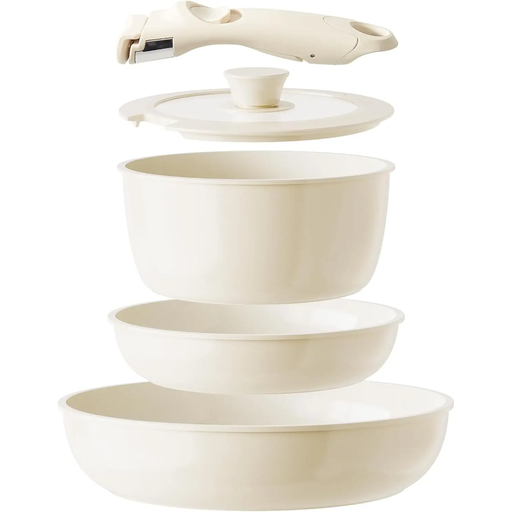
Why it suits this user: This set includes a lidded saucepan, two frying pans and a removable handle. It’s a practical starter set for a small kitchen, student room or campervan.
The product information states that the material is free from PTFE, PFOA and PFAS, and that it’s compatible with gas, electric and induction hobs. Use the handle only as directed in the instructions provided.
A compact, stackable design, dishwasher-safe according to the product information, and two pan sizes for everyday cooking.

Why it suits this user: A single 24 cm ceramic frying pan for anyone who prefers to buy just what they need and values solid construction and a clearly stated temperature limit.
The product description lists a PFAS-free ceramic coating, compatibility with all common hob types and an oven limit of 200 °C. Hand-washing is recommended to protect the coating.
24 cm size, aluminium with recycled material according to the product information, and a riveted stainless steel handle.

Why it suits this user: The three-layer stainless steel–aluminium–stainless steel construction is designed to distribute heat evenly and stand up to intensive everyday use, including frying, searing and simmering.
No ceramic non-stick coating is specified here. This avoids confusion about coating care, but you’ll need to manage the temperature carefully to prevent food from sticking.
304 stainless steel, an aluminium core, compatibility with induction and other common hob types, and dishwasher-safe according to the description.
We’ve put together a complete, up-to-date list of products that meet these strict selection criteria and current European safety regulations.
It depends on the model. Ceramic coating alone doesn’t automatically make a pan suitable for induction. The base needs to be magnetically conductive. Look for “induction-compatible” in the product specifications and check that the base diameter matches your cooking zone.
Its lifespan depends on how you use and care for it, and the temperatures it’s exposed to. Don’t use metal utensils, heat the pan while empty or expose it to sudden temperature changes. Even if a pan is dishwasher-safe, hand-washing it with a soft sponge can put less strain on the coating.
No. “PFAS-free” is a claim about the coating material, while “ceramic frying pan” refers to the type of coating. Always check the full product information. A brand may describe its coating as free from PFAS, PTFE and PFOA based on its own testing or claims, but this shouldn’t be mistaken for a general guarantee that applies to every ceramic product.
