
Vandaag of morgen in huis

Kwaliteit gegarandeerd

Welkomstaanbiedingen ontgrendelen: GRATIS bezorging | Tot 80% korting | Gratis 30 dagen JoyPlus-proefperiode
Download de app
A ceramic frying pan for induction may seem straightforward to choose on paper. However, there are important differences in the coating, heat source compatibility, maintenance and size. For example, a pan may have a smooth non-stick coating but not be suitable for induction. “Ceramic” also does not automatically mean that the pan is made from solid ceramic: in most cases, it is a metal pan with a ceramic coating.
For UK households, three pitfalls are particularly relevant:
For induction, a flat base containing magnetic material is essential. Check whether the product page explicitly states suitable for induction, and whether gas, ceramic, electric or halogen hobs are also mentioned. A frying pan for all hobs is practical if you move house or use several types of cooker.
Also pay attention to the diameter of the base. A 28 cm pan may have a smaller induction zone than the top rim suggests. A suitably sized base generally provides better contact with the cooking zone and prevents the pan from heating unnecessarily slowly.
According to the product information, a PFAS-free frying pan contains no substances from the PFAS group. PFOA-free and PTFE-free are more specific descriptions and do not automatically mean the same as PFAS-free. Therefore, check which terms are actually included in the product specification.
With a titanium ceramic coating, titanium is generally incorporated into or combined with a ceramic layer. This does not mean that the pan is made entirely from titanium. Claims such as “extra scratch-resistant” or “longer-lasting” should be understood as information provided by the brand. Ideally, use wooden, silicone or plastic utensils, even when the coating is described as highly durable.
A 20 to 24 cm pan is handy for one or two portions, eggs and pancakes. For a family, 26 to 28 cm and a higher rim are more practical. A ceramic sauté pan with a lid is suitable for sauces, stir-fries and one-pan meals.
Before buying, also check:
A ceramic coating generally remains usable for longer at low to medium temperatures. Do not heat an empty pan over high heat for a prolonged period, and allow the pan to cool before washing it.
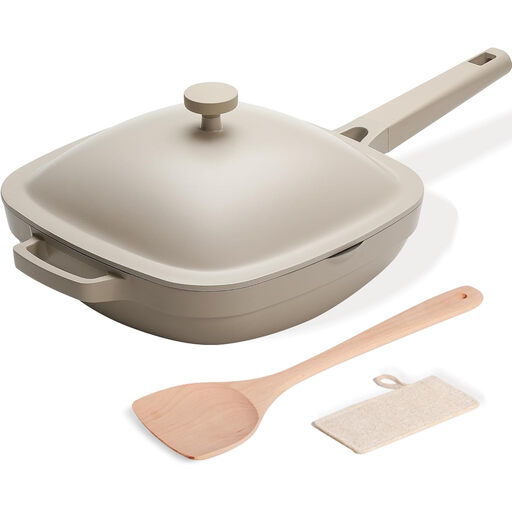
Why it suits this profile: The deep 3.8-quart pan provides room for stir-fries, casseroles and meal prep without having to buy a complete cookware set straight away.
The specification states compatibility with all hobs, including induction, and mentions a PFAS-free ceramic coating. The pan is not dishwasher-safe or oven-safe, which helps prevent incorrect expectations.
Includes a lid, wooden spatula and scrubber; the two pouring spouts are practical for sauces and gravy.
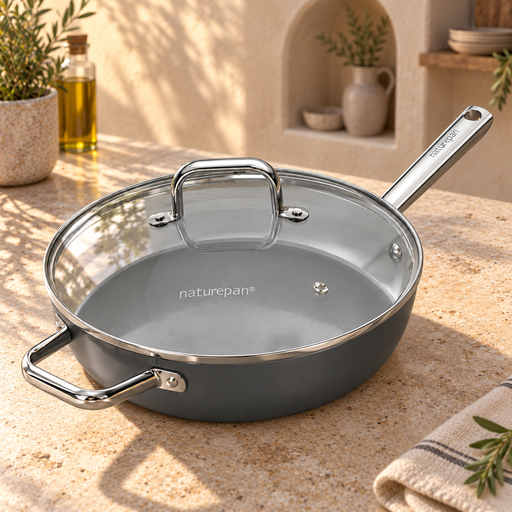
Why it suits this profile: The high rim and lid make this pan suitable for families who want to fry, stew and serve in one pan.
The product information states that the ceramic coating is free from PTFE, PFAS and PFOA, and that the pan is suitable for induction, gas, ceramic and electric cooking.
Dishwasher-safe and, according to the product specification, oven-safe up to 260 °C; a stainless-steel handle is included.
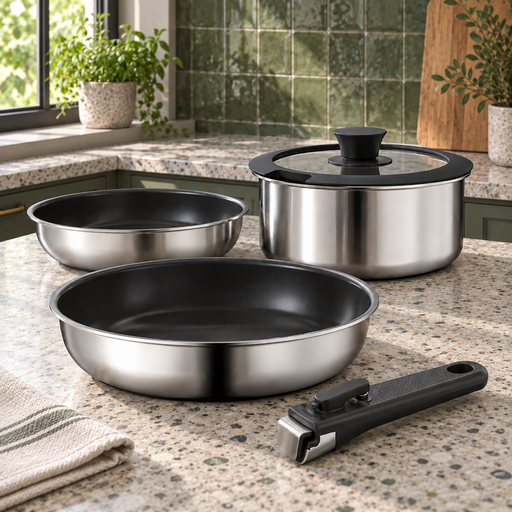
Why it suits this profile: This set is aimed at households with limited cupboard space, campervan users and anyone who needs several different sizes.
The set states that it is induction-compatible and has a removable handle and PFOA-free ceramic coating. However, check whether your preferred PFAS and PTFE specifications are mentioned separately.
Two frying pans, a saucepan, lid and handle; dishwasher-safe and suitable for ovens up to 250 °C according to the product information.
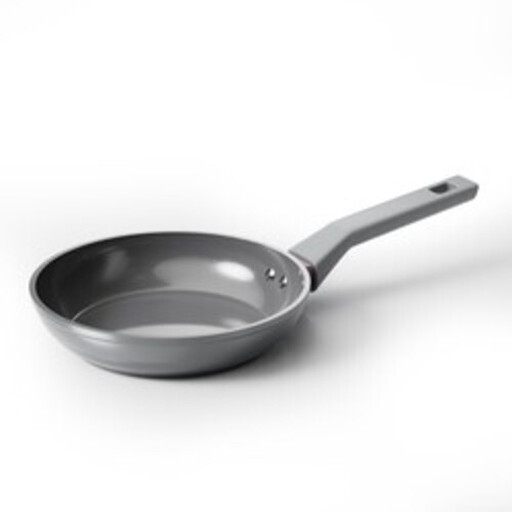
Why it suits this profile: The compact size is ideal for a one-person household, a small kitchen or preparing a single omelette or portion.
The specification states that the coating is PFAS-free and PFOA-free, and that the pan is suitable for induction, gas, electric and ceramic cooking. The pan is not suitable for use in an oven or microwave.
Compact size, dishwasher-safe according to the product page, and a multi-layer base for even heat distribution.
We have put together a complete, up-to-date list of products that fully meet these strict selection criteria and the applicable European safety regulations.
A durable frying pan is not determined by the coating alone; everyday use also makes a difference. Heat the pan gradually, generally choose low to medium heat and avoid heating it empty for extended periods. Do not use metal forks or spatulas. Allow the pan to cool naturally and clean it with a soft sponge and mild washing-up liquid.
A dishwasher can be convenient, but always check the product page. Some models are dishwasher-safe, while hand washing is recommended for others to help protect the coating. Stack pans carefully and, if necessary, place a soft protector between the surfaces.
No. Look specifically for “suitable for induction” or “suitable for all hobs”. A ceramic coating only describes the non-stick layer and does not automatically indicate that the base is suitable.
Lifespan varies depending on the coating, frequency of use, temperature and cleaning method. Manufacturer claims about scratch resistance or lifespan come from the brand. Low to medium heat and suitable utensils can help keep the coating usable for longer.
No. Check each product specification separately. Some models state that they are PFAS-free, PFOA-free and PTFE-free, while others mention only one or two of these terms. Use only information provided on the product page or in the manufacturer’s documentation.
