
Vandaag of morgen in huis

Kwaliteit gegarandeerd

Welkomstaanbiedingen ontgrendelen: GRATIS bezorging | Tot 80% korting | Gratis 30 dagen JoyPlus-proefperiode
Download de app
Ceramic cookware is a good choice if you cook on an induction, gas or ceramic hob and want a smooth cooking surface without intentionally added PFAS. However, seeing “ceramic” on the packaging doesn’t tell you everything. It could refer to a ceramic non-stick coating, a ceramic exterior or a combination of materials.
The most common buying mistakes come down to three things:
Always check the product specifications, maximum oven temperature, cleaning instructions and the exact contents of a ceramic cookware set.
A ceramic non-stick coating is usually applied to a base made from aluminium, stainless steel or another metal. That’s different from a pan made entirely of ceramic. The base affects things such as how quickly the pan heats up and whether it’s suitable for induction.
When looking at PFAS-free pans, check for a specific product claim, such as PFAS-free, PTFE-free or PFOA-free. According to the relevant brands’ product information, these claims appear on various models. Don’t take a marketing term as proof that it applies to every part of the pan: check whether the claim relates to the inner coating, the whole pan or just a particular range.
A stainless steel pan without an inner coating, such as the PURECOOK Tri-Ply 304 pan, is not a traditional ceramic non-stick pan. According to the product description, it does have a ceramic coating on the outside, while the inside is made from polished 304 stainless steel.
Induction pans need a magnetic base. A flat, magnetically conductive base also ensures stable contact with the cooking zone. Don’t just look for “all hobs”; check specifically for compatibility with:
The Tefal Easy Cook & Clean, 32 cm, is an exception. According to the product information, it’s suitable for gas, electric and ceramic hobs, but not for induction. This makes it less suitable for households that might switch to an induction hob in future.
“Oven-safe pans” can vary considerably in their maximum temperature. A removable handle can be useful, but check whether it needs to be removed and whether the lid can go in the oven too.
“Dishwasher-safe pans” also need a little more thought. Some models can go in the dishwasher, but the manufacturer recommends washing by hand to help the ceramic coating last longer. For ceramic cookware, it’s best to use a soft sponge, mild washing-up liquid and wooden or silicone utensils. Avoid heating an empty pan, abrasive cleaners and sudden changes from hot to cold.
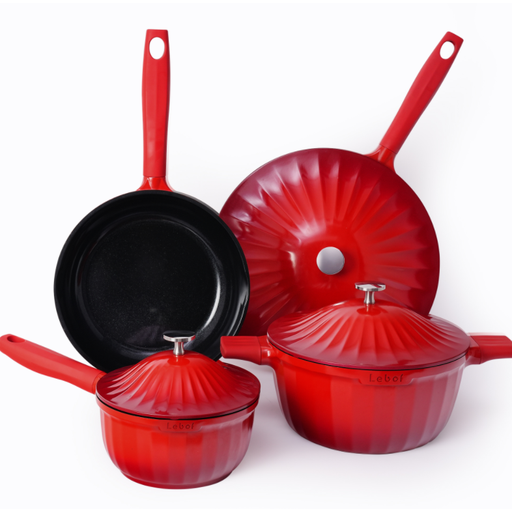
Why it suits this profile: The set includes two frying pans, two saucepans and a casserole with lids. It gives beginners the basics for everyday cooking in one purchase.
According to the product information, the set is suitable for all hob types, including induction, and is PFAS-, PFOA- and PTFE-free. The same information states that the set is not oven-safe, helping you avoid any mistaken expectations.
7 pieces, lids, cast aluminium and dishwasher-safe according to the product description. Use soft utensils to protect the coating.

Why it suits this profile: The 20 and 24 cm pans are practical for one to three people and complement each other for everyday frying.
The product information lists a PFAS-free ceramic coating, induction compatibility and oven use up to 200 °C. This makes the key limitations clear.
Made from 100% recycled forged aluminium according to the product description, with two sizes and dishwasher-safe construction. Hand washing is still recommended to help the pans last longer.
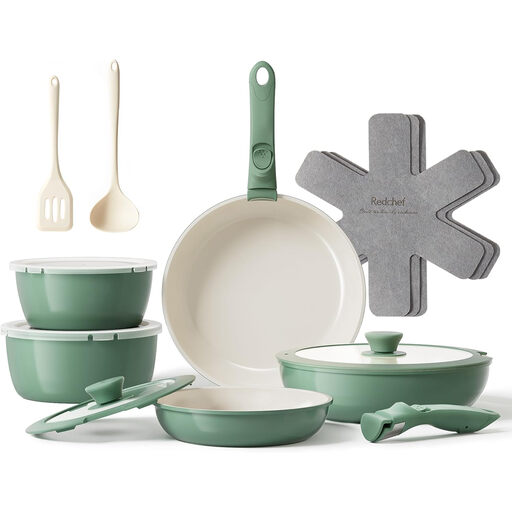
Why it suits this profile: Handy for small kitchens and campervans, or if you want to move pans straight from the hob to the oven, fridge or table.
According to the product information, the set is suitable for gas, electric, ceramic and induction hobs. Make sure the handle is securely attached before lifting, and keep it away from direct heat.
According to the manufacturer, the set is PFAS-, PTFE- and PFOA-free, stackable and dishwasher-safe once the handle has been removed. The product information lists a maximum oven temperature of 450 °C.
We’ve put together a complete, up-to-date list of products that meet these strict selection criteria and the applicable European safety regulations.
A 20 to 24 cm ceramic frying pan is usually a good fit for one to three people. For families or larger portions, a 26 to 32 cm pan is more practical. A 28 to 30 cm ceramic wok gives you plenty of room for stir-fries, noodles and vegetables, but check the diameter of the magnetic base if you have an induction hob.
A deep pan is more practical than a shallow frying pan for soups, pasta or stews. According to the product information, the 24 cm PURECOOK Tri-Ply 304 Stock Pot has a capacity of 5.64 qt, around 5.3 litres, and is designed for three to five people. However, its stainless steel interior has no non-stick coating. Choose this type if capacity, durability and easy maintenance matter more to you than ceramic frying.
It depends on the base. Ceramic itself isn’t magnetic. A pan will work on an induction hob if the manufacturer states that it has a magnetic or induction-compatible base. Always check each model, even when a range includes several different versions.
Their lifespan depends on how you use, heat and care for them. Don’t heat an empty pan for a long time, stick to low or medium heat for most cooking and avoid metal spatulas. Washing by hand with a soft sponge can help keep the coating in good condition for longer than frequent intensive dishwasher cycles.
Cooking costs depend mainly on your hob, cooking time and heat setting, not on the word “ceramic” on the packaging. A pan with a flat, well-fitting base can transfer heat efficiently. Choose a size that matches the cooking zone and avoid preheating for longer than necessary.
