
Vandaag of morgen in huis

Kwaliteit gegarandeerd

Welkomstaanbiedingen ontgrendelen: GRATIS bezorging | Tot 80% korting | Gratis 30 dagen JoyPlus-proefperiode
Download de app
A beautiful bowl in a product photo says little about everyday use. Does it hold enough soup? Can you safely put it in the microwave? Will there still be room in your kitchen cupboard? When choosing ceramic bowls and dinnerware, size, usage guidance and maintenance are especially important.
Many buyers focus only on colour and price. This can lead to three common purchase mistakes:
Use the points below to compare a ceramic dinnerware set or bowl set based on practical features rather than appearance alone.
The ideal size depends on what you usually serve:
Do not look at diameter alone. A high rim, curved interior and actual capacity determine how much food you can serve comfortably.
Ceramic, earthenware, stoneware and porcelain have different characteristics. Stoneware is often heavier and feels particularly sturdy. Porcelain is generally thinner and lighter. Terracotta has a more rustic appearance and may require different care instructions.
Check the following before buying:
According to the product description, the Dafuceramic dinnerware products are made from lead- and cadmium-free ceramic. This is a product statement from the brand and should not be extended to other models without comparable information.
A hand-painted rim or embossed pattern can be attractive, but may require more careful maintenance. Do not use an aggressive scouring pad if the product information advises against it.
Microwave-safe dinnerware is practical for leftovers and quick meals. Dishwasher-safe bowls save time in households with several people. However, a statement such as “oven-safe” does not automatically mean that every sudden temperature change is safe.
Keep these points in mind:
For everyday use, straightforward care instructions are often more valuable than a striking design label.
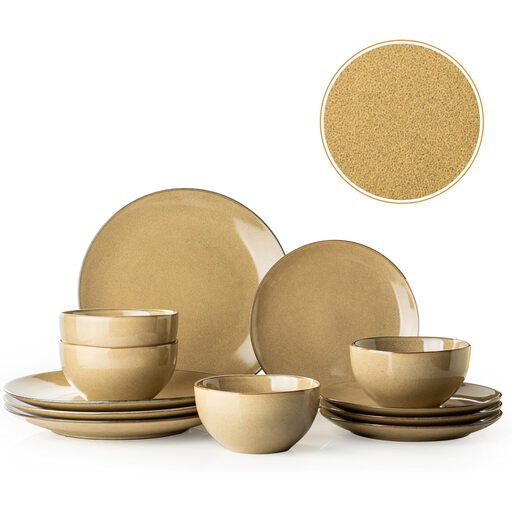
Why it is a good fit: A household looking for basic dinnerware for four people in one purchase gets dinner plates, salad plates and bowls in a single set.
The contents are clearly specified: 4 dinner plates measuring 10.5 inches, 4 salad plates measuring 8 inches and 4 bowls with a capacity of 23 oz. This makes the set easier to assess against your needs.
According to the product description, the pieces are suitable for microwave and dishwasher use. The design features a hand-painted rim in an earthy colour.
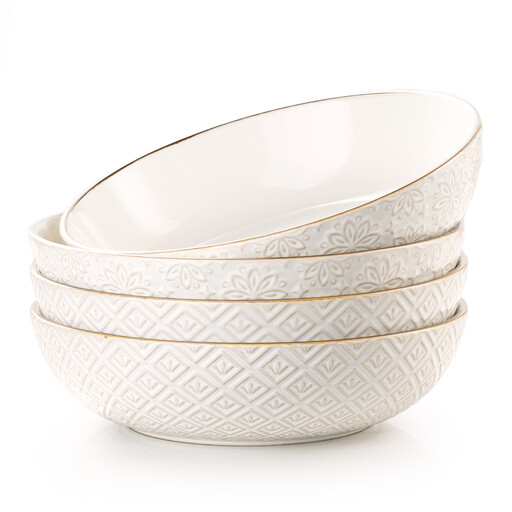
Why it is a good fit: The wide shape is suitable for pasta, salad, soup and main courses when presentation at the table matters.
Both diameter and height are specified: 8.5 inches in diameter and 2.4 inches high. The wide shape prevents you from buying a deep soup bowl when you mainly serve pasta.
According to the product description, the bowls are stackable and suitable for dishwasher, microwave and conventional oven use.
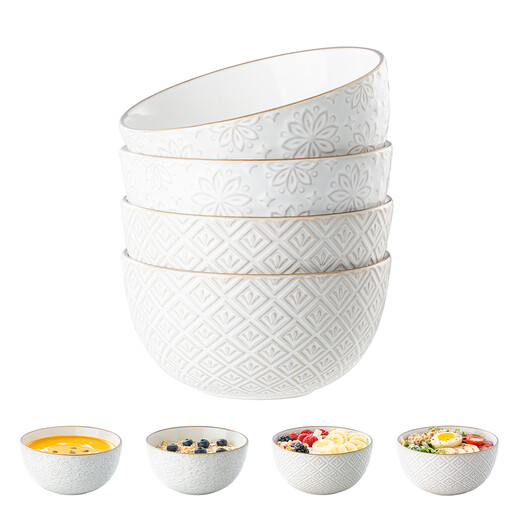
Why it is a good fit: These larger bowls are designed for families who regularly serve breakfast, soup, salad, fruit or noodles in the same dinnerware.
The 29 oz capacity per bowl is clearly stated. A stackable design is also specified, which is important for everyday use and limited cupboard space.
According to the product description, the bowls are suitable for microwave, oven, freezer and dishwasher use. The interior has a smooth glazed finish.
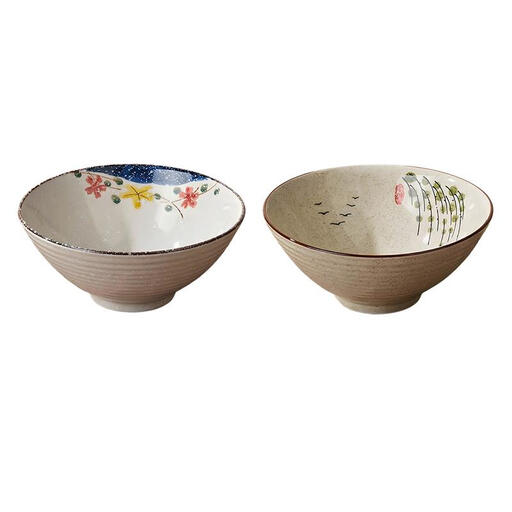
Why it is a good fit: With a capacity of 1,200 ml per bowl, this set is designed for generous portions of ramen, soup, pasta, salad or rice dishes.
The generous capacity is clearly stated, so you do not have to rely solely on the Japanese styling or decoration. The bowls are not intended for oven or hob use.
According to the product description, the bowls are suitable for microwave and dishwasher use. The set includes 2 bowls with an underglaze pattern.
For snacks, appetisers and table decoration, compact models are more practical than large pasta bowls:
Always check the specific product page for microwave and dishwasher information. Not every decorative bowl has the same usage classification.
Browse a current selection of bowls and compare size, material, colour and practical features for your household.
That depends on the product information and care requirements. A bowl that is dishwasher- and microwave-safe is practical for everyday use. Also check the size, weight and whether the bowl is stackable. Damaged glaze or cracks are reasons to stop using a bowl.
Compact bowls are often sufficient for breakfast. For soup, capacity is particularly important; models around 29 oz provide room for a generous portion. Pasta bowls are generally wider and shallower. If you regularly eat ramen or large noodle dishes, consider a model of approximately 1,200 ml, such as the YumiPLUS bowl.
Avoid sudden changes, such as placing a cold bowl directly into a hot oven or holding a hot bowl under cold water. Only use oven or microwave functions listed on the product page. Allow the dinnerware to stand for a short while after heating and handle it with suitable protection.
