
Vandaag of morgen in huis

Kwaliteit gegarandeerd

Welkomstaanbiedingen ontgrendelen: GRATIS bezorging | Tot 80% korting | Gratis 30 dagen JoyPlus-proefperiode
Download de app
A beautiful bowl or oven dish can still prove disappointing in practice. A dish may turn out to be too small for a family meal, a lid may not be microwave-safe, or a ceramic bowl may take up unnecessary cupboard space. When buying ceramic bowls and oven dishes, it therefore pays to look beyond colour and price.
Three common pitfalls are:
By checking the material, dimensions and care requirements carefully, you can avoid buying something that remains unused after just a few weeks.
Ceramic and porcelain are suitable for serving, baking and reheating when the manufacturer explicitly states this. Always check separately whether the product is suitable for:
Microwave-safe tableware is not automatically suitable for the oven. Also be aware of thermal shock: do not place a cold ceramic bowl straight into a hot oven, and do not put a hot dish on a very cold surface. Use oven gloves and follow the product instructions.
For products with lids, assess the materials separately. A ceramic dish may be oven-safe, while a plastic lid may only be suitable for storage or limited microwave use. According to the product information for the Dafuceramic ramekins, for example, the lids are heat-resistant up to 120 °C and must be vented before heating. This is a product specification, not a general feature of all ramekins.
A glass alternative may be practical. The 5five Keepeat oven dishes are made from borosilicate glass. The 2.4-litre oval version is designed for baking and storing; according to the product information, the lid must not be put in the oven, microwave or dishwasher. So check which component you are heating.
The right capacity depends on how you intend to use it:
A stated diameter does not tell you everything. A wide 8.5-inch pasta bowl can be ideal for dishes with plenty of sauce, but it takes up more room than a compact, deep soup bowl. If in doubt, measure your cupboard shelf, oven space and microwave turntable.
For everyday use, dishwasher-safe tableware with a smooth glaze is practical. Raised detailing, gold-coloured accents or deep patterns may require extra care. Check whether decorative bowls are dishwasher-safe.
Stackable bowls are helpful when cupboard space is limited. Do not just look at the shape; also consider the rim and the height of the stack. A set of four or six matching bowls is useful for families and guests, while a single dish may be more suitable for occasional baking.
For meal prepping, secure-fitting lids are more important than simply having an attractive appearance. Check whether the lid is leakproof, whether it can go in the fridge and freezer, and how it should be cleaned. Some lids are recommended for hand washing, even when the ceramic container itself is dishwasher-safe.
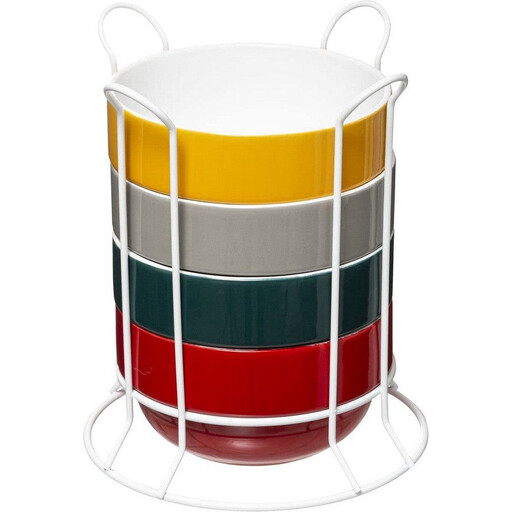
Why it suits this profile: A set of four 50 cl porcelain bowls is suitable for breakfast, dessert and smaller portions. The set provides a simple everyday tableware solution without having to combine several sizes.
The capacity is clearly stated and the set contains four matching bowls. According to the product information, they are suitable for the microwave and dishwasher; check the current instructions before use.
Four-piece porcelain set, 50 cl capacity, microwave-safe and dishwasher-safe according to the product listing.
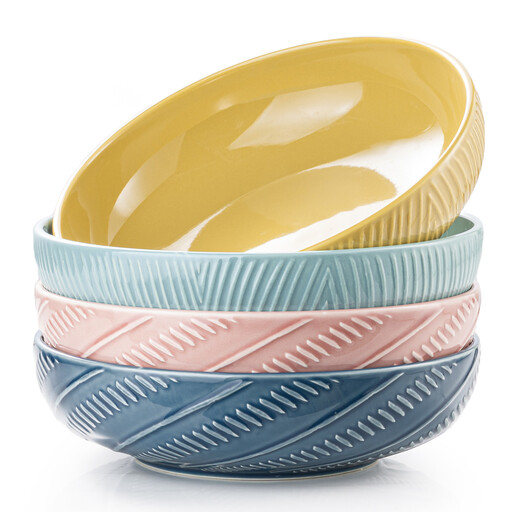
Why it suits this profile: The wide shape is designed for generous portions of pasta, salad, soup and side dishes. The set is ideal for households that also want to use their tableware when entertaining.
The specifications state a capacity of 36 oz and dimensions of 8.5 x 8.5 x 2.4 inches. This lets you estimate the portion size and cupboard space required in advance.
Set of four, stackable design and, according to the product description, suitable for the oven, microwave, fridge and dishwasher.
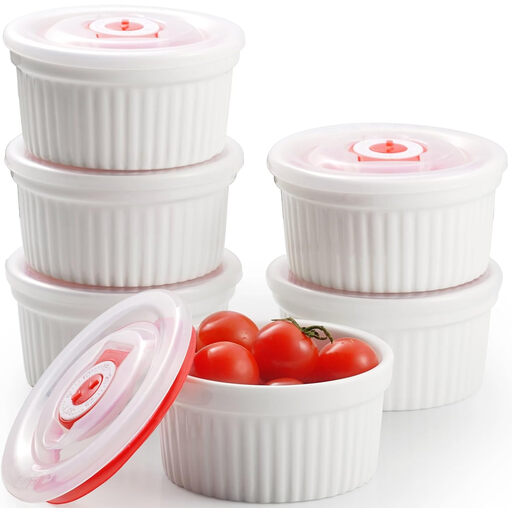
Why it suits this profile: These ramekins are designed for home bakers and meal preppers who want to bake, store and reheat individual portions.
The set lists the properties of the porcelain ramekins and plastic lids separately. The lids are not intended for stovetop use and must be used with the vent opening according to the instructions.
Six 12 oz ramekins, six lids with date indicators and, according to the product information, the ceramic components are suitable for the oven, microwave, freezer and dishwasher.
We have put together a complete, up-to-date list of products that fully meet these strict selection criteria and the applicable European safety regulations.
Only when the product information says that they can. Also check for metal decoration, such as gold-coloured rims. Use the bowl according to the instructions and avoid sudden changes in temperature.
Avoid thermal shock. Do not place a cold dish straight into a preheated oven, and do not put a hot dish on a cold or wet surface. Use oven gloves and check the maximum temperature specified by the manufacturer beforehand.
Ceramic containers are sturdy and can go from the fridge to the oven when this is expressly permitted. However, they are heavier and more fragile. Plastic meal-prep containers, such as a Mepal Cirqula set, are lighter and stackable; according to the product information, they can go in the microwave without the lid and in the dishwasher. The right choice therefore depends on transport, storage space and the type of food you are storing.
