What should you look for when choosing?
First check whether the aprons can go in the tumble dryer. Then measure your usual load and the space available, and compare the consumption of the drying method you actually plan to use.
Washer-dryer
A good fit if: you have room for one appliance, the care label allows tumble drying and the load to be dried is within the drying capacity.
Bear in mind: some models have a smaller drying capacity than washing capacity, and programmes can be long. The Consumentenbond gives an average of almost seven hours for the combined cotton programme; for a standard washer-dryer, the organisation reports around 36 litres of extra water during drying.
Wash and hang to dry
A good fit if: the care label allows machine washing and you have a suitable place to dry the aprons and enough time for them to dry. This may also be the right approach if tumble drying isn’t allowed.
Bear in mind: you’ll need to hang the aprons up yourself and wait for them to dry; there’s no automatic drying programme.
Separate washing machine and heat-pump tumble dryer
A good fit if: you have the space and connections for two appliances, and regularly want to machine-dry aprons or other laundry, provided the care labels allow it.
Bear in mind: you’ll need room for both appliances. Milieu Centraal recommends separate appliances because their combined energy consumption is lower; compare the purchase costs and the specifications of the models you’re considering.
| Factor to consider |
What should you check? |
Who should give this more weight? |
| Weekly load and time |
Compare the weight of your usual dry apron load with both the washing and drying capacities. Check the programme duration for the load you want to run; a short programme for small loads doesn’t tell you how long a full cycle takes. |
If I need the aprons in time after the school week, I want to know whether the full permitted load can also be dried. Around 36% of consumers prioritise their weekly load and cycle time. |
| Space and connection |
Measure the height, width and depth of the available space. Also check that the water inlet, drain and a suitable electrical connection are accessible, as specified in the model’s manual. |
If there’s only room for one appliance, I want to know whether it will fit there physically and can be connected. Around 29% of consumers prioritise limited installation space. |
| Washing and drying care labels |
Check both the washing symbol and the separate tumble-drying symbol on the apron. Choose a wash programme that suits the permitted temperature and treatment; a drying function doesn’t automatically make an apron suitable for the tumble dryer. |
If I want to care for my aprons according to their labels, I check in advance which washing and drying programmes are allowed. Around 21% of consumers prioritise fabric care. |
| Consumption when drying |
On the EU energy label, compare the consumption for washing only separately from that for washing and drying, on the same cycle basis. Also consider how often you’ll actually want to machine-dry your laundry. |
If I don’t need to machine-dry every load, I want to factor in the ongoing electricity and water consumption. Around 14% of consumers prioritise running costs. |
Washer-dryers at Joybuy
This Joybuy selection includes washer-dryers for anyone who wants to wash aprons in one appliance and machine-dry them, if the care label allows it.
 No image available
Haier HWD90-BP14929A-S
A good fit if you want one appliance and can size your apron load to the separate washing and drying capacities.
Capacity: 9 kg washing and 5 kg drying. The title lists 1400 rpm and a steam function.
A wash load over 5 kg won’t all fit in one drying cycle.
View at Joybuy
 No image available
Midea MF205D80WB/W-NL
A good fit if you’re looking for one appliance and can keep the apron load within the stated drying capacity.
Capacity: 8 kg washing and 6 kg drying. The title lists 1400 rpm, Wi-Fi and a steam function.
If the wash load is over 6 kg, it won’t all fit in the same drying cycle.
View at Joybuy
 No image available
TCL CP1210WA0
A good fit if you want one appliance and can limit the apron load for drying to the stated drying capacity.
Capacity: 10 kg washing and 6 kg drying. The title mentions a 60-minute wash-and-dry programme; the product description specifies that it’s for small loads. A 15-minute wash programme is also listed.
The maximum wash load can’t all be dried in one go without reducing the load.
View at Joybuy
 No image available
Comfee CFP03ED100W-HR
A good fit if you can size the washing and drying loads to suit your aprons and want to use one appliance.
Capacity: 10 kg washing and 7 kg drying. The title lists features including Steam Care, Auto Dry and a Woolmark mention.
If the wash load is over 7 kg, it won’t all fit in the same drying cycle.
View at Joybuy
 No image available
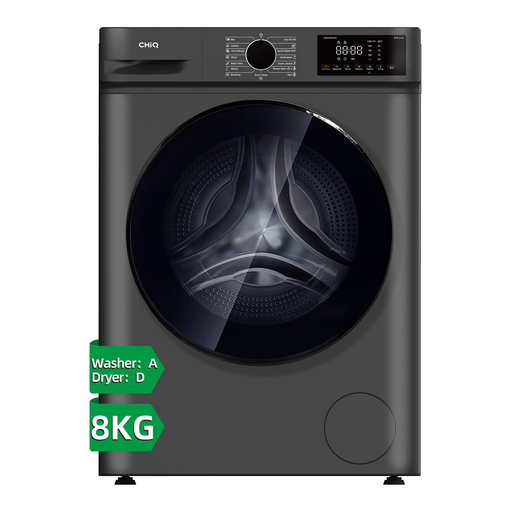
CHiQ JW85882HG
A good fit if you want one appliance and can size your apron load for drying to suit the lower drying capacity.
Capacity: 8 kg washing and 5 kg drying. The title lists a counter-depth design, 1400 rpm and a steam function.
A wash load over 5 kg won’t all fit in one drying cycle.
View at Joybuy
Frequently asked questions
Can a washable apron automatically go in the tumble dryer too?
No. A washable label on its own doesn’t mean tumble drying is suitable. Check the separate tumble-drying symbol; according to GINETEX, the number in the washing symbol indicates the maximum permitted washing temperature.
Can I dry the entire wash load straight after washing?
Only if the load is within the drying capacity for the programme you’ve selected and the care label allows tumble drying. For example, the manufacturers state that both the Bosch WNA13400NL and the LG W4X1085NWB have an 8 kg washing capacity and a 5 kg drying capacity.
What should I check before installation?
Measure the space and consult the manual for the exact model. For its washing machines, Bosch recommends a stable surface, a water supply and drain within reach, and an earthed socket.
How can I limit energy use if drying isn’t always necessary?
If the care label allows it, use a suitable wash cycle and hang the apron up afterwards. When comparing a new washer-dryer, check the EU energy label’s consumption figures for washing only separately from those for washing and drying.
What information does the EU energy label provide for a washer-dryer?
The label includes information such as the energy efficiency class, energy consumption per 100 cycles and water consumption per cycle. The European Commission explains the EU labelling rules for washer-dryers; compare the figures for the correct cycle on the exact model you’re considering.


