
Family with a full load of school clothes
You collect cotton clothes throughout the week and want to know how much of it will actually fit in one wash-and-dry cycle. Compare the drying capacity with the load you want to process in one go.


A washer-dryer could suit your pile of cotton shorts if the whole load is within its drying capacity and you want one appliance. The maximum washing capacity doesn’t tell you how much you can dry straight afterwards. Consumentenbond reports that a combined cotton wash takes almost seven hours on average. If you have room for two appliances and often use a tumble dryer, Milieu Centraal recommends separate appliances because they use less energy. Line-drying does take time and requires a suitable place to dry your clothes.
You collect cotton clothes throughout the week and want to know how much of it will actually fit in one wash-and-dry cycle. Compare the drying capacity with the load you want to process in one go.
You want to wash and dry in the space available for one appliance, and can work around a smaller drying load or a longer cycle.
You compare the energy use of combined cycles with separate appliances or line-drying, especially if you use a tumble dryer regularly.
A good fit if: you want to install one appliance and the load is within its drying capacity.
The trade-off: a full cotton wash may be larger than the drying load; Consumentenbond says a combined cotton wash takes almost seven hours on average.
A good fit if: you have room for two appliances and often use a tumble dryer.
The trade-off: you have to transfer the laundry between appliances and make space for both; Milieu Centraal recommends separate appliances because they use less energy.
A good fit if: the shorts don’t need to be dry straight away and you have a suitable place to dry them.
The trade-off: you’ll need time and drying space; check the care label on each item.
| Buying concern | What should you check? | Who should consider this? |
|---|---|---|
| The weekly wash also fits in the drying cycle | Compare the laundry weight with the drying capacity in kilograms, preferably for the cotton programme you intend to use. | I want to wash and dry the week’s cotton clothes in one combined cycle without taking laundry out halfway through. Around 33% of consumers prioritise the weekly load. |
| Dry clothes ready on time | Check the total programme duration and maximum load for the exact programme you want to use. | If I need clothes at a particular time after the school week, the time taken to wash and dry matters. Around 27% of consumers prioritise turnaround time. |
| Washing and drying in one place | Measure the available space and access route; check the installation instructions for connections and flooring. | I want both functions in the space available for one appliance and need to know whether the model will fit there. Around 20% of consumers prioritise having limited installation space. |
| Ongoing energy and water use | Compare the EU energy label figures for washing and for washing plus drying on a like-for-like basis. | If I often use a tumble dryer, I want to take into account the energy and water use of the cycle I actually run. Around 20% of consumers prioritise running costs. |
Washer-dryers can have a lower stated drying capacity than washing capacity. So a maximum cotton wash load won’t necessarily fit in the drying cycle that follows.
Base a combined cycle on the drying limit for the programme you’ve chosen. If the load is larger, you may need to take some laundry out or plan an extra drying cycle.
A short programme name doesn’t necessarily tell you how long a full wash-and-dry load will take. Bosch says the Wash & Dry 60' programme on the WNA14419NL is intended for small loads; Consumentenbond reports that a combined cotton wash takes almost seven hours on average.
For the exact model, check both the maximum load and the total programme duration for the cycle you want to run.
The EU energy label shows separate figures for washing and for the full wash-and-dry cycle. A claim about a particular setting doesn’t necessarily apply to every combined cycle.
If you often use a tumble dryer, compare figures for the same type of cycle and load, and weigh them against the options for separate appliances.
For the GD3R509S0, LG states a capacity of 9 kg for washing and 6 kg for drying.
Bosch states that the Bosch WNA14419NL has a washing capacity of 9 kg and a drying capacity of 5 kg.
Consumentenbond lists the AEG LWR76144 as having a capacity of 11 kg for washing cotton and 7 kg for washing and drying cotton.
Samsung lists the WD90DB7B85GWU3 as having a washing capacity of 9 kg and a drying capacity of 6 kg.
Consumentenbond lists the Miele WTI 370 WPM as having a capacity of 8 kg for washing cotton and 5 kg for washing and drying cotton.
These picks include both washer-dryers and a separate washing machine and heat pump tumble dryer. Compare a washer-dryer’s drying capacity with the space and set-up required for two appliances.
 No image available
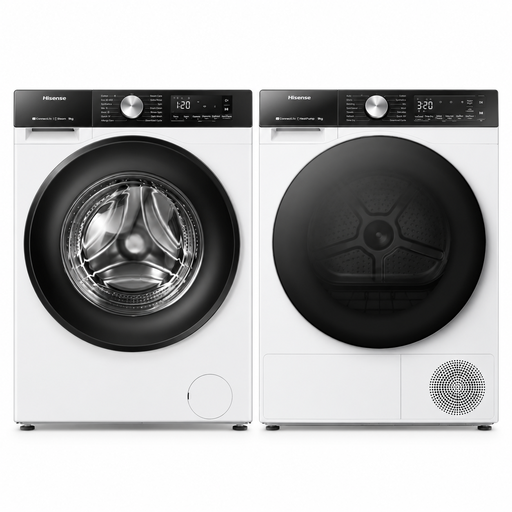
A good fit if you want a separate washing machine and tumble dryer, and like to plan washing and drying cycles at the same time.
The bundle lists a 9 kg capacity for both washing and drying, 1400 RPM and ConnectLife Wi-Fi Control. Each appliance is stated to be 59,5 cm wide, making 119 cm side by side, not including any gap between them or extra installation space.
The product description says that confirmed compatibility and a suitable stacking kit are required for stacking. Check whether the kit is included with the bundle.
 No image available
A good fit if you want to wash and dry cotton in one appliance and can keep the load within the lower drying capacity.
The stated capacity is 9 kg for washing and 5 kg for drying. The description lists separate drying programmes for cotton and wool, a 1400 RPM spin speed and a delay start of up to 24 hours.
A load over 5 kg is above the stated drying capacity for a single combined cycle.
 No image available
A good fit if you want to wash cotton clothes in one appliance and dry them straight afterwards, keeping the combined load within the drying limit.
The stated capacity is 9 kg for washing and 5 kg for drying. The description lists a 1400 RPM spin speed, a cotton hygiene programme, a delay start and a remaining-time display.
For a combined cycle, the load must stay within the 5 kg drying capacity.
 No image available
A good fit if you want one appliance for washing and drying, and can keep the combined load within the drying capacity.
The stated capacity is 8 kg for washing and 5 kg for drying. The description lists AutoDry and a 60-minute Wash & Dry programme.
Check the maximum load for the programme you’ve chosen; the drying capacity is lower than the washing capacity.
 No image available
A good fit if you want a washer-dryer with a drying capacity of 6 kg, plus a short wash programme for smaller loads.
The stated capacity is 9 kg for washing and 6 kg for drying. The description lists AI Wash and a Super Speed programme that washes 5 kg in 39 minutes; those 39 minutes don’t apply to a full wash-and-dry cycle.
A combined load over 6 kg is above the stated drying capacity.
Only if the load is also within the stated drying capacity for the programme you’ve chosen. Check the washing and drying capacities for the exact model and programme.
Don’t rely on the fabric name alone. Check the care label, especially the washing instructions and tumble-drying symbol, before choosing a combined programme.
Consumentenbond recommends a flat, firm surface, removing the transit bolts, connecting the water supply and drain correctly, levelling the appliance and using an earthed socket. Also follow the installation instructions for the model you’ve chosen.
Not necessarily: a short programme time may apply to washing only or be intended for a small load. Check the maximum load and total duration of the specific programme.
Compare the EU energy label figures for washing only and for washing plus drying separately. Make sure the programmes and loads you’re comparing match the way you intend to use the appliance.