
Vandaag of morgen in huis

Kwaliteit gegarandeerd

Welkomstaanbiedingen ontgrendelen: GRATIS bezorging | Tot 80% korting | Gratis 30 dagen JoyPlus-proefperiode
Download de app
A ratchet saves time when tightening and loosening bolts, especially in places where there is hardly enough room to turn the handle all the way around. However, the range often seems simpler than it really is. A ratchet handle, ratchet ring spanner or complete ratchet set may offer plenty of teeth and features on paper, but that does not tell you everything about whether it is suitable for your job.
Pay particular attention to these three common pitfalls:
The drive size determines which sockets you can use and what type of work the ratchet is suitable for.
A 3/8-inch ratchet is a practical middle ground for many DIY enthusiasts. However, check that the sockets have the same square drive. A 3/8-inch ratchet will not fit directly onto a 1/2-inch socket without a suitable adaptor.
A ratchet with 72 or 90 teeth can be operated with a smaller movement than a model with fewer teeth. The stated working angle is important here:
The difference may seem small, but in a confined space it means you need to reposition the handle less often. A small angle does not automatically make the ratchet suitable for heavy loads. Therefore, also consider the construction, drive size and manufacturer's instructions.
Many models in this selection use chrome vanadium steel or a similar chrome alloy. This is a verifiable material specification, but it does not by itself indicate how long a tool will last. Its lifespan also depends on the load, storage, cleaning and correct use.
Also look for:
Do not use a standard ratchet as a torque wrench. For bolts with a specified tightening torque, you need a separate torque wrench. Its setting and measurement range must match the requirements of the vehicle or machine.
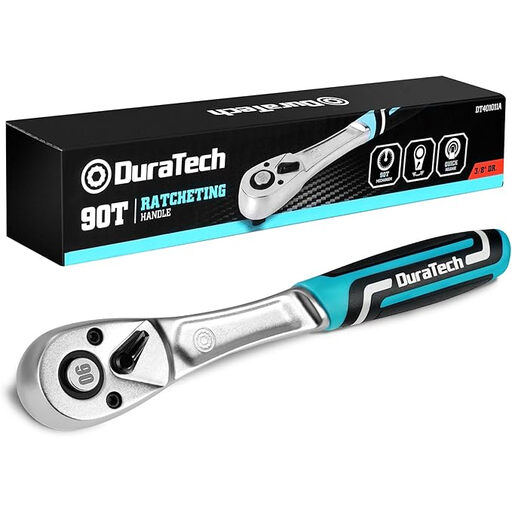
Why it suits this profile: This standalone ratchet handle is ideal if you already have sockets and want to add a 3/8-inch ratchet to your toolkit for car maintenance or general assembly work.
The product description clearly states the 3/8-inch drive, 90 teeth, a 4-degree working angle and a quick-release button. This makes it easier to check in advance whether the handle is compatible with your sockets.
Chrome vanadium steel, reversible mechanism, ergonomic handle and compact movement for confined assembly spaces.
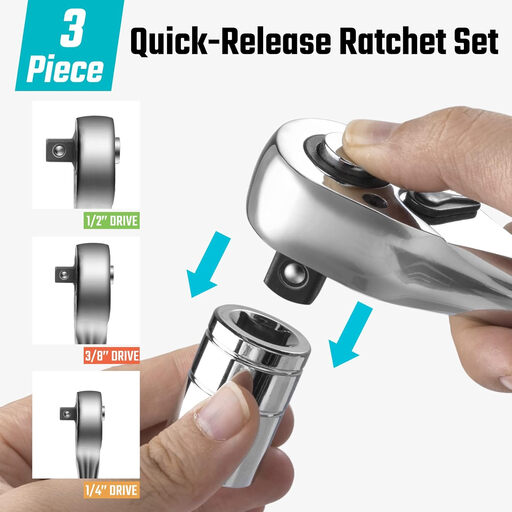
Why it suits this profile: Anyone working on cars, motorbikes, bicycles and machinery gets greater flexibility from three drive sizes than from a single ratchet.
The set lists all three sizes, a 72-tooth mechanism and a 5-degree working angle. The supplied storage case also helps keep the ratchets organised.
1/4, 3/8 and 1/2 inch in one set, quick release, reversible ratchets and a water-resistant storage case according to the product description.
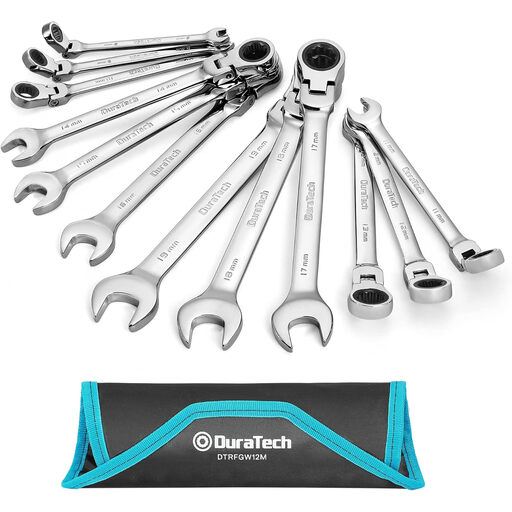
Why it suits this profile: This flexible ratchet spanner set is designed for fitters and technicians who often work with fasteners in hard-to-reach positions.
The specifications state a 180-degree flexible head, 72 teeth, a 5-degree working angle and sizes from 8 to 19 mm. However, check in advance that a flex head is suitable for the available working space.
12 metric sizes, chrome vanadium steel, a 12-point ring end and a storage pouch with size markings.
We have put together a complete, up-to-date list of products that fully meet these strict selection criteria and the applicable European safety regulations.
For many general jobs, a 3/8-inch ratchet is a useful size. Small fasteners often suit a 1/4-inch ratchet, while larger bolts and heavier loads are more likely to require a 1/2-inch ratchet. A three-piece ratchet set is useful if you work on different parts of a vehicle.
The terms are sometimes used interchangeably. A ratchet combination spanner usually has an open-ended spanner at one end and a ratcheting ring end at the other. A ratchet ring spanner generally refers to the ring end with a ratcheting function. Check the exact shape and size when purchasing.
Use a torque wrench when the manufacturer specifies a particular tightening torque, for example on certain car, motorbike or bicycle components. A standard ratchet is designed for tightening and loosening, but it does not measure how much torque you apply. Always check the specified range and the torque wrench's instructions for use.
