
Vandaag of morgen in huis

Kwaliteit gegarandeerd

Welkomstaanbiedingen ontgrendelen: GRATIS bezorging | Tot 80% korting | Gratis 30 dagen JoyPlus-proefperiode
Download de app
A ratchet wrench saves time when tightening and loosening nuts and bolts. However, not every ratchet is suitable for every task. A small 1/4-inch ratchet wrench is ideal for light assembly work, while a 1/2-inch ratchet wrench is better suited to larger fasteners and automotive maintenance. Focusing only on the number of pieces or an eye-catching product claim can therefore lead to buying tools that do not perform well in practice.
In this guide from the Joybuy Product Recommendation Officer, you will learn what to look for, which common pitfalls to avoid and which ratchet tools best match your needs.
A ratchet with 72 or 90 teeth may sound appealing, but the tooth count is not the only important specification. It primarily determines how far you need to move the handle before the mechanism engages again. A small swing arc is useful in confined spaces, but on its own it says nothing about the maximum load, finish or socket fit.
A 1/4-inch, 3/8-inch and 1/2-inch ratchet wrench are not interchangeable versions. The drive size determines which sockets fit and the type of work the ratchet is generally intended for. Using a small ratchet on heavily seized wheel bolts can cause damage. Always check the manufacturer’s specified torque limit and never use a pipe extension to apply extra force.
A box with 123, 172 or 450 pieces may look like good value, but check which sizes are actually included. Pay attention to the difference between metric and SAE sockets, deep sockets, Torx sockets, spark-plug sockets, extensions and universal joints. For automotive maintenance, it is not simply the number of sockets that matters, but whether the set includes the sizes used on your vehicle.
A 3-in-1 ratchet handle with 1/4-, 3/8- and 1/2-inch drives can save storage space. However, check that each connection is secure and properly fitted, and confirm whether the stated torque limits differ by size.
According to the manufacturer’s product description, a 72-tooth mechanism has a swing arc of approximately 5 degrees. Product information for a 90-tooth ratchet states an angle of approximately 4 degrees. This can make it easier to work between pipes, inside an engine bay or beside a furniture panel.
A small swing arc does not mean you can work less carefully. Keep the socket straight on the bolt and avoid applying sideways pressure. For demanding work, using the correct socket and distributing force properly matters more than simply choosing the highest tooth count.
Many models in this selection use chrome vanadium steel, chrome alloy or a combination with a chrome-molybdenum head. A polished finish is easy to clean after contact with oil or grease. A knurled or rubberised handle can provide additional grip, but make sure its shape feels comfortable in your hand.
A reversible ratchet wrench has a selector for changing the direction of rotation without removing the socket. A ratchet wrench with quick release makes changing sockets faster. After fitting a socket, check that it is properly locked in place.
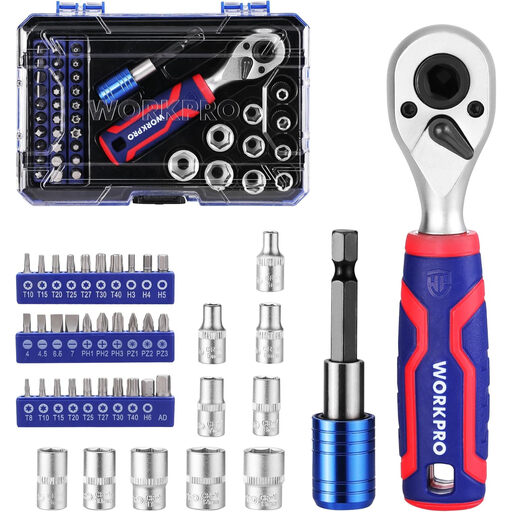
Why it fits: A compact set for household assembly, light automotive work and beginner DIY projects. The set includes a 1/4-inch ratchet, bits, sockets and a storage case.
The contents are clearly specified: 42 pieces, 72 teeth and a 5-degree swing arc. You are not paying simply for a large number of unspecified accessories.
The ratchet also works as a bit driver and features a magnetic quick-release holder. According to the product description, the components are made from chrome vanadium steel.
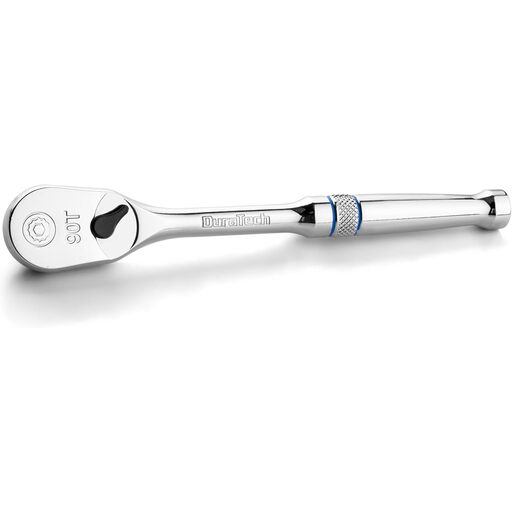
Why it fits: The 3/8-inch size is suitable for general garage work and passenger-car maintenance. According to the product description, the enclosed head is designed to help limit the ingress of dirt.
The product information lists both the tooth count and the 4-degree swing arc. This makes it easier to assess how well the ratchet will perform in confined spaces.
The ratchet has 90 teeth, a reversible direction and a polished chrome finish that, according to the description, is easy to clean.
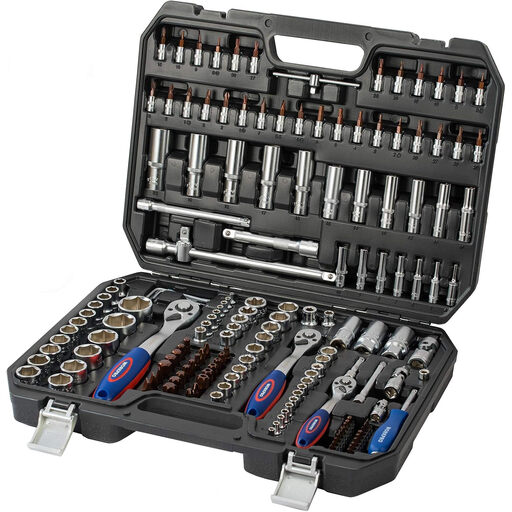
Why it fits: Ideal for DIY mechanics, professionals and motorists who need multiple drive sizes and accessories for automotive, motorcycle and household maintenance.
The set lists the 1/4-, 3/8- and 1/2-inch ratchets separately, along with deep sockets, Torx sockets, spark-plug sockets, extensions and universal joints.
According to the product specifications, all three ratchets have 72 teeth and quick release. The case has designated slots to keep the components securely in place.
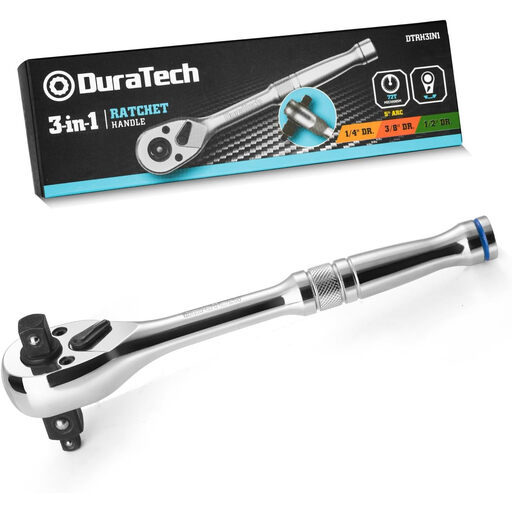
Why it fits: Convenient when you want to use different socket sizes with a single handle for furniture assembly, household repairs and automotive or motorcycle work.
The manufacturer specifies separate maximum torque ratings: 84 Nm for 1/4 inch, 304.5 Nm for 3/8 inch and 350 Nm for 1/2 inch. Do not exceed these values.
According to the product description, the handle features a 72-tooth mechanism, a 5-degree swing arc and a reversible lever.
For occasional assembly work at home, a compact socket set is often sufficient. If you regularly work on a car, a car maintenance tool set with multiple drive sizes, deep sockets and extensions will be more useful. A ratcheting screwdriver is particularly practical for screws with 1/4-inch bits; it does not replace a ratchet for hexagonal bolts.
Before buying, check:
Do not use hand tools on live electrical circuits. Electrical work requires purpose-designed insulated tools with the appropriate markings and usage instructions.
Browse a current selection of ratchet insert-bit wrenches and compare drive size, design and included accessories based on the product specifications.
For many general jobs on a passenger car, a 3/8-inch ratchet wrench is a practical choice. For larger bolts, wheel work or heavier assembly, a 1/2-inch version may be more suitable. Always check the required socket size and your vehicle’s specifications.
According to the product specifications mentioned, a 72-tooth ratchet typically has a swing arc of approximately 5 degrees. This reduces the amount of hand movement required. A 90-tooth model may require even less movement, with an angle of approximately 4 degrees according to the product information. However, the available space around the bolt remains the deciding factor.
Wipe away oil, dust and metal particles after use. Store the ratchet dry in its case and check the selector, socket lock and teeth for wear. Do not use a damaged ratchet and never exceed the maximum torque specified by the manufacturer.
