
Vandaag of morgen in huis

Kwaliteit gegarandeerd

Welkomstaanbiedingen ontgrendelen: GRATIS bezorging | Tot 80% korting | Gratis 30 dagen JoyPlus-proefperiode
Download de app
A pill box can help you keep medicines, vitamins, fish oil and food supplements organised by day. However, not every medication box suits every routine. A compact box works well for a day out, but offers little space for a complete weekly schedule. Conversely, a large pill organiser can be awkward if you only want to carry it in a coat pocket or handbag.
So don’t just focus on colour or price. The layout, closure, dimensions and cleaning method all determine whether a pill box remains practical for everyday use.
A weekly pill box with just seven daily compartments is not always enough. If you take medicines at several points during the day, you may need three or four compartments per day. So check whether the layout suits your schedule:
A larger pill box is not automatically more convenient. Extra compartments take up more space and also need to be filled correctly.
A travel pill box should stay securely closed in a bag or suitcase. A loose lid could allow tablets to fall out of their compartment or become mixed up. Look for a snap-lock closure, individual lids and the manufacturer’s description of moisture resistance or a sealed design.
Claims such as “waterproof” or “moisture-proof” come from the brand’s product information. Do not treat them as a guarantee that the organiser can be used under water for extended periods. Store medicines according to the instructions on the packaging and avoid unnecessary exposure to moisture and heat.
A large pill box may seem appealing if you use lots of capsules or supplements. Also check whether the individual compartments are large enough and whether the lids open easily. A compartment holding several pills can still be impractical if the labelling is unclear or the lid is difficult to close.
For older people and carers, clear day markings and a logical sequence are often more important than an eye-catching appearance.
First decide how many times a day you want to organise. A medication organiser with 21 compartments is divided into three compartments per day. A model with 28 compartments provides four compartments per day. If you only take vitamins or supplements, a 7-day organiser may be sufficient.
Do not use a pill box to change your prescribed instructions yourself. Fill each compartment according to your existing medication schedule and ask a pharmacist or doctor for advice if you are unsure.
Many models are made from PP, ABS or TPE. The product information should clearly state which material has been used. Some models are described as BPA-free or suitable for everyday use; always check the specific product description.
Cleaning requirements vary by model:
Only refill the compartments once they are dry. Where light, temperature or moisture are a concern, it is preferable to keep medicines in their original packaging.
A travel pill box should fit in your bag without taking up unnecessary space. Check the dimensions in centimetres or inches and confirm whether the organiser has separate compartments. A portable pill box with seven compartments is suitable for a simple routine. For several daily doses, a larger model makes more sense.
A built-in pill splitter can be useful for tablets that may be split according to the patient information leaflet or a healthcare professional’s advice. Not every tablet is suitable for this. Do not use a pill splitter for capsules or tablets that must not be divided.
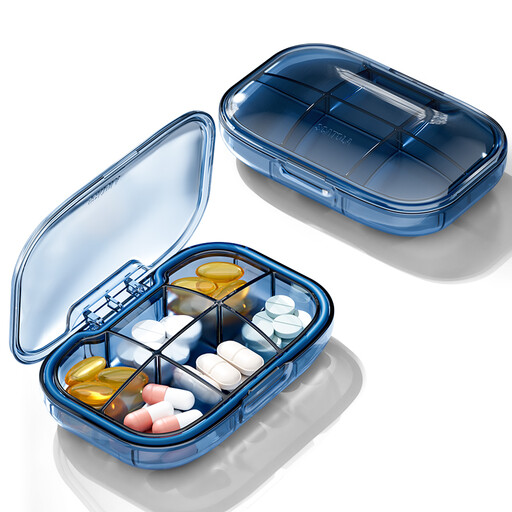
Why it suits this profile: Two compact organisers, each with six compartments, are suitable for a simple daily routine, a spare organiser or short trips.
The six separate compartments prevent all doses from ending up loose in one space. However, check whether six compartments are enough for your schedule.
Pack of two; portable size; suitable for medicines, vitamins and supplements according to the product description.
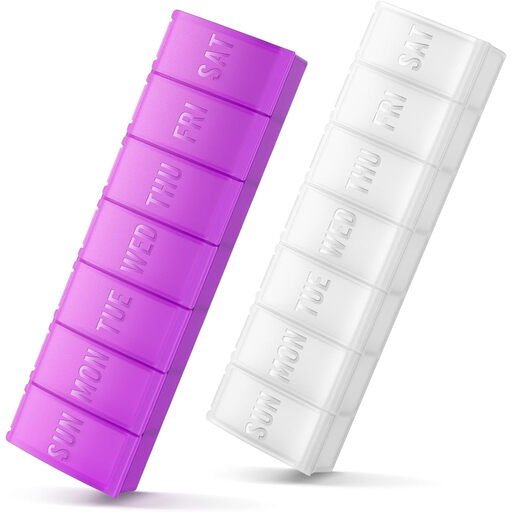
Why it suits this profile: The seven spacious daily compartments are designed for larger vitamins, fish oil capsules and daily supplements.
The day labels and spacious compartments make organising doses clearer than using one large compartment. There are no separate time slots for each day.
Pack of two; BPA-free plastic according to the product description; etched day markings and spacious compartments.
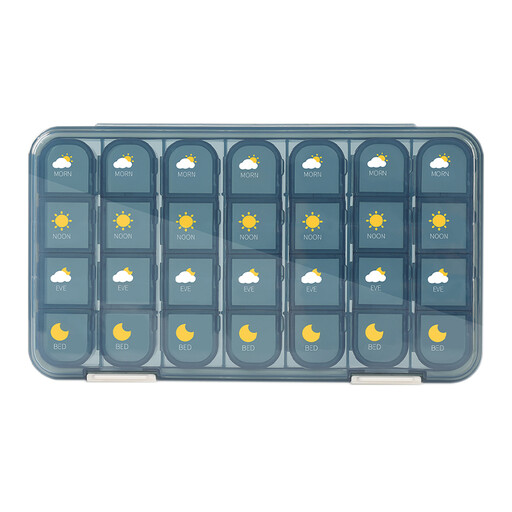
Why it suits this profile: Four compartments per day provide space for a more detailed weekly schedule, divided into morning, afternoon, evening and night.
The 28 separate compartments help prevent doses from being mixed together. According to the product description, the closure is designed as a portable, sealed model.
28 compartments; ABS, PP and TPE materials according to the product information; dimensions of 9.1 × 5.1 × 1.2 inches.
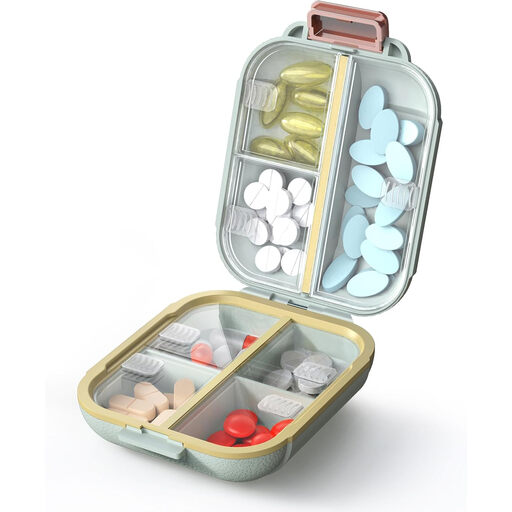
Why it suits this profile: This small box is designed to be carried every day in a handbag, coat pocket or travel luggage.
Seven separate compartments keep the day’s supply organised. Before buying, check that the stated size is suitable for your pills and capsules.
Compact design; seven compartments; airtight lid according to the product description.
A pill box with pill splitter combines storage with a cutting function. The JORDAN&JUDY mini pill box is available in brown and white. According to the product information, the white version has seven removable daily compartments and a stainless-steel splitter.
Only use the splitter when the medicine in question is suitable for this. Do not split capsules or modified-release tablets without advice from a doctor or pharmacist. The cutter contains a sharp component and must be kept out of children’s reach.
We have put together a complete, up-to-date list of products that fully meet these strict selection criteria and the applicable European safety regulations.
Its lifespan depends on the materials, hinges, closures and frequency of use. Replace the organiser when a compartment no longer closes properly, the plastic cracks or the labels become unreadable. For models with a pill splitter, also check the condition of the blade.
No. A weekly pill box is practical for many daily routines, but some medicines must remain in their original packaging because of light, moisture or temperature requirements. Ask your pharmacist for advice if you are unsure.
The price mainly depends on the number of compartments, choice of materials, size and extra features such as a pill splitter. First compare the capacity and closure with the way you intend to use it. A cheaper model that does not suit your medication schedule may ultimately be less practical.
