
Vandaag of morgen in huis

Kwaliteit gegarandeerd

Welkomstaanbiedingen ontgrendelen: GRATIS bezorging | Tot 80% korting | Gratis 30 dagen JoyPlus-proefperiode
Download de app
A pill box may seem simple, but choosing the wrong model can quickly become inconvenient. A lid that is difficult to open, compartments that are too small for large capsules or a layout that does not match your dosing schedule can all create extra hassle. This applies to people who take medication every day, as well as those taking vitamins, fish oil and food supplements.
So do not focus only on the colour or number of compartments. Pay particular attention to the layout, dimensions, closure and care instructions. Below, you can find out which features matter and which models are suited to different situations.
A compact pill box may look easy to carry, but the compartments may be too small for fish oil capsules or large vitamins. Check whether the product description specifically mentions large compartments or extra capacity. A pill box for vitamins and supplements often needs more space than one designed for a few small tablets.
A weekly pill box with just seven daily compartments is not automatically suitable if you have several dosing times each day. For a simple schedule, a pill box with 7 compartments may be sufficient. If you take medication in the morning, afternoon and evening, an organiser with 21 or 28 compartments is likely to be more suitable.
A lid that is too tight can be difficult for people with limited hand strength. A closure that is too loose may open during transport. Check the description of the closure mechanism and find out how the organiser should be cleaned according to the manufacturer. Claims about durability or ease of use come from the brand’s product description and are not a guarantee for every user.
Match the layout to your daily schedule:
A portable pill box with separate compartments can be practical for work, a day out or a short trip. Fill the compartments at a set time and check the contents against your prescription or your own supplement schedule.
As well as the external dimensions, check the shape of the compartments. A wide, shallow compartment may work better for large capsules than a narrow compartment with the same capacity. Product descriptions sometimes state a maximum quantity, but this depends on the shape and size of the pills. Treat such figures as an indication only.
For travel, a compact travel pill box and a secure lid are important. A larger medication organiser offers more capacity, but it also takes up more space in your bag.
Many of the models in this overview are made from PP, ABS or TPE. Some product descriptions mention BPA-free plastic. This is a material characteristic taken from the stated product specifications; it does not mean that an organiser is suitable for every type of medication or for long-term storage in all conditions.
Pay attention to the following points:
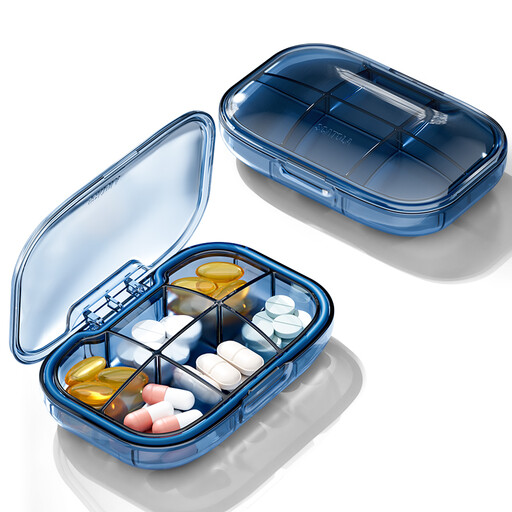
Why it suits this profile: Two compact boxes offer a simple starting point for daily medication, vitamins or supplements. The size is designed to fit in a bag or coat pocket.
The six compartments mean you do not need a large weekly box for every small dosing occasion. However, check beforehand that your pills fit in the compartments.
Pack of 2; portable size; plastic described as moisture-resistant in the product description.
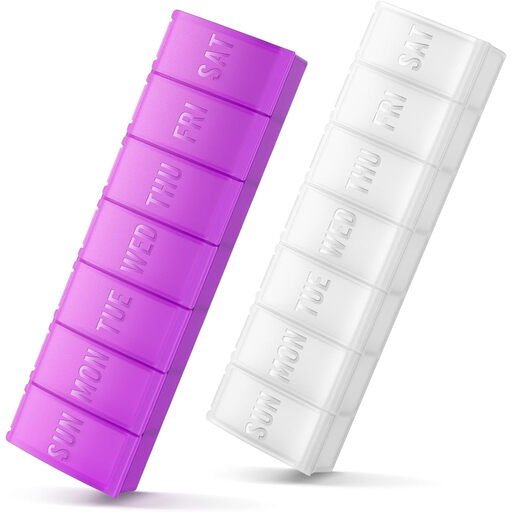
Why it suits this profile: This weekly pill box is designed for users who want to organise large vitamins, fish oil or several tablets per day by day.
The product description mentions spacious compartments, helping you avoid a layout that is too cramped. There are seven daily compartments, not several dosing times per day.
BPA-free plastic according to the product description; 2 organisers; daily labels; easy-to-open lids according to the stated specifications.
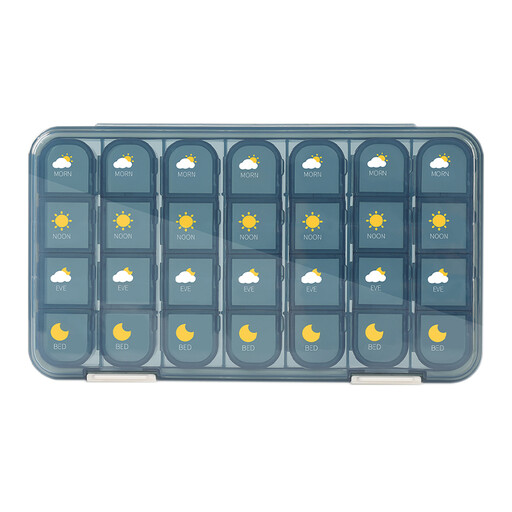
Why it suits this profile: Four compartments per day suit a complex medication routine with several dosing times. The organiser is intended for use at home, at work and while travelling.
The four compartments per day reduce the chance of mixing up different dosing times. Make sure the lids are properly closed before transporting it.
28 compartments; dimensions of 9.1 × 5.1 × 1.2 inches according to the product description; lockable design.
A small pill organiser with a built-in pill splitter is particularly useful when you only need to carry a few tablets with you. According to the product description, the JORDAN&JUDY Mini Pill Case has an integrated cutter and a compact size for a handbag, pocket or travel luggage.
Do not automatically use a pill splitter for every medication. Some tablets have a protective coating or must not be split. Check the patient information leaflet and ask your pharmacist for advice before adjusting a dose.
We have put together a complete, up-to-date list of products that fully meet these strict selection criteria and the applicable European safety regulations.
This depends on the medication, its packaging and the storage instructions. Not every medicine is suitable for being removed from its original packaging in advance. Check the patient information leaflet or ask your pharmacy for advice. Preferably, fill an organiser for a limited period and keep it away from moisture, heat and direct sunlight.
Only if the model has enough compartments for this. A box with seven compartments is generally intended for one combined dosing time per day. For morning, afternoon, evening and night-time doses, a model with 21 or 28 compartments is a better match for your routine.
Always follow the care instructions for the model you have chosen. Many organisers can be cleaned with a dry or damp cloth. Allow all compartments to dry completely before filling them again. Do not use harsh cleaning products, and do not put the box in the dishwasher unless this is expressly permitted.
