
Vandaag of morgen in huis

Kwaliteit gegarandeerd

Welkomstaanbiedingen ontgrendelen: GRATIS bezorging | Tot 80% korting | Gratis 30 dagen JoyPlus-proefperiode
Download de app
A night light with motion sensor can be a handy addition to the nursery, bedroom, hallway, bathroom or toilet. The light automatically turns on when you move in the dark, so you don't have to fumble for a switch. However, models vary significantly in sensor range, brightness, battery life and installation.
Pay particular attention to these common pitfalls:
A PIR sensor detects movement by sensing changes in heat in the surrounding area. The range on many compact models is around 3 to 5 metres, but placement largely determines how well the sensor responds. Don't position the light behind a cupboard door or in a spot where furniture blocks its view.
A light sensor measures how much ambient light is present. On some models, the light switches on when the light level drops below 20 lux. A combination of a light with a PIR sensor and a light sensor is practical for automatic night lighting: the light then only reacts to movement when it is dark enough.
A fixed light with only a light sensor is suitable when you want a soft light to come on automatically in the evening, for example in a hallway or nursery.
For a bedroom or nursery night light, warm white light of around 2800 to 3200 K is usually a calming choice. For a hallway or bathroom, neutral or cooler light can be more pleasant when you want to see more detail.
Alongside colour temperature, pay attention to the brightness in lumens (lm):
A higher CRI value, for example above 80 or 85, indicates that colours are rendered relatively naturally under the light. This is a technical product specification, not a guarantee of a particular user experience.
A rechargeable night light with a built-in lithium battery is flexible to place. USB charging via 5 V is usually possible with a suitable phone charger, laptop or power bank. Always check the specified charging current and use a compatible USB charger.
Battery capacity is expressed in mAh. A 500 mAh battery is compact, while 1100 mAh offers more capacity. The actual usage time depends on brightness, number of activations and operating mode. A stated “up to” number of hours is therefore a maximum indication under certain conditions.
For cupboard lighting with a sensor, slim models with a magnet or adhesive strip are handy. Check beforehand:
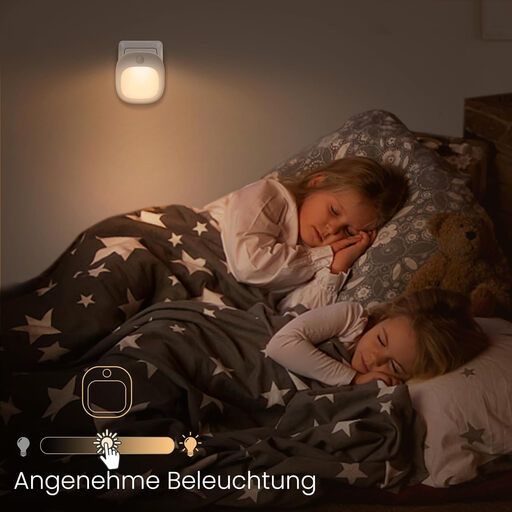
Why this fits the profile: This 2-pack offers wireless placement for, say, a bedroom and hallway. The three colour temperatures and five brightness levels make it possible to adjust the lighting per room.
The product specifications list both a sensor range of 3 to 5 metres and a light threshold of up to 20 lux. This makes it clear when the automatic mode is intended.
Built-in 500 mAh battery, USB charging, 30 lm brightness and a compact size of 7.45 x 6.99 x 2.55 cm.
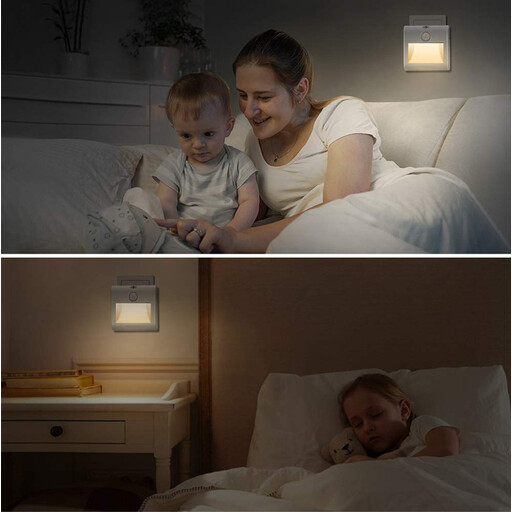
Why this fits the profile: The combination of a constant light setting, automatic detection and touch dimming suits anyone who wants one light for multiple everyday situations.
The dimming function is stepless and has a memory function. You are therefore not limited to a few preset brightness levels.
2-pack, 20 lm, warm white light from 4000 to 4500 K, motion detection at 3 to 5 metres and support for 100-240 V.

Why this fits the profile: These long lights are designed for cupboards, shelves and worktops where a small night light doesn't spread enough illumination.
The 40 cm length and 61 LEDs make the light distribution more suitable for wide surfaces than a compact model next to the bed.
2 lights, PIR range of 3 to 5 metres, three colour temperatures and a built-in 1100 mAh battery. Installation is possible without drilling using adhesive material.
We've put together a full, up-to-date list of products that fully meet these strict selection criteria and comply with current European safety regulations.
Don't place a night light for the bedroom directly at eye level, and preferably direct the light away from the bed. This keeps the lighting limited to what is needed to walk or find something. In a nursery, it's wise to keep cables out of reach and to secure the light firmly. No model replaces general safety measures, supervision or adequate visibility during care.
For a hallway or toilet, automatic night lighting is practical when the light has sufficient range and isn't placed behind a door. A warm white night light is often less harsh there than cool white light, but the right choice depends on the desired brightness.
Mount or place the light in a spot where the sensor has a clear view of the walking route. Check the distance to where movement begins. With a magnetic or self-adhesive model, the surface must be clean and dry. Keep USB connections and electrical components away from water.
That varies per battery, brightness setting and number of activations. A model with a 500 mAh battery can, according to the product specification, work for up to 10 hours in sensor mode. Treat such values as an indication; more intensive use shortens the time between charges.
A sensor light only turns on when movement or low light levels are detected. This means consumption can be lower than with a light that stays on continuously. With a USB rechargeable light, the power consumption also depends on how often you charge the battery. Always check the wattage, such as 0.3 W or 1 W, and the chosen operating mode.
