
Vandaag of morgen in huis

Kwaliteit gegarandeerd

Welkomstaanbiedingen ontgrendelen: GRATIS bezorging | Tot 80% korting | Gratis 30 dagen JoyPlus-proefperiode
Download de app
A motion-sensor night light may seem straightforward: the light turns on as soon as someone walks past. Yet there are clear differences between models. A sensor may respond too slowly, a lamp may be too bright for a bedroom, or a battery may run out sooner than expected.
For households in the Netherlands, three common pitfalls are particularly important:
Check whether the motion sensor only operates in the dark. For various models, the activation threshold is around 20 lux. This means the lamp will not switch on with every movement during the day. A stated range of 3 to 5 metres is practical for a bedroom, toilet or short hallway.
Also consider the difference between a motion-sensor lamp and a day/night sensor. A day/night sensor recognises the difference between light and dark, but does not necessarily detect a person. When automatic activation as someone walks past is important, look specifically for PIR or motion detection in the product information.
For a bedroom or nursery, a low light level is often more comfortable than a powerful beam. The lumen value helps when comparing products:
A dimmable night light offers greater flexibility. Warm white light around 2700 to 3200 kelvin creates a softer light effect. Cool white light of approximately 5000 to 6500 kelvin makes details clearer, but can feel more pronounced in a dark bedroom. According to the product descriptions of some models, multiple colour temperatures and five dimming levels are available; always verify that this applies to the product you choose.
A rechargeable night light with USB is convenient when there is no power socket nearby. Pay attention to battery capacity, charging time and stated operating time. For example, the 2-pack with 0.5 W lists a built-in 500mAh battery, USB charging at 5 V/1 A and up to 10 hours of operation in sensor mode, according to the product description.
A wireless battery-powered night light eliminates cables, but does require spare batteries. A plug-in model is immediately ready to use, but must remain connected to a socket. For a nursery, a low light level, stable placement and a cable-free setup are often practical. Keep the lamp out of the reach of young children and do not use a sensor lamp as a replacement for general room lighting.
For outdoor use, the IP rating and installation method are important. IP44 means protection against splashing water; it does not mean the lamp can be exposed to a powerful water jet. IP65 offers greater protection against dust and water jets, but correct installation is still essential.
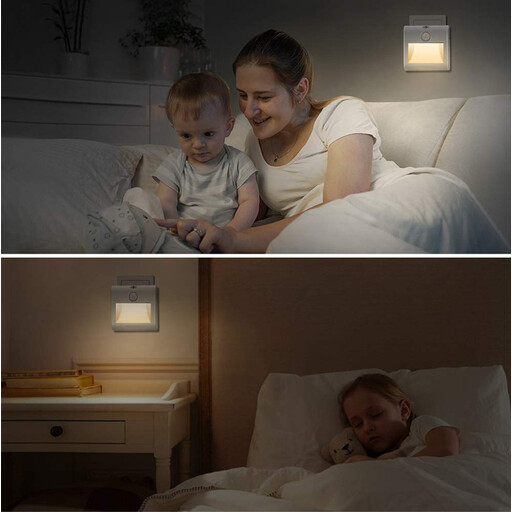
Why it’s a good fit: Ideal for households that want to illuminate two areas at once, such as a bedroom and toilet or a hallway and nursery.
The description mentions both a continuous-light mode and automatic activation in low ambient light and when movement is detected.
Two lamps, 1 W consumption per lamp, stepless touch dimming with memory function and 20 lumens according to the product specifications.

Why it’s a good fit: Suitable for anyone who wants to adjust different light colours and brightness levels in a bedroom, bathroom or hallway.
The battery eliminates dependence on a power socket. The operating time of up to 10 hours applies to sensor mode, according to the product information.
Three colour temperatures, five dimming levels, 30 lumens, a PIR sensor with a range of 3 to 5 metres and USB charging.
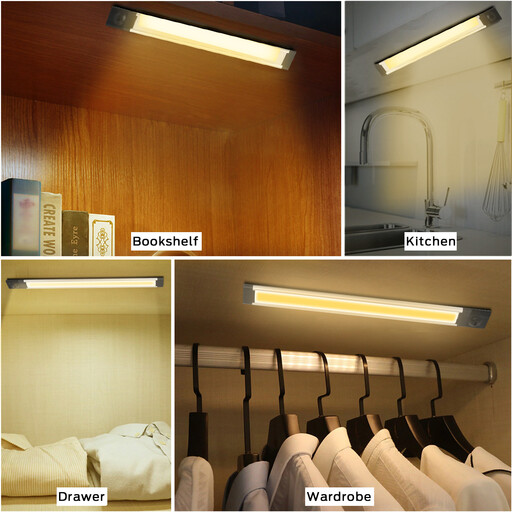
Why it’s a good fit: At 26 cm long, this lamp can illuminate a larger area in a wardrobe, hallway, stairwell, garage or storage room.
The lamp uses magnetic mounting and hanging hooks. Before installation, check that the surface is flat and sturdy enough.
36 Epistar 4014 SMD LEDs, a stated luminous flux of 400 lumens, a colour temperature from 2800 to 6500 kelvin and USB charging.

Why it’s a good fit: For homeowners looking for outdoor motion-sensor lighting without installing a fixed power cable to a façade, garden path or entrance.
A solar outdoor light depends on sunlight. Install the panel where it receives sufficient direct sunlight and keep it clean.
According to the product data: 1000 lumens, warm white light at 3000 kelvin, two lighting modes and IP44 protection.
Browse a current selection of sensor wall lights and compare installation, power supply, brightness and protection for each product.
Install the lamp where the sensor has an unobstructed view of the walking route. A sensor behind a cupboard door, curtain or decoration may respond less effectively. Also check whether the stated detection distance suits the space. For a short hallway, 3 metres is often sufficient; a greater range may be more practical for a wide entrance.
Consumption depends on the wattage and operating time. An LED lamp rated at 0.5 or 1 watt uses very little electricity when it switches on only briefly. With a rechargeable night light, the main energy cost comes from charging the battery. A lamp that remains on continuously will naturally use more energy than a model that activates only when movement is detected.
Only if the product information explicitly states that it is suitable for outdoor use and provides an appropriate IP rating. An outdoor LED wall light with sensor, such as a solar model rated IP44 or IP65, must be installed correctly and protected against immersion. An ordinary bedroom lamp is not suitable for rain or damp outdoor areas.
