
Vandaag of morgen in huis

Kwaliteit gegarandeerd

Welkomstaanbiedingen ontgrendelen: GRATIS bezorging | Tot 80% korting | Gratis 30 dagen JoyPlus-proefperiode
Download de app
An LED sensor night light can illuminate a dark hallway, bedroom or nursery without you having to fumble for a switch every time. However, models vary significantly. Some respond to movement, others only to darkness. Brightness, light colour, power source and placement also determine whether a light works well in practice.
Watch out for these common pitfalls:
First, check which type of sensor is used:
Some models list a threshold value, for example maximum 20 lux. Lux indicates how much ambient light is present. A motion detection range of 3 to 5 metres is, according to the product description of certain models, suitable for a hallway, bedroom or passageway. The actual performance also depends on placement and obstacles in the room.
For a bedroom or nursery night light, warm white light around 2800 to 3200 Kelvin is usually a practical choice. It appears less harsh than cool white light. For a hallway, toilet or cupboard, neutral or cool white light can be more useful when you need to see details more clearly.
Alongside colour temperature, pay attention to the number of lumens:
A dimmable night light offers more control. Five brightness levels or stepless dimming make it possible to adjust the light intensity to the moment of use. According to the product description of some models, the set level is saved via a memory function. Do check whether the product is actually dimmable; a simple light-sensor night light does not always have this feature.
A plug-in model works directly from the mains socket. That is handy for a fixed point in the hallway or nursery. A wireless night light with a USB rechargeable battery can be used in multiple places, even where there is no socket nearby. Pay attention to the stated usage time: for a model with a built-in 500mAh battery, the product description mentions up to 10 hours of use in sensor mode.
For cupboard lighting with a sensor, magnetic attachment, hooks or a flat housing are practical. Before mounting, check:
Do not place an electrical light in direct contact with water or moisture. The product descriptions of the models below state that they must not be exposed to excessive moisture. For a bathroom or toilet, a dry position away from splashing water is therefore important.
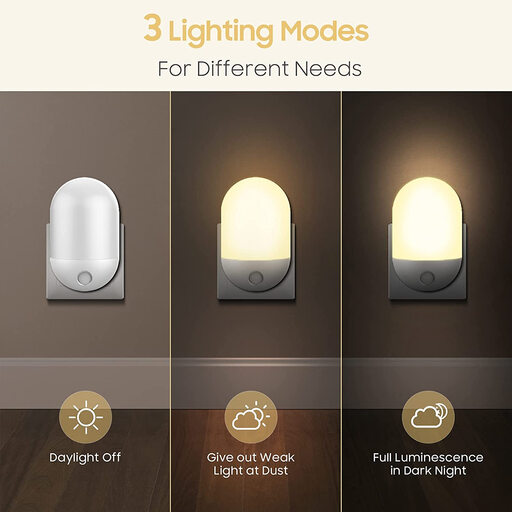
Why this fits the profile: This simple model is designed for anyone looking for a fixed warm white night light for a bedroom, nursery or hallway, without a battery or complicated controls.
The product name and specifications mention a light sensor, so it is clear that this is not a motion sensor. The stated light output of 20 lumens prevents false expectations about strong main lighting.
Warm white light of 2800-3200 K, 0.5 W power consumption and connection to 110-220 V according to the product data.
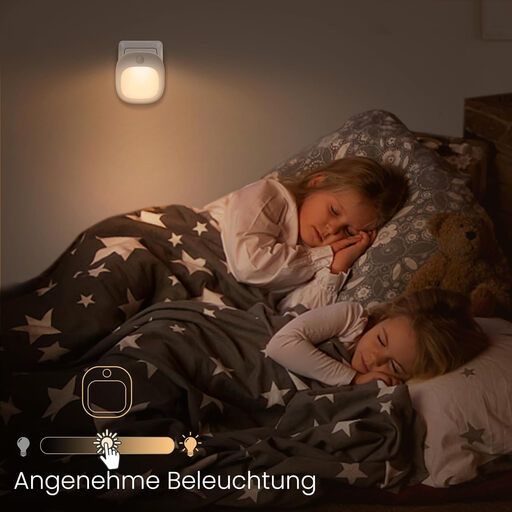
Why this fits the profile: A household can split the two lights between, for example, a bedroom and hallway. The USB battery offers flexibility when a socket is not available.
The product description mentions both motion detection and five brightness levels. This means you do not have to choose between automatic activation and adjustable light intensity.
500mAh rechargeable battery, USB charging, three colour temperatures, five dimming levels and, according to the product description, 30 lumens.
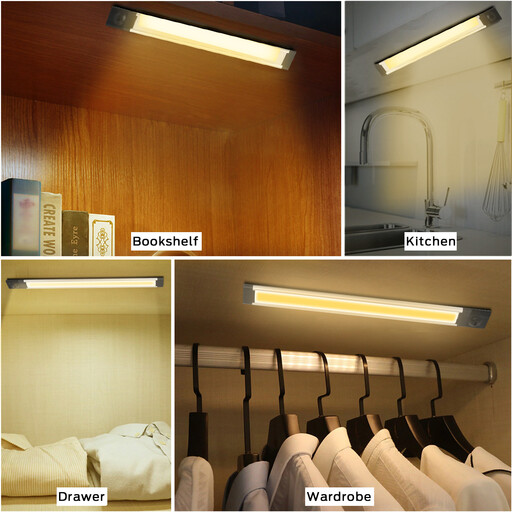
Why this fits the profile: This model is aimed at places where more light is needed, such as a cupboard, staircase, storage room, garage or long corridor.
The stated 400 lumens makes it clear that this is not a subtle bedroom light. Therefore, do not choose it if you are only looking for a faint orientation glow.
36 SMD LEDs, 400 lumens, adjustable colour temperature from 2800 to 6500 K and magnetic mounting according to the product description.
We have compiled a full, up-to-date list of products that fully meet these strict selection criteria and current European safety regulations.
LED lighting typically uses very little power. A model of 0.3 W or 0.5 W consumes less energy than a 1 W lamp when both are on for the same amount of time. The actual cost depends on the number of hours of use, the electricity price and how the sensor is set. An automatic shut-off can limit unnecessary burning.
Place the light at a height where the sensor can detect movement, for example along a bed, by a doorway or at the start of a corridor. Do not point the sensor directly at a strong light source and do not cover it. For cupboard lighting with a sensor, mounting on the inside or under a shelf often works well.
The usage time varies depending on the battery, brightness level and number of activations. For the model mentioned with a 500mAh battery, the product description states up to 10 hours in sensor mode. That is a product specification, not a fixed guarantee for every use situation. Therefore, also check how long charging takes and whether a USB cable or adapter is included.
