Who is a convector heater suitable for?

Resident with a cold external wall

Wants to make a room more comfortable without mistaking condensation or recurring mould for a moisture problem that has been solved. Milieu Centraal points out that recurring mould can have an underlying cause; the Dutch Government stresses the importance of ventilation to remove damp air.

Occasional supplementary heater for one room

Uses mainly one small room and wants adjustable heat at certain times. Noise, the option to switch off a fan and a suitable place to position the heater can all influence the choice.

Flat-dweller mindful of electricity costs

Wants to factor expected running time into the decision and avoid confusing wattage or a thermostat with guaranteed low heating costs. Milieu Centraal treats electric supplementary heating as a different use from heating an entire home.

What should you look for when choosing one?

Convector heater without a fan

Suitable if: you want to heat one room as a whole from time to time and avoid fan noise. Compare the manufacturer’s guidance with your room, but don’t treat it as a guarantee if you have cold external walls.

Keep in mind: a convector mainly heats the air, not a cold wall directly. If you use it for long periods, you’ll also need to consider the cost of electricity.

Convector heater with a switchable fan

Suitable if: you want to circulate warm air around the room more quickly and can select the fan setting on the exact model.

Keep in mind: check how the fan is controlled and whether the noise at your preferred setting suits the way you’ll use the heater. A fan won’t resolve a damp or building-related problem.

A different approach for damp or long-term heating

Suitable if: the wall is damp, mould keeps coming back or you need your main heating every day. In that case, also look into ventilation, possible defects and alternatives for long-term heating.

Keep in mind: investigating changes to your home may take more steps than buying a portable heater, but it helps prevent an air heater being mistaken for a solution to a different underlying cause.

What to consider What should you check? Who is it for?
Cold walls, condensation and mould Check whether the wall is dry, whether mould keeps coming back and how the room is ventilated. Then assess the heater as a way to improve comfort. I want extra warmth without overlooking a damp problem. Around 33% of consumers put the question of walls and damp first when choosing.
Adjustable heat Compare the power settings, thermostat and fan controls on the exact model. If a range is given in m² or m³, use the unit as stated; it’s the manufacturer’s guidance, not a performance measurement for your flat. If I mainly want to warm the room at certain times, I look at how adjustable the heat is and how it circulates. Around 27% of consumers say room comfort is their top buying priority.
Electricity use for the expected running time Calculate kW × the hours the heating element is actually on = kWh. Multiply this by your own electricity rate per kWh to estimate the cost. I want to know whether the expected use fits my electricity bill, especially if the heater will be on often. Around 20% of consumers put running costs first when deciding what to buy.
Safe positioning in a small flat Check the model-specific clearances, dimensions and cable length, and make sure you can reach a fixed wall socket without using an extension lead. The Fire Service advises plugging electric heaters directly into a wall socket. I want to put the heater somewhere suitable without having to improvise with the space or socket. For around 20% of consumers, safe, space-saving positioning is their top buying priority.

Common buying mistakes

  • Mistaking a warmer room for a solution to a damp problem

    A convector warms the air in the room, but won’t automatically deal with condensation, recurring mould or a possible underlying building issue. Milieu Centraal and the Dutch Government highlight the importance of addressing the causes and ensuring good ventilation.

    Look out for condensation and recurring mould, and investigate ventilation and possible causes before choosing a heater as a solution for the wall.

  • Treating the stated room size as a guarantee of heating performance

    Manufacturers specify different ranges; this guidance doesn’t tell you how much heat your room loses through cold external walls.

    Compare the exact model and stated unit with your room, and assess insulation and cold walls separately.

  • Assuming a thermostat or lower setting means lower heating costs

    A thermostat or timer can limit how long the heater runs, but you can’t assume a fixed saving without knowing how long it actually switches on for and your electricity rate.

    Work out the cost using the wattage, the hours the heating element is actually on and your own rate. If you’ll use it every day, also compare it with your existing heating or a suitable alternative. Milieu Centraal does not present an electric heater as an automatically sensible alternative for long-term heating.

  • Squeezing the heater into a corner and using an extension lead

    A heater needs a suitable position. The Fire Service advises plugging high-power appliances, including electric heaters, directly into a wall socket rather than using a cable reel or extension lead.

    Before buying, check the positioning instructions, clearance from flammable materials and cable length, and make sure a fixed wall socket is within reach.

Brands to consider

Eurom

The Safe-T-Convect 2400 is a freestanding convector heater with a thermostat, timer and switchable turbo fan.

  • Eurom lists a power rating of 2400 W and a maximum coverage of 90 m³ for this model. The turbo setting may be useful if you want to circulate warm air more quickly.
  • The stated coverage is the manufacturer’s guidance, not a measurement for a flat with cold walls. Bear the socket and running time in mind when using the maximum power setting.

Rowenta

The Vectissimo II CO3035F1 has a mechanical thermostat and two power settings.

  • For this exact model, Rowenta lists settings of 1200 W and 2400 W.
  • The manufacturer gives an ideal coverage of 20 to 25 m²; compare this guidance with the heat loss in your room. Check the user manual to see which noise setting applies when the heater is blowing air and heating.

De’Longhi

The HSX2320F is a portable convector heater with a room thermostat and fan system for localised heating.

  • For this model, the manufacturer specifies a heating power of 800 W to 2000 W.
  • A fan may be useful if you want to circulate warm air more quickly. Check whether the noise suits the room and the time you plan to use the heater.

Mill

The SG2000LED combines an electronic thermostat, three power settings and an integrated fan.

  • Mill lists settings of 750 W, 1250 W and 2000 W, and recommends the model for rooms smaller than 28 m².
  • That recommendation isn’t a guarantee for a room with cold external walls. Mill also states a maximum surface temperature of 80 °C, so take the heater’s position into account.

VONROC

According to VONROC, the 1000 W glass convector model reviewed offers app control, a timer and either floor supports or wall mounting.

  • For this specific model, VONROC lists settings of 500 W and 1000 W and coverage of up to 12 m².
  • The stated coverage isn’t independent confirmation of performance in a room with cold walls. Also check which mounting option and position are right for your room.

Joybuy product selection

This selection focuses on a portable convector heater for adjustable supplementary heating in one room.
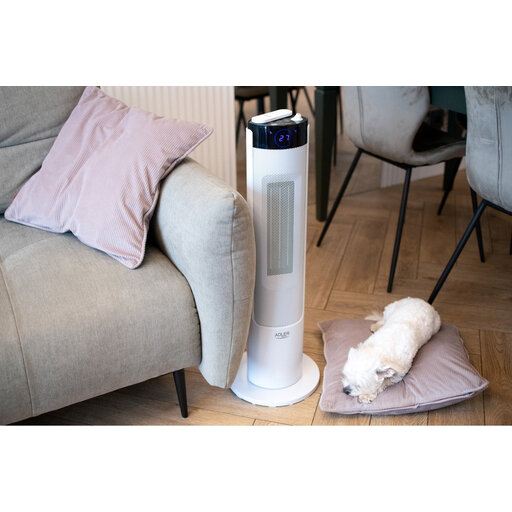
ADLER AD 7730 electric ceramic tower convector heater

ADLER AD 7730 ceramic convector heater

The stated thermostat, timer and two heat settings make this a good fit if you want to adjust supplementary heating to suit the times you use the room.

The product description lists power settings of 1400 W and 2200 W, temperature control, a 1–12-hour timer and 80° horizontal oscillation. It also mentions a tower design and carry handle. Check that the specific appliance being offered has the applicable CE marking and note any usage restrictions.

According to the product description, keep the heater uncovered and at least 1 metre away from flammable materials; don’t use it in a damp room unless this is expressly permitted. A convector isn’t a guaranteed solution for a cold wall or recurring mould.

View at Joybuy

Frequently asked questions

Will a convector heater dry out a cold wall?

No, a convector isn’t a guaranteed solution for a cold or damp wall. If you have condensation or recurring mould, you should also assess the ventilation and any possible underlying cause. Milieu Centraal and the Dutch Government offer practical guidance on these issues.

Does the stated room size mean the heater will warm my room?

Not necessarily: the stated coverage is the manufacturer’s guidance and doesn’t automatically take the heat loss in your room into account. Compare the exact model, the unit given (m² or m³) and the conditions in your flat, including any cold external walls.

How do I estimate a convector heater’s electricity use?

Multiply the power used in kW by the number of hours the heating element is actually on. At 2000 W for one full hour switched on, that’s 2 kWh; a thermostat can change the actual time the element is on. Use your own rate per kWh to calculate the cost.

Can I plug an electric heater into an extension lead?

The Fire Service advises plugging electric heaters directly into a fixed wall socket, not into a cable reel or extension lead. Also follow the instructions for using and positioning the specific appliance.

Which marking should I check on an electric convector heater in the Netherlands?

CE marking is mandatory for electrical products covered by the Dutch Commodities Act Decree on Electrical Equipment. For the applicable low-voltage rules, the NVWA specifies a rated AC voltage of 50 V to 1000 V. Check that the rules and marking apply to the specific appliance being offered, and note any usage restrictions.
