Choose a convector heater based on the heating needs of the room you actually use, and match its power output to the room and its insulation. A fan-free convector with a thermostat is a good choice for quiet supplementary heating. If you mainly want to heat one seating area, or plan to run the heater for long periods, it’s worth weighing up alternatives and electricity use too. Manufacturer specifications alone do not prove that an individual item for sale meets all applicable product requirements.
Who is a convector heater suitable for?
Anyone looking to top up the heat in a small room
You want extra warmth in the room you use and need to match the heater’s power output to the space and its insulation, rather than assuming that more watts are always better. Milieu Centraal and Tristar note that supplementary heating is worth considering for a well-insulated room that’s in use.
Anyone working from home who wants peace and quiet
You sit or work in the same room as the heater, so you’ll want to consider fan-free operation, a thermostat and the space the appliance takes up. Tristar, De'Longhi and Eurom describe models with different fan functions.
Anyone who often uses supplementary heating, or runs it for long periods
You’ll want to check in advance whether an electric convector suits the length of time you plan to use it. If you mainly want to heat one regular seating or work area, Milieu Centraal suggests considering an infrared panel as an alternative.
What should you look for when buying?
First, compare the heating needs of the room you use with its size and insulation. Then consider energy use, a safe position for the heater, and the fan and control functions you need.
| What to consider |
What should you check? |
Who should pay particular attention? |
| Heating the room |
Compare the room’s size and insulation with the exact model’s power output and any room-size claims made by the manufacturer. |
I want the room I’m in to be warm enough, so I need to choose a heater that suits the space. Around 40% of consumers prioritise heating the room. |
| Electricity use |
To work out consumption when heating continuously, multiply the power in kW by the length of time you use the heater, and factor in your own electricity tariff. |
If I use the heater often or for long periods, I want to know in advance how its energy use compares with how long I’ll run it. Around 30% of consumers prioritise running costs. |
| Safe positioning |
Measure the space available and follow the positioning and connection instructions for the exact model. Brandweer Nederland advises plugging electric heaters directly into a socket, not using a cable reel or extension block. |
In a small room, I need to find a suitable spot and socket without overlooking the space around the heater. Around 20% of consumers prioritise safe positioning. |
| Quiet operation |
Check whether the fan is absent, optional or running in each setting, and see which thermostat or timer functions the model has. |
If I work or relax in the same room, I want to know whether the heater can run without a fan and how I can control the heat. Around 10% of consumers prioritise quiet operation. |
Common buying pitfalls
-
Assuming a higher wattage means lower costs
The stated power output alone won’t tell you whether a heater suits your room or how much it will cost to run. Electricity use also depends on how long the heating element is actually switched on.
First, compare the room and its insulation with the model information. To estimate the cost of continuous heating, multiply the power in kW by the length of time you’ll use the heater and your own price per kWh.
-
Assuming every setting is fan-free
Eurom says that the built-in fan on the Safe-T-Convect 2400 blows warm air around the room in turbo mode. So a model with this feature won’t operate without a fan in every setting.
Check how each setting works if you plan to use the heater while working or relaxing.
-
Choosing a compact heater without a suitable place to put it
Even in a small room, the heat outlet must remain clear, and the appliance must be positioned and connected according to the model instructions.
Measure the space in advance, follow the manual and check whether you can plug the heater directly into a suitable socket. Brandweer Nederland advises against using a cable reel or extension block with electric heaters.
Brands and models for reference
Tristar
The Dutch product information describes the KA-5911 as a freestanding convector for well-insulated rooms or occasional supplementary heating.
- Tristar says the KA-5911 has 750 and 1500 W settings and an adjustable thermostat.
- Tristar does not mention fan assistance and advises against using the model in damp rooms.
De'Longhi
The Dutch product information describes the HSX2320F as a convector with additional air circulation.
- De'Longhi lists a room thermostat, up to 2000 W of power and a fan system for the HSX2320F.
- A fan changes how the heater works; it doesn’t prove that it uses less electricity. Compare the maximum power output with your room.
Eurom
Eurom describes the Safe-T-Convect 2400 as a freestanding convector with an optional turbo function.
- Eurom lists up to 2400 W of power, a thermostat, timer, tip-over protection and a fan in turbo mode.
- The manufacturer’s stated coverage of up to 90 m³ does not automatically mean the model is right for a small room.
Mill
Mill offers several types of convector, including an app-controlled model and one with mechanical controls.
- Mill lists 1200 W and a recommended room size of under 18 m² for the CO1200WIFI3. For the CO2200MECMAX, Mill lists 1000/1200/2200 W, a mechanical thermostat and tip-over protection.
- The recommended room size is a manufacturer’s estimate. Claims about energy savings or extra heating capacity do not prove how the heater will perform in your home.
Convector heaters at Joybuy
This selection focuses on portable convector heaters for supplementary heating in a room you use. Compare the model information with your space, how long you plan to use the heater and the space available for positioning it.
 No image available
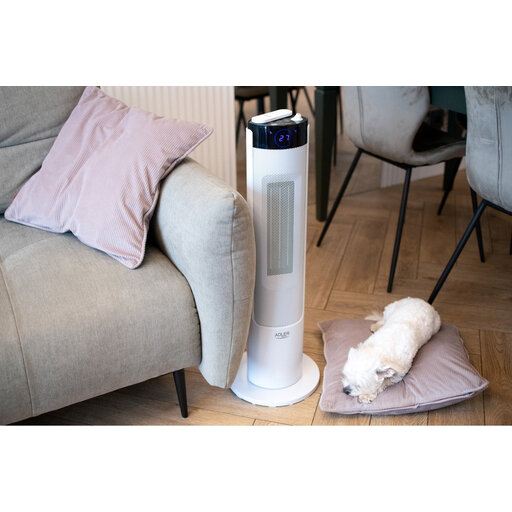
ADLER AD 7730 electric ceramic tower convector heater, white
According to the product description, the carrying handle and timer make this model a useful option for portable supplementary heating. Compare the stated room-size claim with your home.
The product description lists two heat settings, a thermostat and heating for a room of 25 m².
It also mentions a 1–12-hour timer, LCD controls, a remote control, and tip-over and overheat protection.
Do not cover the appliance, and keep flammable materials at least 1 metre from the air outlet. Do not use it in a damp room, such as a bathroom, unless this is expressly permitted.
View at Joybuy
Frequently asked questions
Can a convector heater replace my main heating system?
Not necessarily. Milieu Centraal does not recommend electric heaters as a general replacement for gas heating, and suggests an infrared panel as an option for targeted supplementary heating. First decide whether you want to heat the whole room or mainly one seating area, and how many hours a day you’ll use the heater.
How do I connect an electric convector safely?
Brandweer Nederland advises plugging electric heaters directly into a socket rather than using a cable reel or extension block. Also follow the positioning and cleaning instructions for your chosen model, and keep the heat outlet clear. This advice does not specify a universal legal clearance distance.
How can I estimate electricity use before buying?
Multiply the power in kW by the number of hours the heating element is actually switched on to calculate consumption in kWh. A 1500 W heater running continuously at that setting for one hour uses 1.5 kWh. To work out the cost, you’ll also need your own price per kWh.
Is a manufacturer’s guarantee the same as the statutory guarantee in the Netherlands?
No. According to ACM ConsuWijzer, your rights against the seller apply alongside any manufacturer’s guarantee. The Dutch statutory guarantee depends on what you could reasonably expect from the product; it is not simply a fixed two-year period.
What product requirements apply to a new electric convector heater in the Netherlands?
Electric heaters placed on the EU market must meet the applicable product safety and ecodesign requirements. The European Commission says the revised ecodesign rules for local space heaters have applied since 1 July 2025; the Government of the Netherlands says electrical appliances on the EU market must carry a CE mark. A product listing alone does not prove that an individual item for sale meets all applicable requirements.


