
Heating for a fixed spot
You often sit at the same desk or on the same sofa and want targeted supplementary heating for shorter periods. Milieu Centraal describes infrared panels as suitable for heating a particular spot.


An infrared panel is best suited to short periods of heating at a fixed seating or working spot, while a convector panel is designed to heat the air in the room. If a wall is cold or damp, neither type of heater will resolve an underlying cause of damp or a structural problem. Check the insulation, heat loss and ventilation too before considering a panel as your main heating source.
You often sit at the same desk or on the same sofa and want targeted supplementary heating for shorter periods. Milieu Centraal describes infrared panels as suitable for heating a particular spot.
You move around a small room and want to know whether a panel can heat the air. Take the insulation and heat loss into account; a manufacturer's estimate for a room is no guarantee that it will work for yours.
You notice condensation or recurring mould as well as the cold, and don't want to lose sight of the cause. Milieu Centraal points out that mould may be linked to ventilation problems or a structural issue.
Suitable if: you mainly want to feel warm for short periods in one seating or working spot, and the panel can reach that area.
The trade-off: areas outside the reach of the infrared won't warm up to the same temperature on their own.
Suitable if: you move around the room and want to heat the air throughout it.
The trade-off: compare the output and any stated room-size guidance with the actual room volume and heat loss. Long periods of electric heating also mean considering energy use.
Suitable if: cold walls go hand in hand with recurring condensation, mould or a suspected leak.
The trade-off: a panel may make you more comfortable, but it won't replace ventilation or an investigation into a possible structural issue.
| Consideration | What should you check? | Who is this important for? |
|---|---|---|
| Heating a fixed spot | Check that your chosen seating or working spot is within range of the panel and that you can position the panel there. | If I mainly sit in one spot, I want to feel warm there without heating the whole room all the time. Around 36% of consumers prioritise targeted heating for a seating area. |
| Heating the whole room | Compare the heating method, stated output and room-size guidance with the room volume and insulation. | If I move around the room, I want to know whether the air can be warmed and what prolonged use means. Around 29% of consumers prioritise heating the air in the room. |
| Damp or mould | Look out for condensation, damp patches or recurring mould, and consider the ventilation options. | If the cold wall is also damp or mouldy, I want to make sure a panel doesn't hide the cause. Around 21% of consumers prioritise concerns about damp or mould. |
| Fitting in a small home | Check the fixing method, dimensions and connection point, and whether any installation changes in a rented home can be reversed. | If space is limited or I rent, I want to know in advance whether the panel will be practical to install. Around 14% of consumers give most weight to installation and space requirements. |
You mainly feel the direct warmth where the infrared reaches. If you heat a less well-insulated room for long periods, energy use may also be an important consideration.
First decide whether you want warmth in one spot or to heat the air in the room. Check the insulation and how long you'll use it for before relying on a panel as your main heating source.
Recurring mould may be linked to ventilation problems, a leak or another structural issue. Heating the area doesn't establish that the cause has been resolved.
Check for damp and consider ventilation too. If you suspect a problem in a rented home, report it to your landlord.
A manufacturer's room-size guidance doesn't automatically mean that a room with cold walls and heat loss will get warm enough.
Compare the actual room volume, panel position and heat loss with the specifications for the particular model.
With ETHERMA, the standard version with external controls differs from the SMART version with integrated controls.
Check the full version name and which controls you'll need for the functions you want.
Offers models for both targeted infrared heat and convection heating for the air in a room.
The LAVA BASIC 3.0 range includes infrared panels for wall or ceiling mounting, with different control options.
Offers a low-profile wall panel for heating the air in a room, with programmable controls.
This selection includes household room heaters and a freestanding infrared model for targeted warmth; the product names do not indicate a wall panel.
 Image unavailable
The product description presents this model as a household room heater. Check that the version suits where you want to use it and how you want to heat the room.
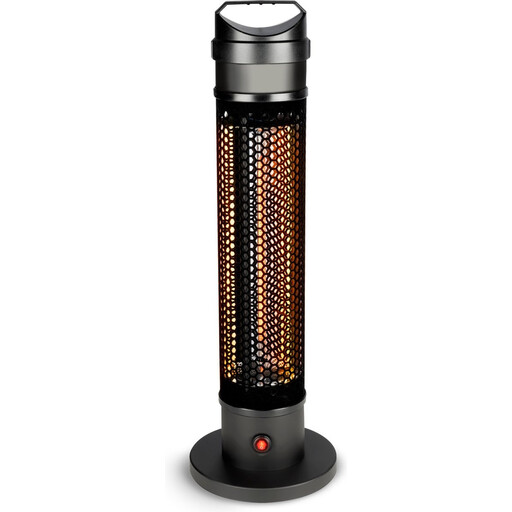 Image unavailable
This freestanding infrared model is designed to provide targeted warmth. It isn't a wall panel, and the product information doesn't describe it as heating the whole room.
Output: 800 W.
The stated heating area is 2–3 m², so consider this model for localised heating, not as a solution for the whole room.
No, not automatically: an infrared panel mainly warms the areas reached by its rays. Milieu Centraal says that infrared heating is most suitable for heating an entire room for long periods in a very well-insulated home.
Make sure moisture can escape. If there is a lot of mould or it keeps coming back, also investigate a possible leak or another structural issue. Milieu Centraal stresses the importance of ventilation; if you rent and suspect a fault, report it to your landlord.
According to the Dutch government, you don't need permission for a minor change that can be reversed without too much expense, such as holes that can be repaired. For a renovation or a change that isn't easily reversible, you need your landlord's permission; assess the specific installation separately.
The Fire Service advises plugging high-power appliances such as electric heaters directly into a wall socket, not into a multi-socket adaptor or cable reel. Also follow the installation and operating instructions for the exact model.
No. ACM ConsuWijzer distinguishes between a voluntary manufacturer's or seller's warranty and your statutory rights against the seller. What you can reasonably expect in terms of the product's lifespan with normal use depends on the product and the circumstances; there is no fixed statutory warranty period that applies to every panel.