
Occasional hem presser
You want to press a few trouser hems neatly, then put the iron away. Compare the tip, controls and water tank before opting for a larger appliance. Philips describes the DST3031/20 as suitable for smaller ironing sessions.


For a few trouser hems, a standard steam iron with a useful pointed tip and suitable temperature and steam settings is usually the most practical choice; you don’t necessarily need a large water tank. If you also have lots of heavy clothes to iron when the seasons change, compare a steam generator, but always follow the care label for each pair of trousers. Check that the appliance you’re considering also has the required CE marking.
You want to press a few trouser hems neatly, then put the iron away. Compare the tip, controls and water tank before opting for a larger appliance. Philips describes the DST3031/20 as suitable for smaller ironing sessions.
When the seasons change, you have a bigger pile to tackle, perhaps including sturdy trousers. The Dutch Consumers’ Association suggests a steam generator as an option if you have a lot of ironing to do or stubborn creases to remove. Bear in mind that it has a separate water tank and needs more storage space.
You want to protect the fabric and hem. Let the care label determine the appropriate temperature and steam settings; GINETEX says you should base the maximum ironing temperature on the care label.
Choose this type: for a few hems and smaller amounts of ironing.
Bear in mind: if you have a larger pile, you may need to refill the integrated water tank more often.
Compare this type: if you have lots of heavy clothes to iron as well as the hems.
Bear in mind: the separate water tank needs more storage space. The Dutch Consumers’ Association notes that higher steam output can make a generator suitable for heavy fabrics, but powerful steam won’t automatically be right for every hem.
| What to consider | What to look for | Who should pay particular attention? |
|---|---|---|
| Protecting the fabric and hem | Set the temperature and steam according to the care label. Also check the instructions for any hemming tape. | If I’m ironing different fabrics or a delicate hem, I want to be able to adjust the settings to match the label. Around 31% of consumers put protecting the fabric and hem first. |
| Precise pressing | Check the tip and soleplate of the exact model, especially for working along seams and turn-ups. | For me, it’s about pressing a narrow hem precisely, not just smoothing large areas. Around 31% of consumers prioritise precise work on hems. |
| Capacity for the whole session | Work out how many clothes you’ll be ironing in one go. If you have a large pile, compare a steam generator too. | If I’m ironing a large pile of clothes as well as hems, the size of the whole session matters. Around 19% of consumers give the amount of ironing they have to do top priority. |
| Use and care | Find the manual and descaling instructions for the full model number. | I want to know in advance how to care for the appliance after use and what settings it has. Around 19% of consumers prioritise ease of use and maintenance. |
The care label determines which treatment is suitable. An iron’s maximum steam specification isn’t necessarily right for every pair of trousers.
Check the label before setting the temperature or steam. Don’t treat a stated maximum steam boost as advice for every fabric.
A generator has a separate water tank and is mainly worth considering if you have lots of ironing to do or stubborn creases to remove.
Think about your entire ironing session: a few hems call for something different from a large pile of heavy clothes.
Remember to allow extra storage space for the separate tank.
The Braun TexStyle 3 SI3030PU and SI3030 don’t have the same full model designation. The suffix helps distinguish between versions.
Check the full model number before comparing specifications for different versions.
The Philips DST3031/20 is a standard steam iron in the 3000 Series that you can compare for smaller ironing sessions.
The Ultragliss Anti-Calc Plus FV6830 is a model to compare if its stated steam features and maintenance system matter to you.
The TexStyle 3 SI3030PU is a model to compare for precise ironing.
This selection includes standard steam irons for precise work on hems and smaller sessions, as well as a steam generator to compare if you have larger amounts of ironing to do.
 No image available
A standard steam iron to compare for precise work on hems and smaller ironing sessions.
The product name lists a 180 g steam boost, 40 g/min and a 300 ml water tank.
 No image available
A steam generator to compare if you have lots of clothes to iron in one go as well as trouser hems.
The separate water tank needs extra storage space.
 No image available
A handheld steam iron to compare for localised ironing; check that its handheld controls offer the settings you need for your clothes.
The product name lists Dual Voltage.
 No image available
A standard steam iron to compare for precise work along seams or turn-ups.
The product name lists 2000 W.
 No image available
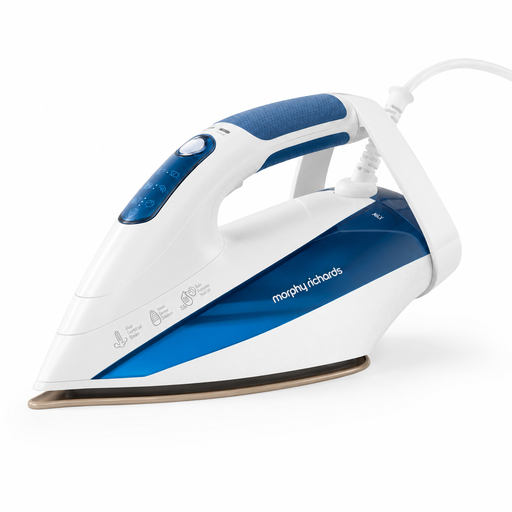
A standard steam iron to compare for precise work around seams and hard-to-reach areas.
The product name lists 2400–2800 W, 50 g/min steam and a 350 ml water tank.
Not just for those few hems. Compare a standard steam iron first; a generator is mainly worth considering if you also have lots of heavy, ironable clothes to deal with.
Let the care label determine the right temperature and steam setting, rather than relying on the fibre name alone. GINETEX says you should choose the maximum ironing temperature solely according to the care label; if the instructions specify a maximum of 110 °C, iron without steam.
Get the trousers ready according to the care label and set the temperature and steam accordingly. If the hem has a separate iron-on tape, follow the tape’s instructions too.
Yes. The Dutch government states that electrical appliances offered for sale in the EU must have a CE mark. Check that the specific appliance has the required marking.
The retailer is your point of contact for a remedy under the statutory guarantee, not the manufacturer. The Dutch government distinguishes between the statutory guarantee and any additional manufacturer’s warranty.