
Crease presser with limited space
You want to press your school trousers flat and neatly, but need to be able to store the appliance in an upstairs flat afterwards.


If you usually iron just one or a few pairs of school trousers and want to press in a sharp crease, a standard steam iron is generally the most practical choice for an upstairs flat: it has no separate generator base and is easier to store. A steam generator is worth considering if you have a large pile of laundry or thick fabrics, and enough room for the base. A handheld steamer is better for quickly freshening clothes than pressing in a crease. Always check the care label and adjust the temperature and steam accordingly, as advised by the Consumers’ Association.
You want to press your school trousers flat and neatly, but need to be able to store the appliance in an upstairs flat afterwards.
You mainly want to freshen up a pair of trousers quickly without having to set up an ironing board every time. Pressing in a sharp crease isn’t your main priority.
You regularly iron several pairs of trousers or other thick garments in one go, and can make room for a separate steam generator base.
Best for: ironing a few pairs of trousers, pressing in a crease and making the most of limited storage space.
The trade-off: with a smaller tank, you may need to refill more often when ironing larger loads. Thick fabrics may also take more work to iron.
Best for: regularly ironing larger piles or thick fabrics, if you have room for the separate tank and ironing set-up.
The trade-off: the base and cord take up extra space, and you’ll need to move them along with the iron.
Best for: quickly removing creases from hanging trousers without setting up an ironing board.
The trade-off: Philips makes clear that a clothes steamer won’t give you the same results as an iron, particularly on thicker fabrics.
| What to consider | What to check before buying | Who might prioritise this? |
|---|---|---|
| Creases and fabric care | Check the care label and make sure the temperature and steam are adjustable. Also check whether you can iron without steam. | If I want to press in a neat crease without damaging the fabric, I look for heat and steam settings that suit the garment. Around 36% of consumers prioritise pressing results and fabric care. |
| Storage and carrying | Check the dimensions and total weight of the complete set, as well as the space needed for the tank and cord. | If I need to store the appliance after use and carry it up to an upstairs flat, I need to consider the complete set. Around 29% of consumers give storage and portability top priority. |
| Removing creases without an ironing board | Decide whether it’s enough to reduce visible creases or whether you want to press in a sharp crease. | If I want to freshen up a pair of trousers quickly without setting up an ironing board, a sharp crease is less important. Around 21% of consumers mainly want to remove creases without a dedicated ironing space. |
| Large piles or thick fabrics | Compare the tank capacity and stated continuous steam output. Also consider how much room the complete set-up takes up. | If I iron several pairs of trousers or thick fabrics in one go, I want to stop less often to refill the tank. Around 14% of consumers prioritise capacity for larger or thicker piles. |
A clothes steamer isn’t the same as an iron. Philips says that a clothes steamer won’t give you the same results, particularly on thicker fabrics.
First decide whether you want to quickly remove creases from hanging trousers or iron them flat to press in a crease.
If crease removal isn’t enough, you may still need an iron and a suitable ironing set-up.
The weight of the handheld part doesn’t tell you how much the complete set weighs. A steam generator also has a separate tank and base.
Before deciding whether you can move and store it in an upstairs flat, check the dimensions and weight of the complete set.
The base, tank and cord need extra storage space, and you’ll need to take them with you when moving the set.
A model with automatic temperature selection doesn’t necessarily have an automatic shut-off function too. Tefal states that the FV2838E0 does not have automatic shut-off.
Check the safety feature separately for the full model number. Don’t assume it’s included based on a description of the temperature control.
The TexStyle 3 range includes standard steam irons. The SI 3054 is one option if you don’t want a separate steam generator base.
The 3000 Series includes standard steam irons. The DST3031/20 is one example, with a stated tank capacity of 300 ml.
The FV2838E0 and SV9202E0 models represent a standard steam iron and a steam generator respectively.
These product picks are standard steam irons for ironing on a board, with no separate generator base. They’re suited to balancing neatly pressed school trousers with limited storage space.
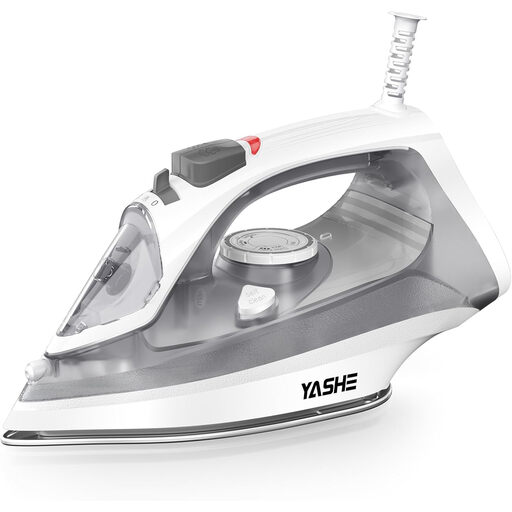 No image available
An iron with a soleplate and adjustable steam, for anyone who wants to iron school trousers flat.
Tank: 300 ml. Continuous steam output: 25 g/min. The description lists an adjustable thermostat and steam control.
 No image available
The soleplate and dry ironing function make this a good option if you want to iron trousers with direct contact.
Tank: 350 ml. The description lists five temperature settings, continuous steam, a steam boost, a spray function and a non-stick soleplate.
 No image available
The description lists both dry and steam ironing, making it suitable if you want to press school trousers flat.
Removable tank: 0,15 l. Product weight: 0,77 kg. The description lists manual temperature and steam controls, plus a steam boost.
 No image available
The temperature dial and no-steam setting are useful if you want to adjust the heat and steam to suit the fabric.
Continuous steam output: 20 g/min; steam boost: 90 g/min. Cord: 1,6 m. According to the instructions, steam isn’t available on the synthetic setting.
 No image available
The soleplate and precision tip are useful if you want to iron seams and creases with direct contact.
Tank: 300 ml. The description lists a SuperCeramic soleplate, a precision tip, a steam boost and self-cleaning.
First, read the care label on the trousers and adjust the temperature and steam accordingly. The Consumers’ Association recommends using suitable heat and steam. After steaming, you can dry-iron without steam. Don’t iron a garment with a ‘do not iron’ symbol.
Use only as much steam as you need and let the appliance heat up fully before steaming. According to the Consumers’ Association, excess steam can turn into water and make your laundry and ironing board damp. Steaming too soon can cause leaks.
According to ACM ConsuWijzer, the seller is responsible for providing an appropriate free remedy if a product doesn’t perform as you could reasonably expect under normal use. This could be a repair, replacement or refund. A manufacturer’s warranty doesn’t replace your statutory rights. Online purchases usually come with a cooling-off period of up to 14 days after delivery, subject to statutory exceptions.
The Netherlands Food and Consumer Product Safety Authority states that the Low Voltage Directive applies to electrical equipment with a rated AC voltage between 50 V and 1000 V. This requirement for the relevant market participants doesn’t prove that a specific appliance for sale has been checked. So be sure to review the model information, instructions and safety warnings.