
Vandaag of morgen in huis

Kwaliteit gegarandeerd

Welkomstaanbiedingen ontgrendelen: GRATIS bezorging | Tot 80% korting | Gratis 30 dagen JoyPlus-proefperiode
Download de app
A ceramic electric heater can quickly provide extra warmth in a bedroom, home office or living room. However, a high wattage does not tell the whole story. A model that looks powerful on paper may be less practical in everyday use because it is noisy, has a limited thermostat or offers a timer that does not suit your routine.
Pay particular attention to these three pitfalls:
Confusing wattage with heating range
A 2000W heater uses more power than a 1500W model when both are running at full power. That does not automatically mean a room will become twice as warm, or heat up twice as quickly or evenly. Insulation, ceiling height, draughts and air distribution all play a part.
Treating “energy-efficient” as a fixed characteristic
A ceramic heater with a PTC element can regulate its power, but electricity consumption depends on the selected setting, thermostat and length of use. Energy-saving claims are made by the brand. According to DREO’s own research, certain models can save up to 40% energy; always check how this was measured and compare it with your own usage.
Failing to check the safety features
Tip-over protection and overheat protection are important basic features. However, they are no substitute for safe placement. A heater must not be covered and should be positioned at least about one metre away from curtains, bedding, furniture and other flammable materials.
A ceramic heater with a PTC element uses a ceramic heating element with a positive temperature coefficient. Product descriptions often associate this with rapid heating and stable operation. Also check the available settings:
For a fair comparison, you can calculate the consumption: a 1500W heater running continuously at full power for one hour uses 1.5 kWh. A thermostat can reduce actual consumption because the heating element does not remain active continuously.
A heater with a thermostat switches the heating on or off around a set temperature. This is more practical than repeatedly switching the heater on and off manually. Check:
A heater with a 12-hour timer is suitable for a working day or evening. Some models offer 24 hours or a weekly programme. A remote control is convenient when you are in bed or on the sofa, while an app can offer additional features but often requires an account and a Wi-Fi connection.
An oscillating heater distributes warm air across a wider angle. Check the specified oscillation, such as 70°, 80° or 90°. This helps to warm more than just the area directly in front of the outlet.
Noise levels are relevant for a bedroom or office. Products in this selection specify values of approximately 24 to 50 dB, depending on the setting and measurement method. Treat this as a product specification, not a guarantee that the appliance will be inaudible in every room.
Also check for:
Do not use an electric heater in a bathroom unless the manufacturer expressly states that the model is suitable for this purpose. An ordinary portable heater is not automatically protected against moisture.
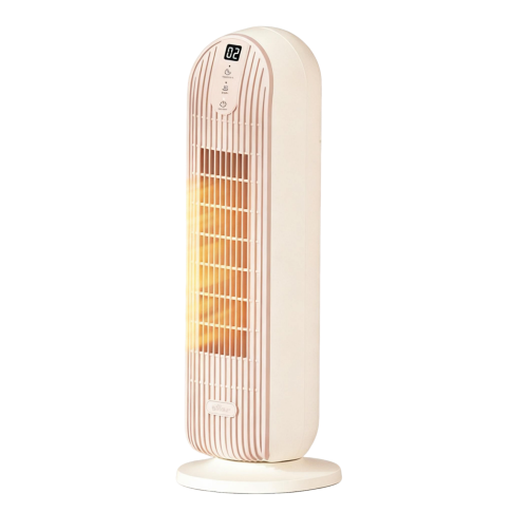
Why it suits this profile: This model combines 1200W and 2000W settings, 90° oscillation and a timer of up to 12 hours. This makes it easy to start on a lower setting and increase the power when needed.
The two power settings mean you do not always have to heat at 2000W. The product information also lists several safety features and a concealed handle.
1200W/2000W, 90° oscillation, HD display, quiet operation according to the product description and a timer of up to 12 hours.
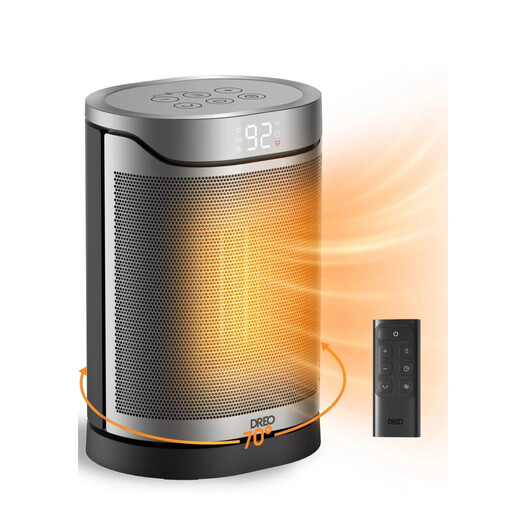
Why it suits this profile: For those who value precise control, a low stated noise level and a compact design. The manufacturer states that it is suitable for areas of 10–20 m².
The thermostat can be adjusted from 5–35°C and the power has three settings. This gives you more control than a basic model with just on/off operation.
1500W PTC element, remote control, 12-hour timer, 25–42 dB according to the product specification and CE+CB listing.

Why it suits this profile: The stated capacity of 15–25 m², 2000W power and 70° oscillation are well suited to larger living or working spaces.
The product information lists a 5–35°C thermostat, multiple layers of safety protection and automatic shut-off in unsafe conditions. However, check the current manual before buying.
2000W, 70° oscillation, remote control, timer of up to 12 hours and stated operation at 25–42 dB.

Why it suits this profile: A compact electric fan heater for rooms of up to 15 m², with simple settings and a low weight of 1.51 kg.
The choice between 600W and 1500W makes it easier to tailor consumption to your needs. The product description also mentions tip-over and overheat protection.
24 dB(A) according to the product specification, two power settings, portable casing and automatic shut-off.
We have compiled a complete, up-to-date list of products that fully meet these strict selection criteria and the applicable European safety regulations.
This depends primarily on the power, the set temperature and how long the heater is used. A thermostat, eco mode and lower power setting can prevent the element from running continuously at full power. Calculate consumption based on kWh and compare it with your energy tariff.
You can use models intended for indoor use, provided you follow the safety instructions. Ideally, choose a quiet electric heater with a timer, thermostat, tip-over protection and overheat protection. Keep the appliance clear of bedding and curtains, and never cover it.
The lifespan varies depending on the model, intensity of use and maintenance. Keep the ventilation openings clear, remove dust according to the instructions and only move the heater once it has been switched off and cooled down. Stop using the appliance if the cable, plug or casing is damaged.
