What should you look for in a washing machine for a shared house?
First decide whether you mainly combine your washing or do separate loads, then choose a drum size and programmes to suit.
Combining loads in a more modest drum
A good fit when: housemates can combine their cotton washing, so the drum is usually well filled.
Trade-off: there is less room for a large shared cotton load.
A larger drum for shared washing
A good fit when: you regularly have larger shared cotton loads and the machine will fit in the laundry area.
Trade-off: a larger drum may not be the right choice if it is often only partly filled.
Separate, short washing slots
A good fit when: residents keep their washing separate and short time slots are important.
Trade-off: a short programme may have a lower maximum load than the stated cotton capacity.
| What to consider |
What to look for |
Who is this important for? |
| Capacity and consumption |
Compare the stated cotton capacity with your usual loads. Check the kWh per 100 eco 40-60 cycles and water use per eco cycle; these figures do not automatically apply to other programmes. |
If we combine socks and other cotton washing, I want a drum that suits our usual load. Around 33% of consumers prioritise capacity and consumption per load. |
| Wash time and cotton programmes |
Check the duration and maximum load of the short programme separately from cotton and eco 40-60. |
If I share a washing slot with housemates, I want to know whether my programme will fit into the time available. Around 27% of consumers are mainly looking for a practical washing slot and suitable programmes. |
| Spin noise |
Compare the spin noise figure on the energy label and check whether the machine can stand on a firm, level surface. |
If the laundry room is next to a bedroom or living room, I want to take the noise during spinning into account. Around 20% of consumers say noise around the shared laundry area is their main concern. |
| Positioning and water protection |
Measure the available space and check the connections, installation requirements and water protection for the exact model. |
If a leak could affect other rooms, I want to know in advance whether the machine will fit and what water protection it has. Around 20% of consumers prioritise a suitable installation and limiting potential water damage. |
Washing machines on Joybuy for shared use
These Joybuy models are examples you can compare for capacity and programmes, whether you do your washing together or separately.
 No image available
Samsung WW90DG6U25LE, 9 kg, 1400 rpm
A 9 kg model to compare if you combine larger cotton loads and want to look at short programmes too.
The product details list Quick 15min, Super Speed for 5 kg in 39 minutes and a cotton programme. They also give a spin noise level of 72 dB, 44 kWh per 100 cycles and 50 litres per cycle.
View at Joybuy
 No image available
AEG LR73R862 7000 Series, 8 kg, 1600 rpm
An 8 kg model to compare if you want to weigh up capacity against a programme for mixed loads.
The product details list a 69-minute MixLoad programme for mixed washing at 30 °C. For eco 40-60, they give 42 kWh per 100 cycles and 42 litres of water per cycle. The spin noise level is stated as 76 dB.
View at Joybuy
 No image available
Bosch WGB2440BFG Serie 8, 9 kg, NL/FR panel
A 9 kg model to consider if you want to weigh up small separate loads against washing together.
The product details list Mini Load and Extra Quick 15'/30'. They also mention AquaStop and a spin noise level of 69 dB.
View at Joybuy
 No image available
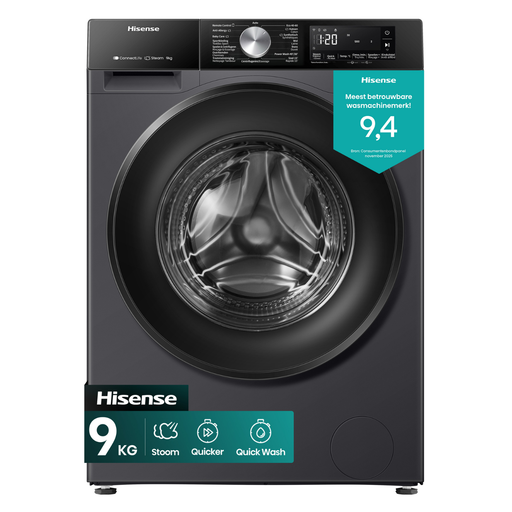
Hisense WF3S9043BB3, 9 kg, black
A 9 kg model to compare if you’re planning both short, separate washing slots and larger loads.
The product details list Quick 15' for small loads and Power Wash 49'. The stated spin speed is 1400 rpm. The details also give 33 kWh per 100 cycles, 39 litres of water per cycle and a spin noise level of 72 dB.
View at Joybuy
 No image available
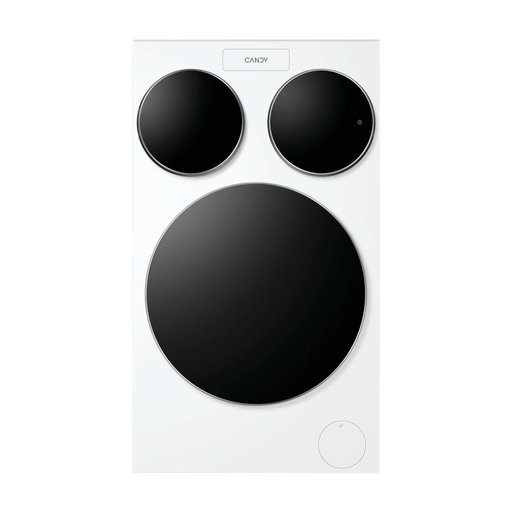
Candy MQD 410CBL9-S, three drums, 10+1+1 kg
A model with three drums to compare if housemates want to keep their washing separate more often.
The product details say you can wash items together or separately and list special quick programmes. The stated capacity is 10+1+1 kg and the spin noise level is 68 dB. For eco 40-60, the stated figure is 33 kWh per 100 cycles.
View at Joybuy
Frequently asked questions
Do cotton socks always need to be washed at 60 °C?
No. Check the care label first. Eco 40-60 does not guarantee that the washing will actually be done at 60 °C. If the situation calls for a hotter wash, choose a suitable cotton or hygiene programme, provided the fabric allows it.
What should you check before connecting the machine in a shared laundry area?
Measure the space and check the connections, floor and installation instructions for the exact model. Ask in advance what is included with delivery and installation; the Consumentenbond says installation is sometimes a separate service. Also compare the water protection if a leak could affect other rooms.
Who can you contact in the Netherlands if a washing machine you bought is faulty?
The buyer can contact the retailer. According to the Dutch government, the retailer cannot simply send the buyer to the manufacturer if a product is faulty. The Netherlands does not have a fixed statutory guarantee period that applies to all products. In a shared house, agree who will keep the proof of purchase and deal with the retailer.
Can the retailer charge you to take away your old washing machine?
When you buy a new, similar appliance, the retailer must take back the old appliance free of charge under the Dutch take-back scheme. The Dutch government distinguishes this from any charges for installing the new machine.
What does the energy label tell you about a washing machine’s consumption?
The European Commission describes mandatory energy labelling for household washing machines covered by the rules. The consumption figures on the label relate to eco 40-60; do not assume they also apply to a quick or hotter programme.


