
Small entranceway, limited storage space
You don’t want to have to store an unnecessarily large appliance after a small cleaning job. The Consumers’ Association highlights the size of a wet and dry vacuum as something to consider when choosing one.


For a few dry leaves indoors, a broom or a vacuum cleaner you already own may be enough, provided the manual says it’s suitable for the job. If you also want to pick up coarser debris by the entrance, a compact wet and dry vacuum is a better fit. Check the nozzle, reach, storage space and the right filter. Outdoors, your choice may be limited by the power supply and the model’s conditions of use.
You don’t want to have to store an unnecessarily large appliance after a small cleaning job. The Consumers’ Association highlights the size of a wet and dry vacuum as something to consider when choosing one.
Along with leaves, you’re clearing sand or other coarser debris, so you want the nozzle and intended use to suit the job. The Consumers’ Association lists coarse and fine debris as factors to consider when choosing a wet and dry vacuum.
You may need to work around corners or take other people into account. Check the reach and consider where the leaves will end up if you use a blower function; the Dutch government recommends agreeing things with your neighbours first if noise is causing a nuisance.
For a small entranceway cleaning job, your choice mainly depends on the type of debris, the storage space available, how far you are from a socket and how much filter maintenance you’re willing to do.
| What to consider | What should you check? | Who should pay particular attention? |
|---|---|---|
| Leaves and coarser debris | Check the permitted use, the shape of the nozzle and the filter instructions for the exact model. | If I want to pick up both leaves and coarser debris, I want to know whether the nozzle and filter set-up are suitable. Around 36% of consumers prioritise suitability for this type of debris. |
| Compact storage | Compare the external dimensions and tank capacity with your storage space; also check where you can store the hose and accessories. | With limited storage space, I want to be able to put the appliance away easily after the job. Around 29% of consumers consider compact storage essential. |
| Reach to the door | Measure the route from the socket and compare the cable and hose lengths separately; don’t simply add them together and assume that’s the guaranteed working reach. | If the socket isn’t close to the entranceway, I want to know whether I can reach the area without constantly moving the appliance. Around 21% of consumers prioritise reach. |
| Filter maintenance | Check which filter and dust bag are needed for the intended use, and find out which parts you’ll need to replace later. | I don’t want to be left guessing which filter set-up to use after cleaning. Around 14% of consumers prioritise filter maintenance that’s straightforward and suited to the job. |
The filter set-up can vary depending on the model and intended use. The wrong set-up may not be suitable for the job.
Before use, check the instructions for your specific model and the filters supplied.
A larger appliance needs more storage space, while the job in a small entranceway may be limited.
Compare its dimensions with your available storage space, and consider whether a broom or a vacuum cleaner you already own will do the job.
Blowing moves leaves, but doesn’t collect them in the tank.
Choose based on what you want to do: pick up and dispose of the leaves, or move them to a collection point first.
A Joybuy listing for a wet and dry vacuum gives different tank capacities in the title and specifications: the title says 20 litres, while the specifications say 15 litres.
Before deciding, check the model number, capacity and parts supplied for the exact listing.
The WD range includes compact wet and dry vacuums. The WD 2 Plus V-12/4/18 is a model we looked at, with a 12 l tank.
The Buddy II range includes compact wet and dry vacuums; the Buddy II 12 we looked at is designed for jobs indoors and outdoors.
The TC-VC 1812/1 S is a wet and dry vacuum with a 12 l tank, described as suitable for workshop and garage jobs.
Bosch describes the UniversalVac 15 as a wet and dry vacuum with a blower function for clearing leaves outdoors.
These product choices are wet and dry vacuums with a blower function, intended for picking up or moving leaves around an entranceway. Compare the dimensions and filter instructions with your job. Under EU low-voltage rules, new mains-powered electrical equipment within the scope of 50–1.000 V AC is subject to requirements including CE marking and an EU declaration of conformity; check the documentation for the exact model. CE is not a quality mark.
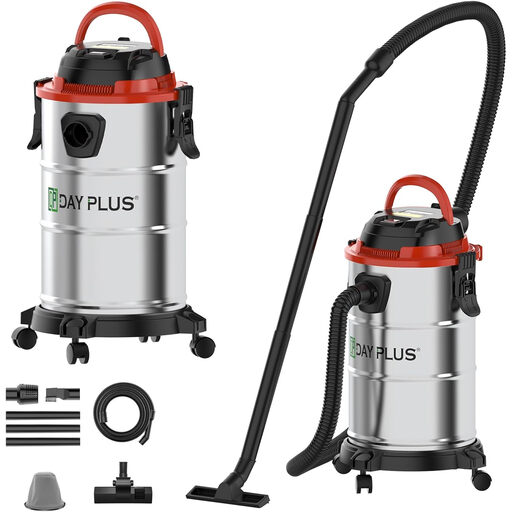 Image unavailable
The wet and dry vacuuming and blower functions are suited to picking up or moving leaves around an entranceway.
The product title states that it has a 20 l tank and a washable HEPA filter. The Joybuy listing also gives a tank capacity of 15 l in the specifications; check the capacity and exact model before deciding.
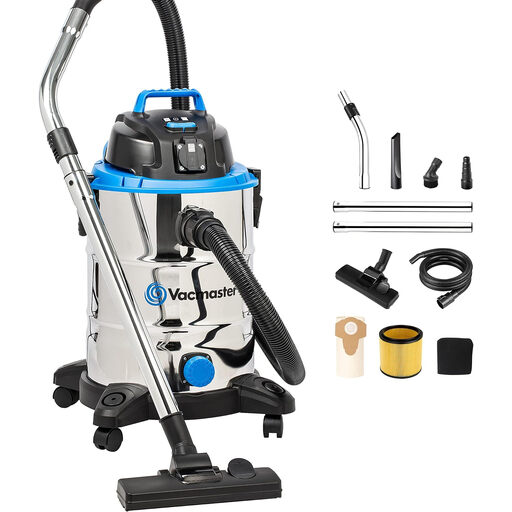 Image unavailable
The blower function may be useful if you want to move leaves to a collection point first.
The product title states that it has a 1500 W motor and a 30 l stainless steel tank. It is specified for indoor use; bear this in mind if your entranceway is outside your home.
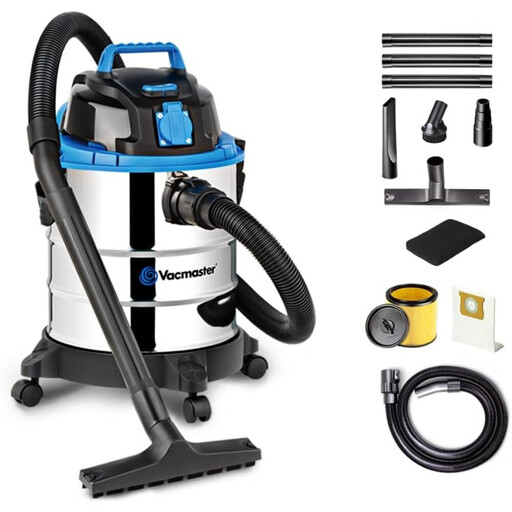 Image unavailable
The stated blower function and crevice nozzle are worth considering if you want to move leaves or clean around a threshold.
The product title states that it has a 1250 W motor, a 20 l stainless steel tank and a suction pressure of 18 kPa.
That depends on the exact model and the specified filter set-up. Nilfisk advises removing the dust bag and dry filter and fitting the wet filter before vacuuming liquids. Don’t follow this instruction for another brand without checking first.
Before use, check the cable for damage and read the safety and weather instructions for your chosen model. The Dutch fire service highlights damaged electrical cables as something to look out for during maintenance; a wet and dry function alone doesn’t mean the appliance can be left out in the rain.
According to the Dutch government, if a product develops a fault within the first year after purchase, the seller must show that the consumer caused it. If they can’t, you’re entitled to a free repair or replacement; a manufacturer’s guarantee doesn’t replace your statutory consumer rights.
Electrical equipment within the scope of the EU low-voltage rules, 50–1.000 V AC, is subject to requirements including CE marking and an EU declaration of conformity. CE is not a quality mark; check the documentation for the exact model.