
Vandaag of morgen in huis

Kwaliteit gegarandeerd

Welkomstaanbiedingen ontgrendelen: GRATIS bezorging | Tot 80% korting | Gratis 30 dagen JoyPlus-proefperiode
Download de app
A wet and dry vacuum cleaner can combine several tasks: vacuuming up crumbs, removing spilled liquids, mopping hard floors and, in some cases, cleaning carpets or car upholstery. However, not every household automatically gets an all-purpose solution from a single appliance. The main differences lie in the construction, filters, tanks and accessories.
For families with pets, car owners and DIY enthusiasts, three common purchasing pitfalls are worth avoiding.
A high wattage rating or a large Pascal figure does not, on its own, indicate how effectively an appliance cleans in practice. The result also depends on the nozzle, airflow, brush roll and type of surface. A wet and dry vacuum for a garage requires different features from a cordless wet and dry vacuum for everyday use on laminate flooring.
Always assess the complete combination of:
A vacuum cleaner with a mopping function is generally designed for hard, sealed floors such as tiles, PVC, laminate or treated wood. That does not automatically make it suitable as a carpet cleaner or carpet-washing machine. Carpets and fabric furniture usually require a spray-extraction system: cleaning solution is applied and then vacuumed up together with the dirt.
Check whether the product description explicitly refers to carpets, sofas, stairs or car interiors. According to Tineco’s own information, for example, the iFLOOR 5 Breeze Complete and Floor One Stretch S6 are intended for hard indoor floors. Do not use them as general upholstery cleaners without following the appropriate instructions.
A self-cleaning floor cleaner often rinses the brush roll and internal tube. You still need to empty the dirty-water tank, allow the filters to dry and remove hair or debris from the brush. Failing to do so can lead to unpleasant odours and blockages.
Battery-powered appliances also require a full charging cycle. For corded models, pay attention to the power-cord length and the storage space available.
For mopping or washing, separate clean- and dirty-water tanks are practical. This prevents collected dirt from being spread back across the floor. According to the product specifications, the BISSELL CrossWave OmniForce Edge Select has a 0.63-litre clean-water tank and a 0.44-litre dirty-water tank.
For larger jobs in a workshop, a spacious collection tank is more convenient. The Vacmaster VQ1530SFDC has a 30-litre stainless-steel tank. It is suitable for dry debris and liquids, but it is larger than a compact floor cleaner.
A cordless model is convenient when cleaning multiple floors or a car. Do not look only at the maximum runtime; also consider the charging time and whether the battery can be replaced.
The stated runtime may vary by mode. Turbo or washing modes generally consume more energy.
Dry debris requires a cartridge filter or dust bag. A foam filter is often used for liquids. Do not use the same filter for both modes without checking the instructions. The Vacmaster VQ1530SFDC lists separate filter options for dry and wet vacuuming.
Pet owners will benefit more from a rotating turbo brush or anti-tangle function than from a large tank alone. For a car-interior vacuum cleaner, a long hose, crevice tool and compact upholstery nozzle are important. A spot cleaner also requires a spray function and a separate dirty-water tank.
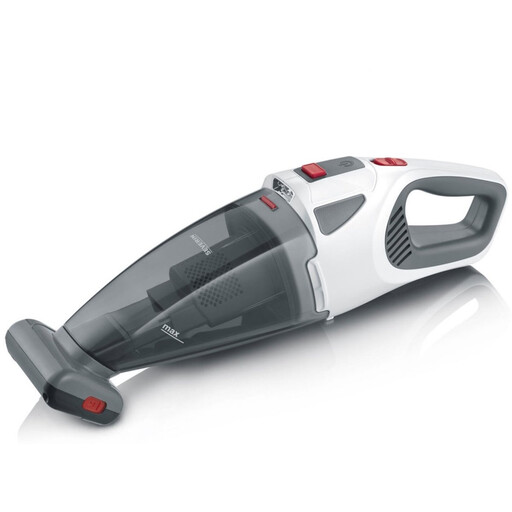
Why it fits: A compact model for crumbs, small liquid spills, furniture and car interiors. Its cordless design is ideal for quick clean-ups.
The product information specifies separate wet and dry functions as well as 4-in-1 accessories. The maximum runtime is clearly stated: up to 30 minutes.
18.5 V lithium-ion battery, rotating turbo brush, LED lighting and wall mount with charger.
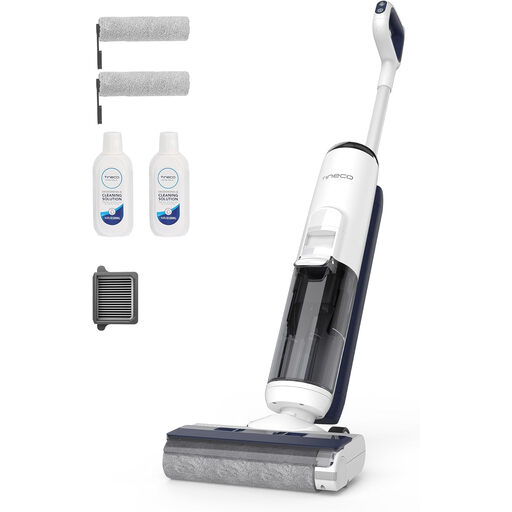
Why it fits: Designed for hard floors such as wood, laminate, ceramic tiles and other suitable sealed surfaces.
The recommended surfaces are clearly specified, making it clear that this is not a general carpet-washing machine.
Cordless design, 4.3 kg weight, two additional roller brushes and a self-cleaning function.
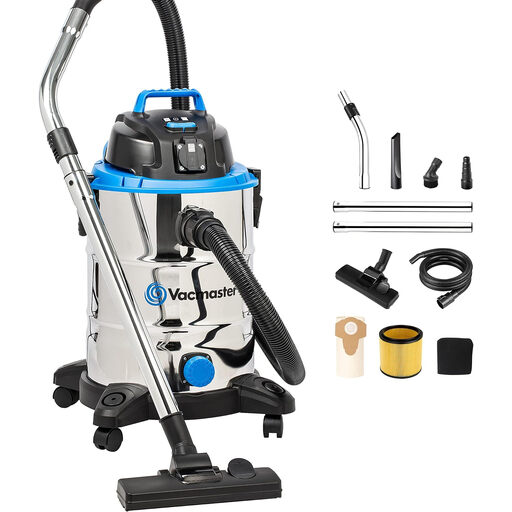
Why it fits: A corded model for workshops, garages, cars and larger quantities of dry debris or liquid.
The product description lists separate dry and wet filters, a drain plug and a 30-litre collection tank.
1500 W motor, stainless-steel tank, blower function and 240 V EU power outlet for electric tools.
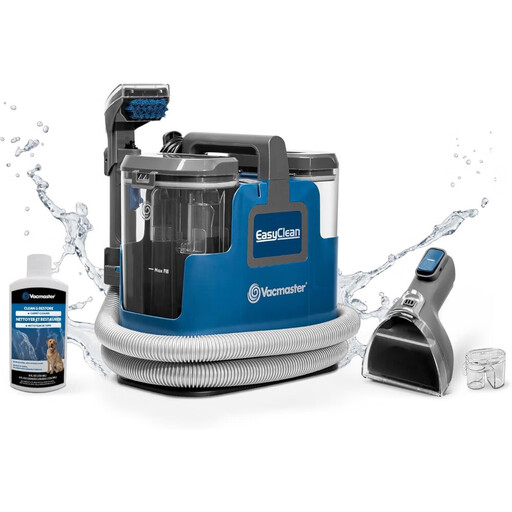
Why it fits: For households mainly tackling stains, upholstered furniture, stairs, rugs and car seats.
The system has separate clean- and dirty-water reservoirs and a 1.8-metre hose for hard-to-reach areas.
500 W motor, compact design, dual-tank technology and included cleaning formula for carpets and pet stains.
Browse a current selection of carpet and upholstery cleaners and compare models by intended use, tank capacity, battery, accessories and maintenance.
Always follow the manufacturer’s instructions. When vacuuming liquids, use only the specified filter and do not exceed the maximum fill line. Do not vacuum flammable liquids, hot ash, sharp objects or hazardous chemicals.
After use:
An appliance with a self-cleaning function reduces manual work, but it does not replace these checks.
That depends on the type of laminate and the manufacturer’s instructions. Use only a floor cleaner explicitly designed for hard, sealed floors. Limit the amount of water and do not leave puddles behind.
Not every model is suitable. A standard wet and dry vacuum cleaner can pick up liquid, but a carpet or upholstery cleaner generally uses spray extraction. Check whether spraying, cleaning and dirty-water collection are explicitly mentioned.
The main costs are electricity for charging, cleaning solution, filters and, where applicable, brushes or batteries. A longer runtime reduces interruptions, but a corded model may be more suitable for extended cleaning in a garage or workshop.
