
Vandaag of morgen in huis

Kwaliteit gegarandeerd

Welkomstaanbiedingen ontgrendelen: GRATIS bezorging | Tot 80% korting | Gratis 30 dagen JoyPlus-proefperiode
Download de app
A ratchet wrench set may seem easy to compare at first glance. However, small differences in drive size, measurements and ratchet mechanism can determine whether you work comfortably or need to buy another set after just a few jobs. For car maintenance, motorbike repairs, machinery and household assembly, the intended use is particularly important.
When buying a ratchet wrench set, watch out for these common pitfalls:
The drive size determines which sockets fit the ratchet. Common sizes are 1/4 inch, 3/8 inch and 1/2 inch.
Also check whether the set contains metric sizes. A metric ratchet wrench covers sizes such as 8, 10, 13 and 17 mm. A set containing only a few small sockets can quickly prove too limited for car repairs.
A ratchet with more teeth usually requires less movement before the mechanism re-engages. This is useful in confined spaces.
Product specifications may state, for example:
This makes turning more efficient when you cannot move the handle very far. It does not mean that every ratchet with more teeth is automatically suitable for higher forces. Use the ratchet within the specified limits and, where a precise torque setting is required, choose a separate torque wrench and a ratchet suitable for the job.
Many sets use chrome vanadium steel (Cr-V). This is a common material for hand tools. The DURATECH 3-in-1 ratchet also specifies Cr-Mo for the ratchet head. Do not focus solely on terms such as ‘hardened’ or ‘heavy duty’; check what is actually stated in the product description.
A chrome-plated or polished finish can make cleaning easier and help protect against surface corrosion. Store your tools in a dry place after use. A foam panel, plastic case or roll-up bag prevents sizes from getting mixed up and reduces time spent searching during a job.
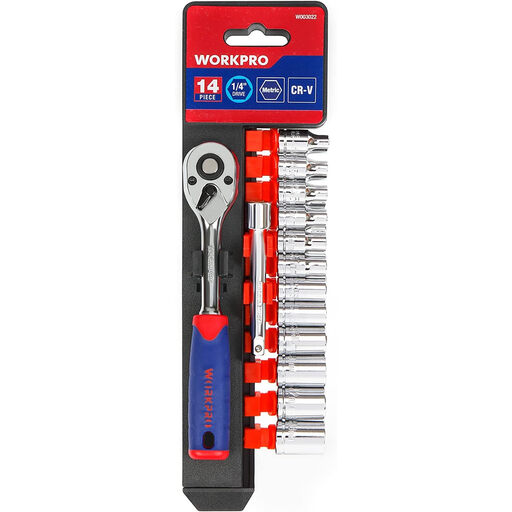
Why it suits this profile: This compact metric socket set is practical for general household jobs, bicycle and motorbike maintenance, and light car repairs.
The set focuses on metric sizes from 4 to 13 mm and clearly lists its components. This makes you less likely to buy a bulky set containing sizes you will not use.
14-piece set, 1/4-inch drive, 72-tooth ratchet, quick release, 76 mm extension bar and a holder for storage.
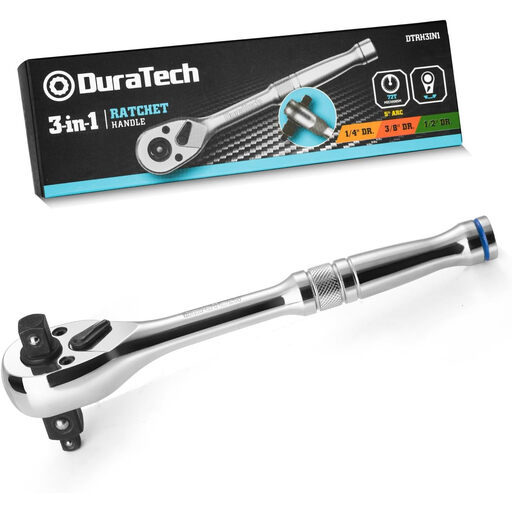
Why it suits this profile: If you want to use one handle with several drive sizes, this model provides a flexible foundation for car repairs and general assembly work.
The three drives are clearly specified: 1/4, 3/8 and 1/2 inch. The maximum values for each drive are also listed in the description: 84, 304.5 and 350 Nm. Do not exceed these values.
72 teeth, a 5-degree working angle, reversing lever and a handle with a ribbed surface. According to the product information, the ratchet head is made from Cr-Mo.
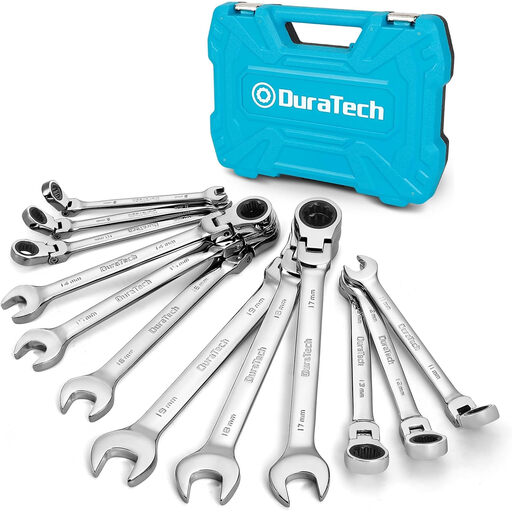
Why it suits this profile: For mechanics and DIY enthusiasts who often work in cramped engine bays or around machinery, an adjustable head offers more positioning options than a fixed ring spanner set.
According to the product specifications, the flex head can pivot by up to 180 degrees. The 8 to 19 mm sizing and 5-degree working angle are clearly stated.
12 metric sizes, 72-tooth mechanism, 12-point ring and Cr-V steel according to the product description. The set comes with a storage case.
A ratchet combination spanner combines an open-ended side with a ratcheting ring side. This is useful when you first need to position a nut with the open end and then quickly continue turning it with the ring end. A standard open-ended spanner is less suitable for brake lines. A flare nut spanner fits around the line nut more securely.
For brake-line work, you could consider a 3-piece metric set with sizes 10–17 mm and a storage pouch, for example. Always use the correct size for critical components and avoid damaging or rounding off nuts.
We have put together a complete, up-to-date list of products that fully meet these strict selection criteria and the applicable European safety regulations.
For many general car jobs, a combination of 1/4, 3/8 and 1/2 inch drives with metric sockets is useful. A 3/8-inch ratchet is versatile. For wheel bolts or larger fasteners, you will often need 1/2 inch. Always check the bolt size and the specified tightening torque.
No. A ratchet tightens or loosens bolts and nuts, but it does not automatically measure torque. For assembly work where the manufacturer specifies an exact tightening torque, use a calibrated torque wrench and follow the vehicle or appliance manual.
Wipe off oil, dust and metal particles after use and store the set in a dry place. Do not use a ratchet as a permanent lever when the product specifications do not permit this. Check the teeth, reversing lever and socket connection for wear. A lightly oiled mechanism can continue to operate smoothly; follow the manufacturer’s maintenance instructions.
