
Vandaag of morgen in huis

Kwaliteit gegarandeerd

Welkomstaanbiedingen ontgrendelen: GRATIS bezorging | Tot 80% korting | Gratis 30 dagen JoyPlus-proefperiode
Download de app
An induction hob requires pans with a suitable magnetic base. However, not every pan labelled “induction” will automatically work properly on your hob. A base that is too small, a warped pan or a delicate non-stick coating can quickly lead to uneven cooking and a purchase you get little enjoyment from.
As a Joybuy Product Recommendation Officer, I focus primarily on verifiable information: materials, dimensions, heat sources, care and usage restrictions. This allows you to compare induction pans without relying solely on marketing copy.
A 24 cm pan does not always have a 24 cm base. The top rim may be wider than the part that actually makes contact with the cooking zone. When available, check the base diameter rather than just the overall diameter.
A magnetic base that is too small may also fail to align properly with the induction zone. This can cause the pan to heat slowly or unevenly.
A pan may be suitable for gas, ceramic, electric and induction hobs, while still having restrictions for oven or dishwasher use. The handle, lid knob and non-stick coating often determine what is and is not possible.
For example, some wooden handles must not be placed in the oven and may be damaged in the dishwasher. A product description that states both “dishwasher-safe” and “hand washing recommended” therefore deserves extra attention. In practice, hand washing can help preserve the life of a coating, handle or finish.
The durability of pans with a non-stick coating varies depending on the coating, use and care. Metal utensils, heating the pan while empty and large temperature changes can damage the coating. Check whether the manufacturer provides information about maximum usage, oven safety and cleaning.
With PFAS-free pans, you should also distinguish between a product claim and an independently verified conclusion. According to the product information from Brabantia and Naturepan, the ceramic coatings mentioned are PFAS-free. Use this information as a product specification and, if in doubt, check the brand’s current documentation.
Induction works using magnetic fields. The pan therefore needs a magnetic base, usually created with a layer or disc of stainless steel. Aluminium pans are generally not magnetic in themselves, but they can still be suitable if they contain an induction base.
According to the product information, the 16 and 18 cm 5five aluminium saucepans have an aluminium body with a stainless-steel induction disc. They are also suitable for gas, ceramic and electric cooking. This makes them practical for households with several types of hob, but pay attention to care requirements: hand washing is recommended or listed as a restriction in both product listings.
Aluminium pans are often lightweight and heat up relatively quickly. They are useful for sauces, eggs and everyday frying, particularly when combined with a non-stick coating. Always check that a suitable induction base is present.
Stainless-steel pans are durable and usually do not have a non-stick coating. They require a little more care when it comes to preheating and using fat, but are suitable for cooking, stewing and making sauces. A sandwich or multi-layer base can improve heat distribution.
Multi-layer pans, such as tri-ply models, combine different metals. According to the product information, the Maxcook saucepan with steamer insert uses 304 stainless steel and a reinforced composite base. However, the wooden handle means that this pan should not be used in the oven and is best washed by hand.
Choose the size based on your portions:
An induction pan set may seem like good value, but check that you will genuinely use all the sizes. A set with three cooking pots and a saucepan makes sense for a household that cooks frequently; buying individual pans may be more cost-effective if you mainly need one frying pan or cooking pot.
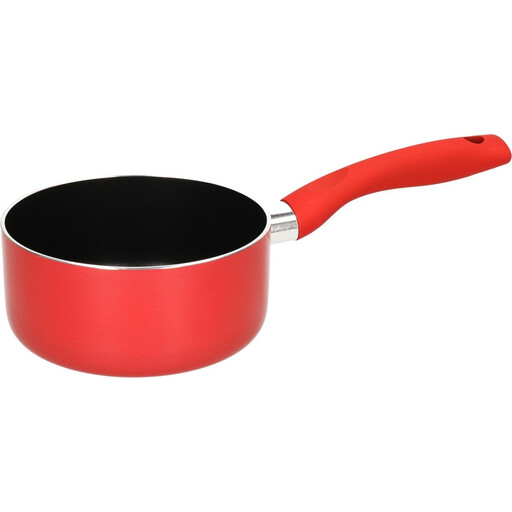
Why it suits this profile: A compact saucepan for small households, students or anyone looking to add a specific pan to an existing collection.
The product information explicitly mentions the stainless-steel induction disc and compatibility with multiple heat sources. However, check the conflicting dishwasher information before ordering.
Aluminium body, 1.5-litre capacity and a weight of approximately 500 grams.
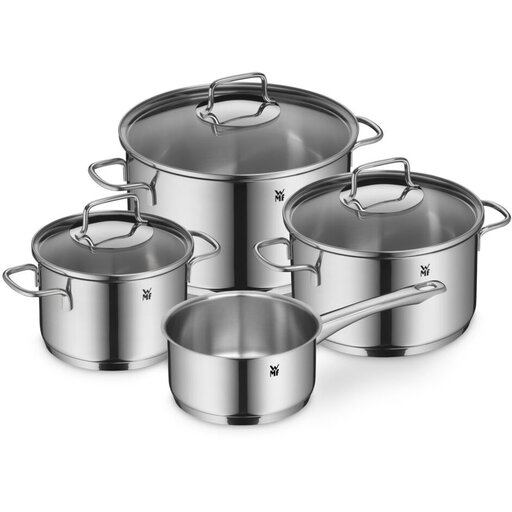
Why it suits this profile: For households looking to replace several cooking pots with lids with one coordinated stainless-steel set.
The set includes three cooking pots with lids and a saucepan, along with a TransTherm base for heat distribution. There is no non-stick coating, so cooking technique remains important.
Four-piece set, glass lids, wide pouring rims and dishwasher safety according to the product information.
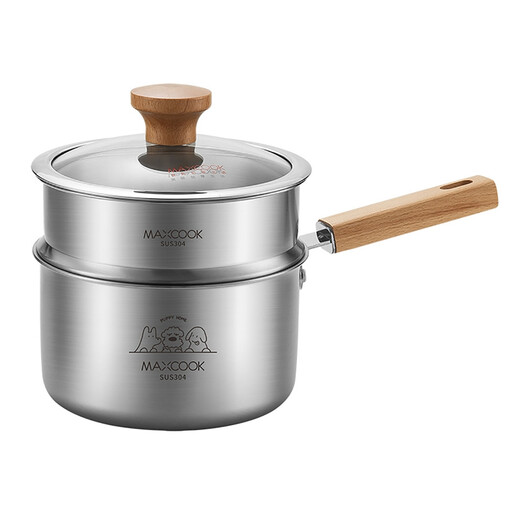
Why it suits this profile: For anyone who wants to prepare sauces, vegetables or steamed ingredients in one compact pan.
The manufacturer states that it uses 304 stainless steel and a composite base for induction. The wooden handle limits oven use and means the pan must be washed by hand.
Approximately 2.5-litre capacity, 18 cm diameter and a supplied steamer insert.
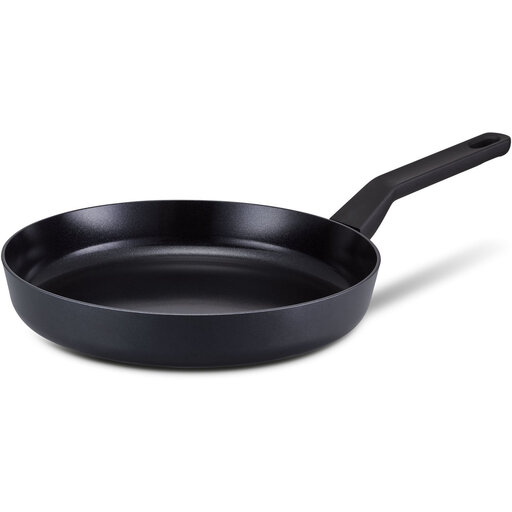
Why it suits this profile: An induction frying pan for everyday frying, stir-frying and quickly preparing meals for several people.
According to the product information, the ceramic coating is PFAS-free and suitable for induction. Do not use metal utensils or heat the pan while empty.
24 cm diameter, recycled aluminium, ceramic double non-stick coating and dishwasher safety according to the product information.
Allow a pan to cool down gradually after cooking before washing it. For ceramic or other non-stick coatings, use a soft sponge and wooden, silicone or plastic utensils. Stainless-steel pans can become discoloured through heat, salt or minerals in the water; a mild acid such as diluted vinegar may help remove these marks, according to the manufacturer’s care information.
Also look out for contradictions in product details. A “dishwasher-safe” statement does not rule out a recommendation to wash by hand. In addition, check the maximum oven temperature, particularly with glass lids and plastic handles.
We’ve put together a complete, up-to-date list of products that fully meet these strict selection criteria and the applicable European safety regulations.
Check the product listing for “induction” and see whether the pan has a magnetic base. A magnet test can provide an initial indication, but it does not replace the official product specification. Also check that the base is flat and sits properly on the cooking zone.
Yes, stainless-steel pans can be suitable for cooking, stewing and frying, provided they have an induction-compatible base. They usually do not have a non-stick coating. Heat the pan gradually, add enough fat when necessary and avoid heating it empty for extended periods.
This depends on the coating, temperature and how the pan is treated. Do not use metal utensils, avoid high temperatures without food in the pan and follow the brand’s care instructions. Once a coating visibly starts to come away or the pan becomes misshapen, replacing it is a sensible choice.
